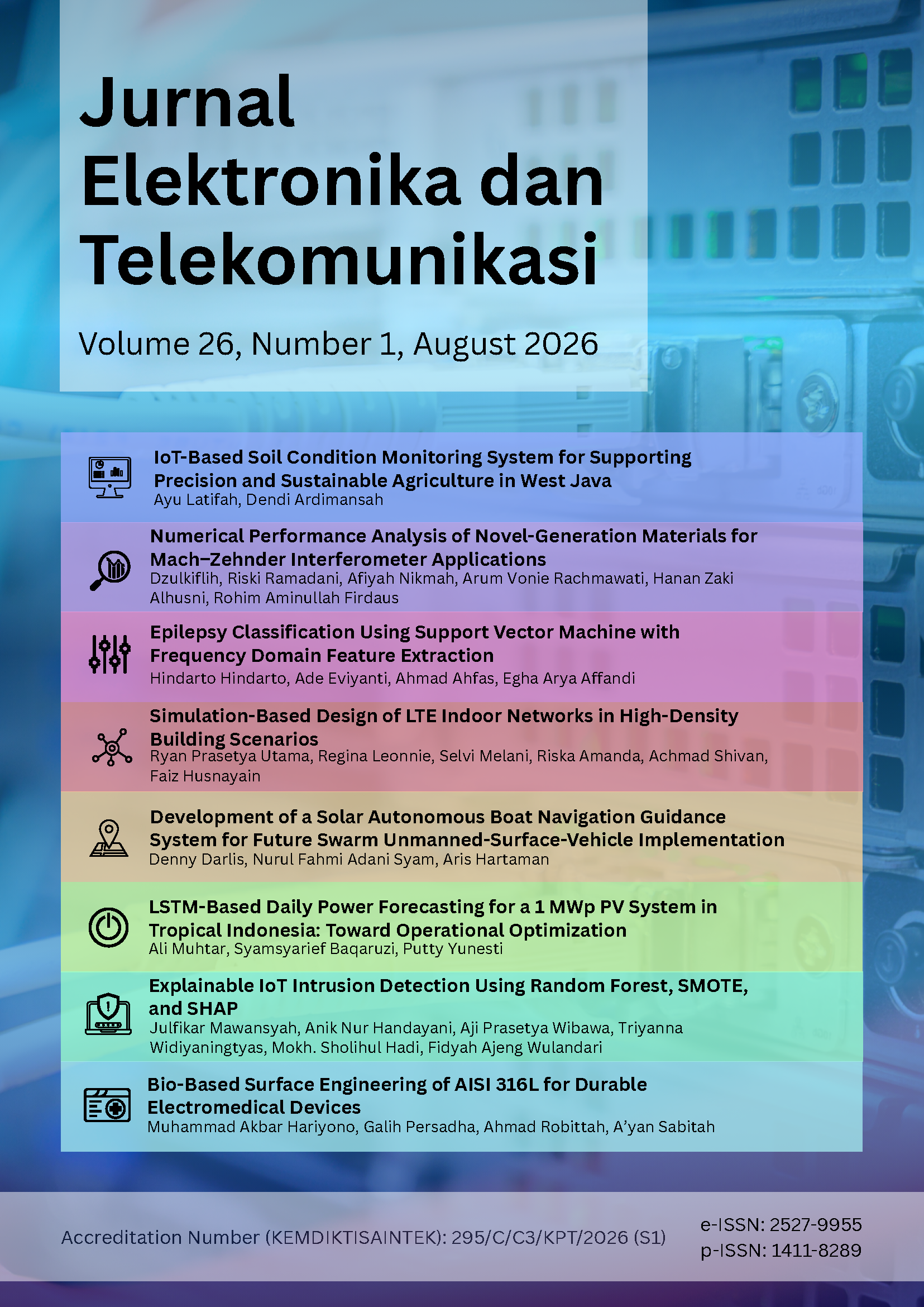
Development of a Solar Autonomous Boat Navigation Guidance System for Future Swarm Unmanned-Surface-Vehicle Implementation
DOI:
https://doi.org/10.55981/jet.774Keywords:
digital compass, GPS, LoRa, navigation system, solar autonomous boat, swarmAbstract
Changes in the quality of the lake environment due to human activities demand efficient and sustainable monitoring solutions. This research designed a navigation guidance system for the solar autonomous boat that operates independently using solar energy and designed as a modular navigation unit to support future swarm-based cooperation between multiple vessels. The system relies on GPS ATGM336H and GY-271 digital compass sensor as positioning and direction determinants, controlled by a TTGO ESP32 LoRa microcontroller. Navigation data is processed in real-time and sent over the LoRa network to a central or intership gateway. This research focuses on the development and validation of the autonomous navigation core, providing the necessary guidance capabilities for integration into a swarm unmanned surface vehicle (USV) framework. The test results showed that the boat could follow the destination's direction with an accuracy of 92%, where most of the trajectory was within the pre-programmed directional tolerance. The average direction error was recorded at 5.4 degrees, within acceptable tolerance limits. The system can adaptively maintain a stable heading and respond to aquatic environmental conditions. By establishing this stable autonomous navigation baseline, the system provides a scalable platform for future swarm implementations aimed at improving large-scale environmental monitoring. This system is considered successful as an intelligent and sustainable autonomous navigation solution.
Downloads
References
C. Mammides, “A global assessment of the human pressure on the world’s lakes,” Glob. Environ. Chang., vol. 63, p. 102084, Jul. 2020, doi: 10.1016/j.gloenvcha.2020.102084.
Y. Han, Q. Lin, S. Huang, C. Du, J. Shen, and K. Zhang, “Human impacts dominate global loss of lake ecosystem resilience,” Geophys. Res. Lett., vol. 51, no. 11, Jun. 2024, doi: 10.1029/2024GL109298.
C. Barrera, I. Padron Armas, F. Luis, O. Llinas, and N. Marichal, “Trends and challenges in unmanned surface vehicles (usv): from survey to shipping,” TransNav, Int. J. Mar. Navig. Saf. Sea Transp., vol. 15, no. 1, pp. 135–142, 2021, doi: 10.12716/1001.15.01.13.
Z. Liu, Y. Zhang, X. Yu, and C. Yuan, “Unmanned surface vehicles: an overview of developments and challenges,” Annu. Rev. Control, vol. 41, pp. 71–93, 2016, doi: 10.1016/j.arcontrol.2016.04.018.
E. M. de Andrade, J. S. Sales, and A. C. Fernandes, “Operative unmanned surface vessels (usvs): a review of market-ready solutions,” Automation, vol. 6, no. 2, p. 17, Apr. 2025, doi: 10.3390/automation6020017.
Q. Wu and R. Zhang, “Towards smart and reconfigurable environment: intelligent reflecting surface aided wireless network,” IEEE Commun. Mag., vol. 58, no. 1, pp. 106–112, Jan. 2020, doi: 10.1109/MCOM.001.1900107.
M. Specht, C. Specht, H. Lasota, and P. Cywiński, “Assessment of the steering precision of a hydrographic unmanned surface vessel (usv) along sounding profiles using a low-cost multi-global navigation satellite system (gnss) receiver supported autopilot,” Sensors, vol. 19, no. 18, p. 3939, Sep. 2019, doi: 10.3390/s19183939.
A. M. Triezani and D. A. Jatmiko, “Rancang bangun unmanned surface vehicle (usv) dengan sistem navigasi berbasis kompas dan estimasi a-gps,” Telekontran J. Ilm. Telekomun. Kendali dan Elektron. Terap., vol. 9, no. 1, pp. 23–36, Oct. 2021, doi: 10.34010/telekontran.v9i1.5607.
J. Ansary, J. O’Donnell, N. Fyza, and B. Trease, “Swarms of aquatic unmanned surface vehicles (usv), a review from simulation to field implementation,” Aug. 2020. doi: 10.1115/DETC2020-22702.
G. Xia and X. Sun, “Swarm control for multiple unmanned surface vehicles with unknown time-varying environmental disturbance and input saturation,” J. Control Sci. Eng., vol. 2022, pp. 1–12, Jul. 2022, doi: 10.1155/2022/8962970.
M. Dorigo, G. Theraulaz, and V. Trianni, “Swarm robotics: past, present, and future [point of view],” Proc. IEEE, vol. 109, no. 7, pp. 1152–1165, Jul. 2021, doi: 10.1109/JPROC.2021.3072740.
S. Devalal and A. Karthikeyan, “LoRa technology - an overview,” in 2018 Second Int. Conf. Electron. Commun. Aerosp. Technol., Mar. 2018, pp. 284–290. doi: 10.1109/ICECA.2018.8474715.
Downloads
Published
Issue
Section
License
Copyright (c) 2026 National Research and Innovation Agency

This work is licensed under a Creative Commons Attribution-NonCommercial-ShareAlike 4.0 International License.
Authors who publish with this journal agree to the following terms:
The copyright to this article is transferred to BRIN if and when the article is accepted for publication. The undersigned hereby transfers any and all rights in and to the paper including without limitation all copyrights to BRIN. The undersigned hereby represents and warrants that the paper is original and that he/she is the author of the paper, except for material that is clearly identified as to its original source, with permission notices from the copyright owners where required. The undersigned represents that he/she has the power and authority to make and execute this assignment. The copyright transfer form can be downloaded here.
The corresponding author signs for and accepts responsibility for releasing this material on behalf of any and all co-authors. This agreement is to be signed by at least one of the authors who have obtained the assent of the co-author(s) where applicable. After submission of this agreement signed by the corresponding author, changes of authorship or in the order of the authors listed will not be accepted.

This work is licensed under a Creative Commons Attribution-NonCommercial-ShareAlike 4.0 International License.