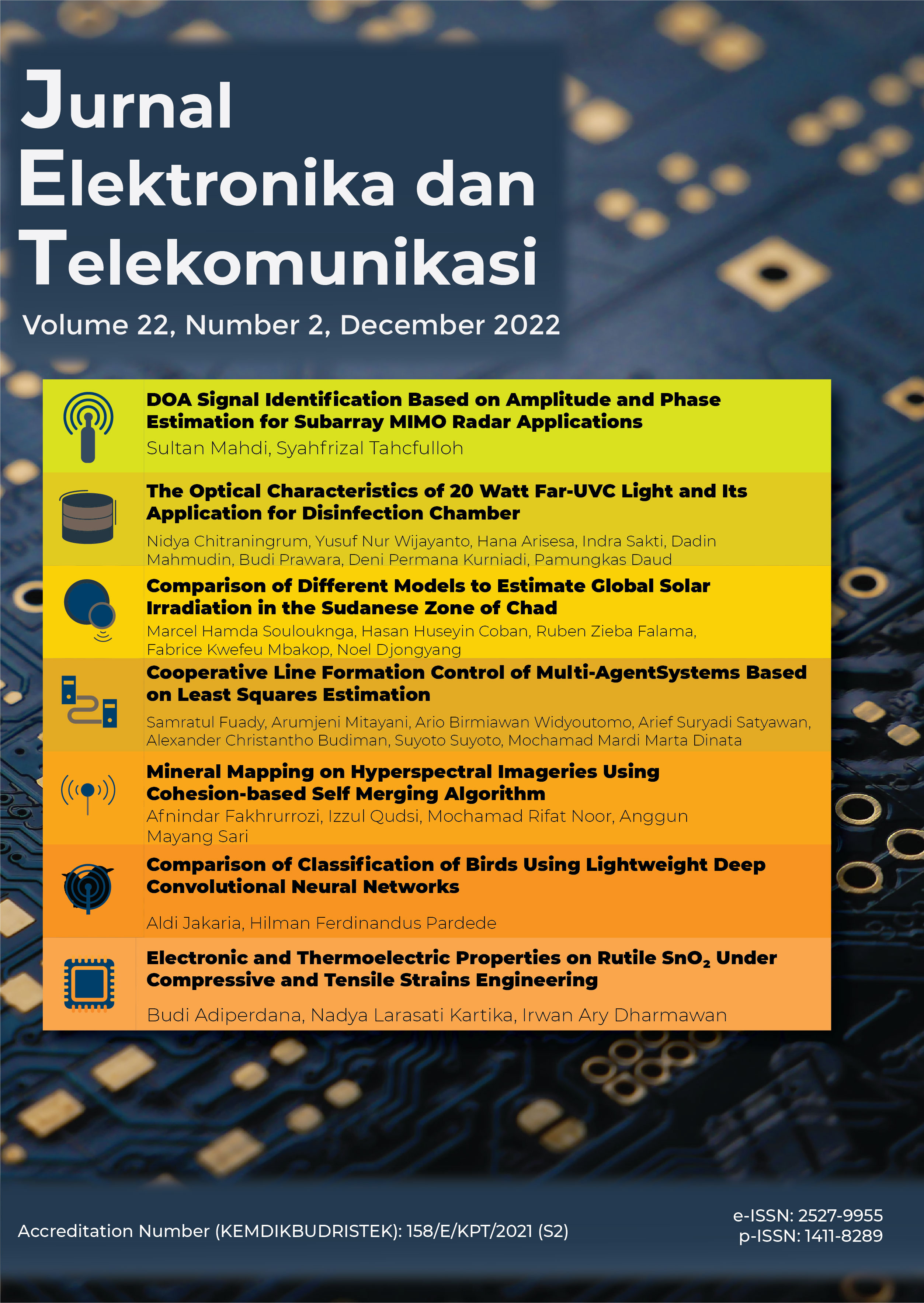
DOA Signal Identification Based on Amplitude and Phase Estimation for Subarray MIMO Radar Applications
DOI:
https://doi.org/10.55981/jet.498Keywords:
amplitude and phase estimation, MIMO, overlapped equal subarray transmit, phased array, radarAbstract
The overlapped equal subarray transmit radar, which is also known as the Subarray Multiple-Input Multiple-Output radar, utilizes the key advantages simultaneously of both types of multi-antenna radar, i.e. the phased array and MIMO radars, so that it is able to detect multiple targets even though it has a radar cross section (RCS) of a weak or small target. In this paper, it is proposed to develop a parameter estimation approach called amplitude and phase estimation (APES). This approach provides improved resolution to the estimation of the amplitude and direction of arrival (DoA) of the target reflection signal on the radar compared to the existing conventional estimation methods such as least squares (LS). The formulation of the APES method on this radar is based on the tested parameters such as DoA and RCS and continuously being evaluated. The results show that the performance of the APES method of this radar can detect targets very precisely when the number of subarrays (M) is greater than the number of detection targets (P), precisely M > P. For the results of DoA and RCS accuracy from the APES method, this radar is more accurate than the LS when testing the angular resolution between the two targets, an angle resolution of 2° is obtained for the APES method which is superior to the LS with an angle resolution of 5.8°. In these conditions, the APES method is able to accurately distinguish between two targets while the LS method is only able to detect one target.Downloads
References
M. I. Skolnik, Introduction to Radar Systems, 3rd ed., New York, USA: McGraw-Hill, 2001.
S. Tahcfulloh and M. Hardiwansyah, “Parameter estimation and target detection of phased-MIMO radar using capon estimator.” Jurnal Elektronika dan Telekomunikasi, vol. 20, no. 2, pp. 60-69, Dec. 2020, doi: 10.14203/jet.v20.60-69. Crossref
M. R. Widyantara, Sugihartono, F. Y. Suratman, S. Widodo, and P. Daud, “Analysis of non linear frequency modulation (NLFM) waveforms for pulse compression radar,” Jurnal Elektronika dan Telekomunikasi, vol. 18, no. 1, pp. 27-34, Aug. 2018, doi: 10.14203/jet.v18.27-34. Crossref
H. Pratiwi, M. R. Hidayat, A. A. Pramudita, and F. Y. Suratman, “Improved FMCW radar system for multi-target detection of human respiration vital sign,” Jurnal Elektronika dan Telekomunikasi, vol. 19, no. 2, pp. 38-44, Dec. 2019, doi: 10.14203/jet.v19.38-44. Crossref
I. Bilik, O. Longman, S. Villeval, and J. Tabrikian, “The rise of radar for autonomous vehicles: signal processing solutions and future research directions,” IEEE Signal Process. Mag., vol. 36, no. 5, pp. 20–31, Sep. 2019, doi: 10.1109/MSP.2019.2926573. Crossref
A. Hassanien and S. A. Vorobyov, “Phased-MIMO radar: a tradeoff between phased-array and MIMO radars,” IEEE Trans. Signal Process., vol. 58, no. 6, pp. 3137-3151, Jun. 2010, doi: 10.1109/TSP.2010.2043976. Crossref
S. Sapriansa and S. Tahcfulloh, “Identifikasi amplitudo dan sudut kedatangan sinyal menggunakan metode forward-backward APES pada radar multi-antena,” Jurnal Telekomunikasi, Elektronika, Komputasi dan Kontrol, vol. 7, no. 2, pp. 89-99, Dec. 2021, doi: 10.15575/telka.v7n2.89-99. Crossref
P. Stoica, H. Li, and J. Li, “New derivation of the APES filter,” IEEE Signal Process. Lett., vol. 6, no. 8, pp. 205-206, Aug. 1999, doi: 10.1109/97.774866. Crossref
C. Gao, H. Zhou, R. Wu, X. Xu, F. Shen, and Z. Guo, “Parameter estimation and multi-pulse target detection of MIMO radar,” in Proc. 2016 IEEE Region 10 Conf., Singapore, Nov. 2016, pp. 909-914, doi: 10.1109/TENCON.2016.7848137. Crossref
M. F. Keskin, H. Wymeersch, and V. Koivunen, “ICI-aware parameter estimation for MIMO-OFDM radar via APES spatial filtering,” in Proc. 2021 IEEE Int. Conf. Acoust. Speech and Signal Process., Toronto, Canada, Jun. 2021, pp. 8248-8252, doi: 10.1109/ICASSP39728.2021.9414537. Crossref
H. Zhang and P. López-Dekker, “Persistent scatterer densification through the application of capon- and APES-based SAR reprocessing algorithms,” IEEE Trans. Geosci. Remote Sens., vol. 57, no. 10, pp. 7521-7533, Oct. 2019, doi: 10.1109/TGRS.2019.2913905. Crossref
S. M. M. T. Majd and B. M. Asl, “Adaptive spectral doppler estimation based on the modified amplitude spectrum capon,” IEEE Trans. Ultrason. Ferroelectr. Freq. Control, vol. 68, no. 5, pp. 1664-1675, May 2021, doi: 10.1109/TUFFC.2020.3044774. Crossref
X. Luzhou, J. Li, and P. Stoica, “Target detection and parameter estimation for MIMO radar systems,” IEEE Trans. Aerosp. and Electron. Syst., vol. 44, no. 3, pp. 927-939, Jul. 2008, doi: 10.1109/taes.2008.4655353. Crossref
J. Zhao, L. Zou, R. Jiang, X. Wang, and H. Gao, “Hybrid antenna arrays with high angular resolution for 77 GHz automotive radars,” Inst. Electron. Inform. and Commun. Eng. Electron. Express, vol. 17, no. 2, 2020, Art. no. 20190687, doi: 10.1587/elex.16.20190687. Crossref
Downloads
Published
Issue
Section
License
Authors who publish with this journal agree to the following terms:
The copyright to this article is transferred to BRIN if and when the article is accepted for publication. The undersigned hereby transfers any and all rights in and to the paper including without limitation all copyrights to BRIN. The undersigned hereby represents and warrants that the paper is original and that he/she is the author of the paper, except for material that is clearly identified as to its original source, with permission notices from the copyright owners where required. The undersigned represents that he/she has the power and authority to make and execute this assignment. The copyright transfer form can be downloaded here.
The corresponding author signs for and accepts responsibility for releasing this material on behalf of any and all co-authors. This agreement is to be signed by at least one of the authors who have obtained the assent of the co-author(s) where applicable. After submission of this agreement signed by the corresponding author, changes of authorship or in the order of the authors listed will not be accepted.

This work is licensed under a Creative Commons Attribution-NonCommercial-ShareAlike 4.0 International License.