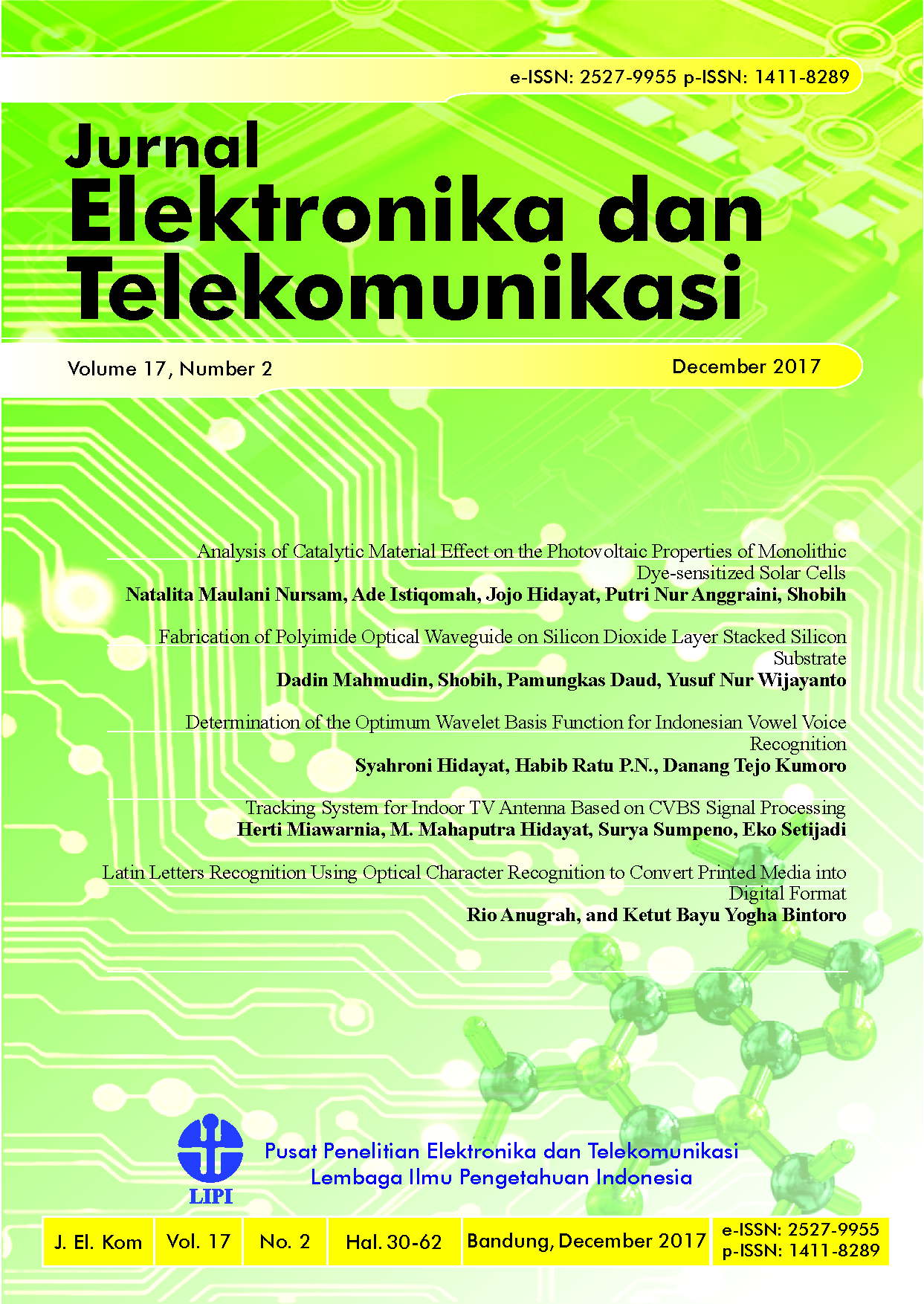
Latin Letters Recognition Using Optical Character Recognition to Convert Printed Media Into Digital Format
DOI:
https://doi.org/10.14203/jet.v17.56-62Keywords:
Optical Character Recognition (OCR), segmentation, feature extraction, artificial neural network (ANN)Abstract
Printed media is still popular now days society. Unfortunately, such media encountered several drawbacks. For example, this type of media consumes large storage that impact in high maintenance cost. To keep printed information more efficient and long-lasting, people usually convert it into digital format. In this paper, we built Optical Character Recognition (OCR) system to enable automatic conversion the image containing the sentence in Latin characters into digital text-shaped information. This system consists of several interrelated stages including preprocessing, segmentation, feature extraction, classifier, model and recognition. In preprocessing, the median filter is used to clarify the image from noise and the Otsu’s function is used to binarize the image. It followed by character segmentation using connected component labeling. Artificial neural network (ANN) is used for feature extraction to recognize the character. The result shows that this system enable to recognize the characters in the image whose success rate is influenced by the training of the system.
Downloads
References
J. Chandarana, and M. Kapadia, "Optical character recognition," International Journal of Emerging Technology and Advanced Engineering, 4(5), pp. 219–223, 2014.
S. Chopra, and A. Ghadge, "Optical Character Recognition," International Journal of Advanced Research in Computer and Communication Engineering, 3(1), pp. 4956-4958, 2014.
A. Sharma, and D.R. Chaudhary, "Character Recognition Using Neural Network. International Journal of Engineering Trends and Technology (IJETT), 4(April), pp. 662–667, Apr. 2013.
A.T. Birhanu, and R. Sethuraman, "Artificial Neural Network Approach to the Development of OCR for Real Life Amharic Documents," International Journal of Science, Engineering and Technology Research, 4(1), pp. 141–147, 2015.
E.S.A. Ahmed, R. E.A Elatif, Z.T. Alser, "Median Filter Performance Based on Different Window Sizes for Salt and Pepper Noise Removal in Gray and RGB Images," International Journal of Signal Processing Image Processing and Pattern Recognition, 8(10), pp. 343-352, 2015. Crossref
B.K Pal, P.S. Tiwari, P.S. Kumar, "Efficient Small and Capital Handwritten Character Recognition with Noise Reduction," International Journal of Emerging Technology and Advanced Engineering, 3(8), pp. 408-413, 2013.
N. Chaki, S.H. Shaikh, K. Saeed, "Exploring image binarization techniques," Studies in Computational Intelligence, 560, pp. 5–16, 2014. Crossref
N. Otsu, "A threshold selection method from gray-level histograms," IEEE Transactions on Systems, Man, and Cybernetics, 9(1), pp. 62-66, 1979. Crossref
G. Mehul, P. Ankita, D. Namrata, G. Rahul, S. Sheth, "Text-Based Image Segmentation Methodology," Procedia Technology, vol. 14, pp. 465-472, 2014. Crossref
D.N. Hakro, S.A. Awan, M. Memon, A. Aamur, G. Mojai, "Interactive thinning for segmentation-based and segmentation-free Sindhi OCR," Sindh University Research Journal-SURJ (Science Series), 47(3), pp. 395-398, 2015.
M.S. Nixon, and A.S Aguado, Feature Extraction and Image Processing, Academic Press, 2008. Crossref
S. Kumar, "A Brief Review of Classifiers used in OCR Applications," International Journal of Computer Trends and Technology (IJCTT), 34(2), pp. 80-88, 2016. Crossref
R. Buse, Z.-Q. Liu, J. Bezdek, "Word Recognition Using Fuzzy Logic," IEEE Transactions on Fuzzy Systems, vol. 10, no. 1, pp. 65-76, 2002. Crossref
N. Bhagava, A. Kumawat, R. Bhargava, "Threshold and binarization for document image analysis using otsu’s Algorithm," International Journal of Computer Trends and Technology (IJCTT), 17(5), pp. 272-275, 2014.
S. Imam Syafi, R. Tri Wahyuningrum, D. Arif Muntasa, "Segmentasi Obyek Pada Citra Digital Menggunakan Metode Otsu Thresholding," Jurnal Informatika, 13(1), pp. 1-8, 2015. Crossref
K. B. Yogha, M. Cendana, R. Lipikorn, “Non-deterministic finite state automata as termites swarm agent model,” in Proc. of 7th International Workshop on Computer Science and Engineering (WCSE), pp. 318-325, 2017.
P. Pooja, R. Phalak, W. Jayashri, S. Yugandhara, "Text extraction from English comic images using connected component algorithm," in Proc. of 4th IRF International Conference, Pune, pp. 166-169, 2014.
A. S. Karne and S. S. Navalgund, "Implementation of an Image Thinning Algorithm using Verilog and MATLAB," International Journal of Current Engineering and Technology (Ncwse), pp. 333-337, 2013.
Hendri, "Character Recognition Dengan Menggunakan Jaringan Syaraf Tiruan," Jurnal TIMES, III(2), pp. 1–5, 2014.
Downloads
Published
Issue
Section
License
Authors who publish with this journal agree to the following terms:
The copyright to this article is transferred to BRIN if and when the article is accepted for publication. The undersigned hereby transfers any and all rights in and to the paper including without limitation all copyrights to BRIN. The undersigned hereby represents and warrants that the paper is original and that he/she is the author of the paper, except for material that is clearly identified as to its original source, with permission notices from the copyright owners where required. The undersigned represents that he/she has the power and authority to make and execute this assignment. The copyright transfer form can be downloaded here.
The corresponding author signs for and accepts responsibility for releasing this material on behalf of any and all co-authors. This agreement is to be signed by at least one of the authors who have obtained the assent of the co-author(s) where applicable. After submission of this agreement signed by the corresponding author, changes of authorship or in the order of the authors listed will not be accepted.

This work is licensed under a Creative Commons Attribution-NonCommercial-ShareAlike 4.0 International License.