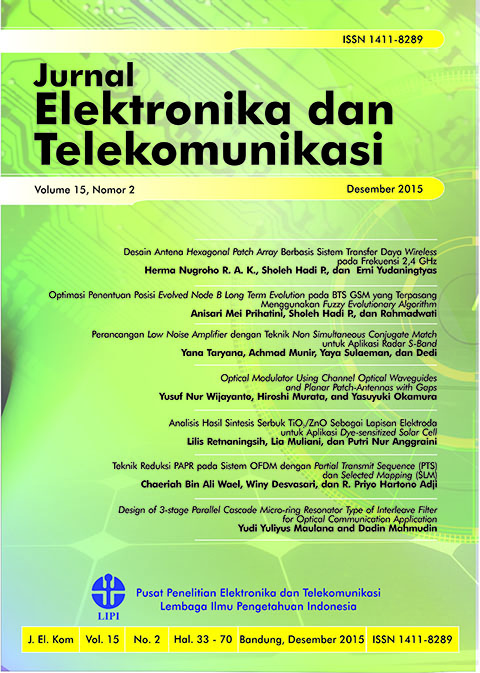
Desain Antena Hexagonal Patch Array Berbasis Sistem Transfer Daya Wireless pada Frekuensi 2,4 GHz
DOI:
https://doi.org/10.14203/jet.v15.33-38Keywords:
patch, array, wireless, rectifier, return lossAbstract
Pada penelitian ini telah didesain antena hexagonal patch array yang dapat digunakan sebagai perangkat catu daya wireless. Antena hexagonal patch array ini didesain untuk menangkap gelombang radio (RF) pada frekuensi 2,4 GHz yang dapat diaplikasikan sebagai antena pada Wireless Local Area Network (WLAN). Desain antena dilakukan menggunakan software CST Microwave studio, kemudian dilakukan pabrikasi dan pengukuran secara riil. Parameter pengujian antena hexagonal patch array meliputi return loss, Voltage Standing Wave Ratio (VSWR), gain, bandwidth, dan daya. Metode yang digunakan adalah pemodelan transmission line dan corporate feed line untuk pengaturan perubahan jarak antar patch antena. Perubahan variabel juga diteliti pengaruhnya terhadap parameter antena khususnya daya terima antena yang kemudian ditransmisikan ke rangkaian power harvester. Nilai parameter antena hasil simulasi menunjukkan nilai return loss adalah -33,38 dB, VSWR sebesar 1,041, gain sebesar 8,81 dBi, bandwidth adalah 0,084 GHz, daya sebesar 0,499 W (-3 dBm). Sedangkan parameter hasil pengukuran dari antena yang telah dipabrikasi adalah nilai return loss sebesar -33,21 dB, VSWR sebesar 1,048, gain sebesar 5 dBi, bandwidth adalah 0,145 GHz, daya sebesar -33 dBm.Downloads
References
O. Imatsu, E. Setijadi, dan Wirawan, “Rancang bangun antena mikrostrip pada frekuensi GPS L1 berbasis sistem transfer daya nirkabel”, Jurnal Teknik POMITS, vol. 1, no. 1, hal. 1-6, 2012.
Anuroop, D. Gangwar, and R. L. Yadava, “Design and analysis of a pentagonal rectenna”, in Proceedings of International Conference on Signal Processing and Integrated Networks (SPINZ), 2014, pp. 654 - 658.
O. Olgun, C. C. Chen, and J. L. Volakis, “Investigation of rectenna array configurations for enhanced rf power harvesting”, IEEE Antennas And Wireless Propagation Letters, vol. 10, April 2011, pp. 262 - 265.
N. Zhu, K. Chang, M. Tuo, P. Jin, H. Xin, and R. W. Ziolkowski, “Design of high-efficiency rectenna for 1,575 ghz wireless low power transmission”, in Proceedings of 2011 IEEE Radio and Wireless Week (RWW 2011) - 2011 IEEE Radio and Wireless Symposium (RWS 2011), Jan 2011, pp. 90-93.
M. T. I. Huque, M. A. Chouwdury, M. K. Hosain, and M. S. Alam, Performance analysis of corporate feed rect angular element and circular patch elemen 4x2 mikcrostrip array antenna”, International Journal of Advanced Computer Science and Application (IJACSA), vol. 2. no. 8, pp. 74-79, 2011.
S. Bin Alam, M. A. Ullah, and S. Moury, “Design of a low power 2.45 GHz RF energy harvesting circuit for rectenna harvesting circuit for rectenna, in Proceedings of 2013 International Conference on Informatics, Electronics & Vision (ICIEV), May 2013, pp. 1-4.
R. Brancroft, Microstrip and Printed Antenna Design, 2nd ed., Raleigh, NC-USA: Scitech Publishing, Inc, 2009. [8] D. M. Pozar, Microwave Engineering, 4th ed., New York, USA: John Wiley & Sons, Inc, 2011.
C. A. Balanis, Antena Theory: Analysis Design, 3rd ed. New Jersey, USA: John Wiley & Sons, Inc, 2005.
S. Basu, A. Srivastava, and A. Goswami, “Dual frequency hexagonal microstrip patch antenna”, Int. J. Sci. Res. Publ., vol 3, iss.11, pp. 1-9, November 2013.
“HSMS-286x series surface mount microwave schottky detector diodes”, Avago Technologies, United States, 2009.
Downloads
Published
Issue
Section
License
Authors who publish with this journal agree to the following terms:
The copyright to this article is transferred to BRIN if and when the article is accepted for publication. The undersigned hereby transfers any and all rights in and to the paper including without limitation all copyrights to BRIN. The undersigned hereby represents and warrants that the paper is original and that he/she is the author of the paper, except for material that is clearly identified as to its original source, with permission notices from the copyright owners where required. The undersigned represents that he/she has the power and authority to make and execute this assignment. The copyright transfer form can be downloaded here.
The corresponding author signs for and accepts responsibility for releasing this material on behalf of any and all co-authors. This agreement is to be signed by at least one of the authors who have obtained the assent of the co-author(s) where applicable. After submission of this agreement signed by the corresponding author, changes of authorship or in the order of the authors listed will not be accepted.

This work is licensed under a Creative Commons Attribution-NonCommercial-ShareAlike 4.0 International License.