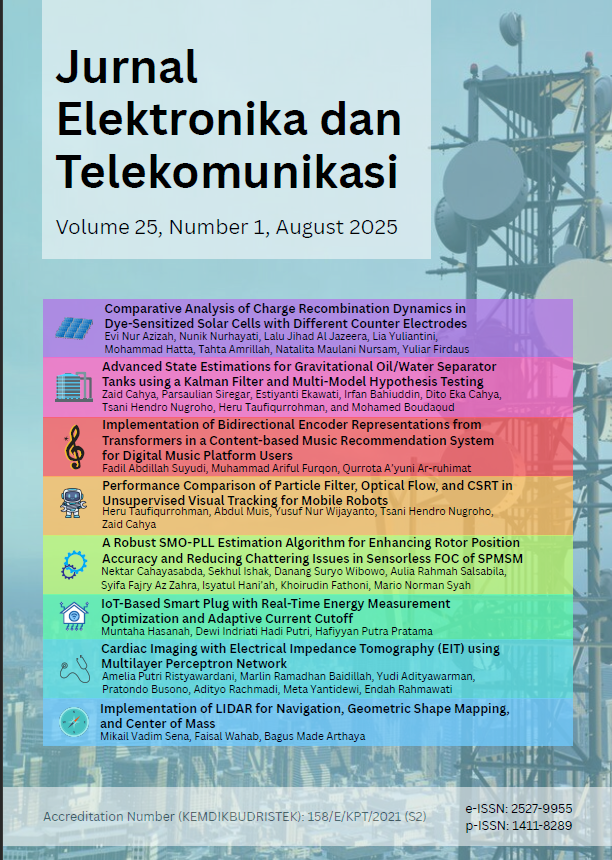
Cardiac Imaging with Electrical Impedance Tomography (EIT) using Multilayer Perceptron Network
DOI:
https://doi.org/10.55981/jet.705Keywords:
Electrical Impedance Tomography, Multilayer Perceptron, Semi-Supervised Learning, Cardiac Imaging, Machine LearningAbstract
This research explores the enhancement of Electrical Impedance Tomography (EIT) for cardiac imaging using Multilayer Perceptron (MLP) networks, focusing on supervised and semi-supervised learning approaches. Using synthetic thoracic datasets simulating dynamic cardiac and respiratory conditions, the study demonstrates that supervised learning achieves lower mean squared error (MSE) values (minimum 4.76) and more stable predictions compared to semi-supervised learning (minimum MSE 5.08). However, semi-supervised learning excels in edge accuracy and noise reduction, particularly in regions with sharp conductivity gradients, making it viable for scenarios with limited labeled data. Dropout regularization at 0.3 provided optimal balance, enhancing model generalization and robustness. While supervised learning outperformed semi-supervised methods in overall accuracy, the latter showed potential for cost-effective and scalable applications in EIT-based cardiac imaging. These findings suggest that integrating advanced machine learning with EIT can improve diagnostic accuracy and enable efficient use of sparse labeled data, paving the way for future optimizations and clinical applications.
Downloads
References
H. Tran, Hoang Van and Kim, Min Hyuck and Le, Thong Chi and Yoon, High accurate and efficient electrical impedance tomography for fast brain imaging. 2023. doi: 10.1117/12.2659172.
A. Z. Hayat, A. T. Nugroho, and N. Priyantari, “Prototype Portable Electrical Resistance Tomography,” IPTEK J. Technol. Sci., vol. 32, no. 3, p. 136, 2022, doi: 10.12962/j20882033.v32i3.8843.
G. Y. Jang et al., “Noninvasive, simultaneous, and continuous measurements of stroke volume and tidal volume using EIT: feasibility study of animal experiments,” Sci. Rep., vol. 10, no. 1, pp. 1–12, 2020, doi: 10.1038/s41598-020-68139-3.
A. Nguyen, Duc and Qian, Pierre and Barry, Michael and Mcewan, “Self-weighted NOSER-prior electrical impedance tomography using internal electrodes in cardiac radiofrequency ablationle,” Physiol. Meas., vol. 40, p. 065006, 2019, doi: 10.1088/1361-6579/ab1937.
C. Putensen, B. Hentze, S. Muenster, and T. Muders, “Electrical impedance tomography for cardio-pulmonary monitoring,” J. Clin. Med., vol. 8, no. 8, 2019, doi: 10.3390/jcm8081176.
A. Santini, E. Spinelli, T. Langer, S. Spadaro, G. Grasselli, and T. Mauri, “Thoracic electrical impedance tomography: an adaptive monitor for dynamic organs,” J. Emerg. Crit. Care Med., vol. 2, no. September, pp. 71–71, 2018, doi: 10.21037/jeccm.2018.08.08.
J. Caruana, Lawrence & Paratz, Jennifer & Chang, A & Barnett, Adrian & Fraser, “The Time Taken for the Regional Distribution of Ventilation to Stabilise: An Investigation Using Electrical Impedance Tomography.,” Anaesth. Intensive Care, vol. 43, pp. 88–91, 2015, doi: 10.1177/0310057X1504300113.
S. Kumar and R. Kumar, “Analysis and Validation of medical Application through Electrical Impedance based System,” 2018. doi: 10.18201/ijisae.2018637925.
S. J. Hamilton and A. Hauptmann, “Deep D-Bar: Real-Time Electrical Impedance Tomography Imaging With Deep Neural Networks,” IEEE Trans. Med. Imaging, vol. 37, no. 10, pp. 2367–2377, 2018, doi: 10.1109/TMI.2018.2828303.
F. Song, X., Xu, Y., & Dong, “A spatially adaptive total variation regularization method for electrical resistance tomography,” Meas. Sci. Technol., vol. 26, no. 12, p. 125401, 2015, doi: 10.1088/0957-0233/26/12/125401.
L. Karrach and E. Pivarčiová, “Using Different Types of Artificial Neural Networks to Classify 2D Matrix Codes and Their Rotations—A Comparative Study,” J. Imaging, vol. 9, no. 9, pp. 1–16, 2023, doi: 10.3390/jimaging9090188.
J. E. van Engelen and H. H. Hoos, “A survey on semi-supervised learning,” Mach. Learn., vol. 109, no. 2, pp. 373–440, 2020, doi: 10.1007/s10994-019-05855-6.
C. S. Perone and J. Cohen-Adad, “Deep semi-supervised segmentation with weight-averaged consistency targets,” Lect. Notes Comput. Sci. (including Subser. Lect. Notes Artif. Intell. Lect. Notes Bioinformatics), vol. 11045 LNCS, pp. 12–19, 2018, doi: 10.1007/978-3-030-00889-5_2.
E. Endarko and A. B. Sanjaya Umbu, “Design of low-cost and simple reconstruction method for Three Dimensional Electrical Impedance Tomography (3D-EIT) Imaging,” J. Penelit. Fis. dan Apl., vol. 10, no. 2, p. 125, 2020, doi: 10.26740/jpfa.v10n2.p125-136.
S. Liu, J. Jia, Y. D. Zhang, and Y. Yang, “Image Reconstruction in Electrical Impedance Tomography Based on Structure-Aware Sparse Bayesian Learning,” IEEE Trans. Med. Imaging, vol. 37, no. 9, pp. 2090–2102, 2018, doi: 10.1109/TMI.2018.2816739.
A. Zhang, Ke and Li, Maokun and Liang, Haiqing and Wang, Juan and Xu, Shenheng and Abubakar, “Deep feature-domain matching for cardiac-related component separation from image series of chest electrical impedance tomography: proof-of-concept study,” Physiol. Meas., vol. 43, 2022, doi: 10.1088/1361-6579/ac9c44.
T. Rymarczyk, G. Kłosowski, E. Kozłowski, J. Sikora, and P. Adamkiewicz, “Improving the tomographic image by enhancing the machine learning algorithm,” J. Phys. Conf. Ser., vol. 2408, no. 1, 2022, doi: 10.1088/1742-6596/2408/1/012020.
T. Rymarczyk, G. Klosowski, E. Kozlowski, and P. Tchórzewski, “Comparison of selected machine learning algorithms for industrial electrical tomography,” Sensors (Switzerland), vol. 19, no. 7, 2019, doi: 10.3390/s19071521.
T. Huuhtanen and A. Jung, “Anomaly location detection with electrical impedance tomography using multilayer perceptrons,” IEEE Int. Work. Mach. Learn. Signal Process. MLSP, vol. 2020-September, 2020, doi: 10.1109/MLSP49062.2020.9231818.
B. Grychtol, B. Müller, and A. Adler, “3D EIT image reconstruction with GREIT,” Physiol. Meas., vol. 37, no. 6, pp. 785–800, 2016, doi: 10.1088/0967-3334/37/6/785.
F. Thürk et al., “Effects of individualized electrical impedance tomography and image reconstruction settings upon the assessment of regional ventilation distribution: Comparison to 4-dimensional computed tomography in a porcine model,” PLoS One, vol. 12, no. 8, pp. 1–16, 2017, doi: 10.1371/journal.pone.0182215.
Z. Han and S. Yin, “Research on Semi-supervised Classification with an Ensemble Strategy,” vol. 136, no. Icsma, pp. 681–684, 2016, doi: 10.2991/icsma-16.2016.119.
K. Hornik, M. Stinchcombe, and H. White, “Multilayer feedforward networks are universal approximators,” Neural Networks, vol. 2, no. 5, pp. 359–366, 1989, doi: 10.1016/0893-6080(89)90020-8.
T. Miyato, S. I. Maeda, M. Koyama, and S. Ishii, “Virtual Adversarial Training: A Regularization Method for Supervised and Semi-Supervised Learning,” IEEE Trans. Pattern Anal. Mach. Intell., vol. 41, no. 8, pp. 1979–1993, 2019, doi: 10.1109/TPAMI.2018.2858821.
B. Liu, B. Yang, C. Xu, J. Xia, M. Dai, Z. Ji, F. You, X. Dong, X. Shi, and F. Fu, “pyEIT: A python based framework for Electrical Impedance Tomography,” SoftwareX, vol. 7, pp. 304–308, 2018.
F. Chollet, “Keras: the Python deep learning API,” 2015, https://keras.io/.
Downloads
Published
Issue
Section
License
Authors who publish with this journal agree to the following terms:
The copyright to this article is transferred to BRIN if and when the article is accepted for publication. The undersigned hereby transfers any and all rights in and to the paper including without limitation all copyrights to BRIN. The undersigned hereby represents and warrants that the paper is original and that he/she is the author of the paper, except for material that is clearly identified as to its original source, with permission notices from the copyright owners where required. The undersigned represents that he/she has the power and authority to make and execute this assignment. The copyright transfer form can be downloaded here.
The corresponding author signs for and accepts responsibility for releasing this material on behalf of any and all co-authors. This agreement is to be signed by at least one of the authors who have obtained the assent of the co-author(s) where applicable. After submission of this agreement signed by the corresponding author, changes of authorship or in the order of the authors listed will not be accepted.

This work is licensed under a Creative Commons Attribution-NonCommercial-ShareAlike 4.0 International License.