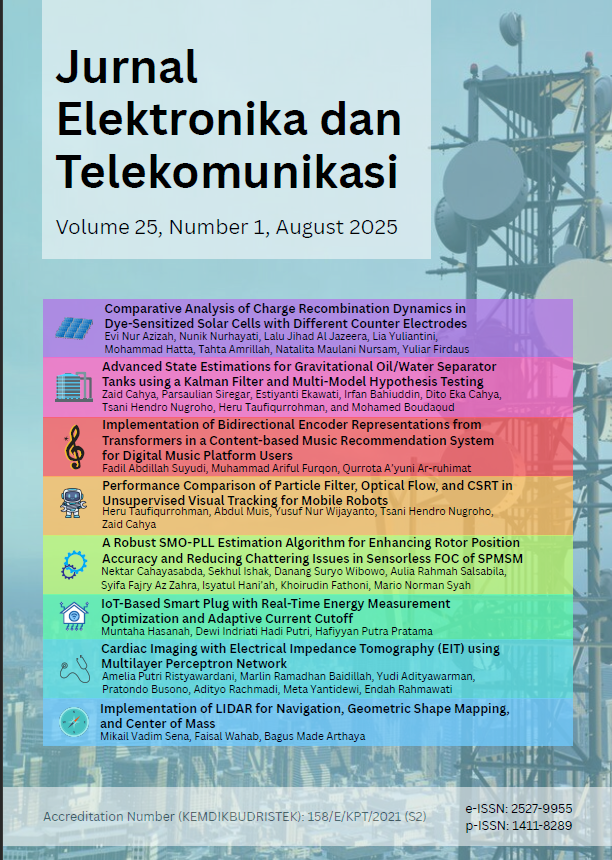
Comparative Analysis of Charge Recombination Dynamics in Dye-Sensitized Solar Cells with different Counter Electrodes
DOI:
https://doi.org/10.55981/jet.703Keywords:
Dye-sensitized solar cells, counter electrodes, recombination dynamics, graphene electrodes, charge extraction, PEDOT, PSS.Abstract
Counter electrodes are essential in dye-sensitized solar cells (DSSCs) for facilitating charge transfer and catalyzing the regeneration of the electrolyte, impacting overall efficiency. Common counter electrode materials include platinum (Pt), poly(3,4-ethylenedioxythiophene)-poly(styrenesulfonate) (PEDOT:PSS), and graphene, each with distinct advantages and challenges. Pt, a traditional choice, offers excellent catalytic activity but is expensive and scarce. PEDOT:PSS, a conductive polymer, is cost-effective and easily deposited but often suffers from high recombination losses and lower efficiency. Graphene, known for its high conductivity and large surface area, is emerging as a promising alternative. However, a lack of comparative studies on how different counter electrode materials influence recombination dynamics limits the understanding needed for optimizing DSSC performance. This study addresses this gap by examining Pt, graphene, and PEDOT:PSS -based counter electrodes, analyzing their effects on charge transfer, recombination behaviour, and efficiency through J-V measurements, charge extraction, and transient photocurrent (TPC) as well as transient photovoltage (TPV) analyses. Graphene-based DSSCs show superior performance, achieving the highest photocurrent density and power conversion efficiency up to 5.12% at an intensity equivalent to 1 sun (100 mWcm-2), due to enhanced charge extraction and minimized recombination. TPC data reveal that graphene supports faster charge transport, while TPV analysis shows longer electron lifetimes than PEDOT:PSS-based DSSCs. In contrast, PEDOT:PSS-based DSSCs exhibit high recombination losses, lower photocurrent, and s-shaped J-V curves, indicating high resistance of limited charge transfer efficiency. These findings highlight graphene’s potential as an optimal counter electrode material for efficient, high-performance DSSCs.
Downloads
References
A. Hagfeldt, G. Boschloo, L. Sun, L. Kloo, and H. Pettersson, "Dye-Sensitized Solar Cells," Chem. Rev., vol. 110, no. 11, pp. 6595-6663, Nov. 2010.
S. Yoon, S. Tak, J. Kim, Y. Jun, K. Kang, and J. Park, "Application of transparent dye-sensitized solar cells to building integrated photovoltaic systems," Build. Environ., vol. 46, no. 10, pp. 1899-1904, Oct. 2011.
Z. Wen et al., "Self-powered textile for wearable electronics by hybridizing fiber-shaped nanogenerators, solar cells, and supercapacitors," Sci. Adv., vol. 2, no. 10, p. e1600097, Oct.
J. Wu et al., "Counter electrodes in dye-sensitized solar cells," Chem. Soc. Rev., vol. 46, no. 19, pp. 5975-6023, Aug. 2017.
S. Thomas, T. G. Deepak, G. S. Anjusree, T. A. Arun, S. V. Nair, and A. S. Nair, "A review on counter electrode materials in dye-sensitized solar cells," J. Mater. Chem. A, vol. 2, no. 13, pp. 4474-4490, Nov. 2014.
H. Murata, Y. Nakajima, N. Saitoh, N. Yoshizawa, T. Suemasu, and K. Toko, "High-Electrical-Conductivity Multilayer Graphene Formed by Layer Exchange with Controlled Thickness and Interlayer," Sci. Rep., vol. 9, no. 1, p. 4068, Mar. 2019.
A. Peigney, C. Laurent, E. Flahaut, R. R. Bacsa, and A. Rousset, "Specific surface area of carbon nanotubes and bundles of carbon nanotubes," Carbon, vol. 39, no. 4, pp. 507-514, Apr. 2001.
P. Z. Sun et al., "Unexpected catalytic activity of nanorippled graphene," Proc. Natl. Acad. Sci., vol. 120, no. 12, p. e2300481120, Mar. 2023.
T. Yohannes and O. Inganäs, "Photoelectrochemical studies of the junction between poly[3-(4-octylphenyl)thiophene] and a redox polymer electrolyte," Sol. Energy Mater. Sol. Cells, vol. 51, no. 2, pp. 193-202, Feb. 1998.
Y. Ren et al., "Hydroxamic acid pre-adsorption raises the efficiency of cosensitized solar cells," Nat., vol. 613, no. 7942, pp. 60-65, Jan. 2023.
E. S. Nurazizah, A. Aprilia, R. Risdiana, and L. Safriani, "Different Roles between PEDOT:PSS as Counter Electrode and PEDOT:Carrageenan as Electrolyte in Dye-Sensitized Solar Cell Applications: A Systematic Literature Review," Polym., vol. 15, no. 12, Jun. 2023.
K. K. Putra, E. S. Rosa, Shobih, and N. Prastomo, "Development of monolithic dye sensitized solar cell fabrication with polymer-based counter electrode," J. Phys. Conf. Ser., vol. 1191, no. 1, p. 012029, Mar. 2019.
S.-H. Park, J.-U. Kim, J.-K. Lee, and M.-R. Kim, "Photovoltaic Properties of Dye-Sensitized Solar Cells with Thermal Treated PEDOT:PSS as Counter Electrodes," Mol. Cryst. Liq. Cryst., vol. 471, no. 1, pp. 113-121, Sept. 2007.
W. Maiaugree et al., "A dye sensitized solar cell using natural counter electrode and natural dye derived from mangosteen peel waste," Sci. Rep., vol. 5, no. 1, p. 15230, Oct. 2015.
N. Fuke et al., "Influence of TiCl4 treatment on back contact dye-sensitized solar cells sensitized with black dye," Energy Environ, Sci., vol. 2, no. 11, pp. 1205-1209, Jul. 2009.
H. Wang and Y. H. Hu, "Graphene as a counter electrode material for dye-sensitized solar cells," Energy Environ, Sci., vol. 5, no. 8, pp. 8182-8188, Jun. 2012.
K. Sim, S.-J. Sung, S.-N. Park, D.-H. Kim, and J.-K. Kang, "Particulate counter electrode system for enhanced light harvesting in dye-sensitized solar cells," Opt. Mater. Express, vol. 3, no. 6, pp. 739-746, Jun. 2013.
J. H. Kim, K. J. Moon, J. M. Kim, D. Lee, and S. H. Kim, "Effects of various light-intensity and temperature environments on the photovoltaic performance of dye-sensitized solar cells," Sol. Energy, vol. 113, pp. 251-257, Mar. 2015.
Y. Firdaus et al., "Polymer Main-Chain Substitution Effects on the Efficiency of Nonfullerene BHJ Solar Cells," Adv. Energy Mater., vol. 7, no. 21, p. 1700834, Nov. 2017.
Y. Firdaus, Q. He, L. Muliani, E. S. Rosa, M. Heeney, and T. D. Anthopoulos, "Charge transport and recombination in wide-bandgap Y6 derivatives-based organic solar cells," Adv. Nat. Sci.: Nanosci. Nanotechnol., vol. 13, no. 2, p. 025001, May 2022.
R.-Z. Liang et al., "Additive-Morphology Interplay and Loss Channels in “All-Small-Molecule” Bulk-heterojunction (BHJ) Solar Cells with the Nonfullerene Acceptor IDTTBM," Adv. Funct. Mater., vol. 28, no. 7, p. 1705464, Feb. 2018.
L. J. A. Koster, V. D. Mihailetchi, R. Ramaker, and P. W. M. Blom, "Light intensity dependence of open-circuit voltage of polymer:fullerene solar cells," Appl. Phys. Lett., vol. 86, no. 12, p. 123509, Mar. 2005.
S. Ryu, N. Y. Ha, Y. H. Ahn, J.-Y. Park, and S. Lee, "Light intensity dependence of organic solar cell operation and dominance switching between Shockley–Read–Hall and bimolecular recombination losses," Sci. Rep., vol. 11, no. 1, p. 16781, Aug. 2021.
H. Paulsson, L. Kloo, A. Hagfeldt, and G. Boschloo, "Electron transport and recombination in dye-sensitized solar cells with ionic liquid electrolytes," J. Electroanal. Chem., vol. 586, no. 1, pp. 56-61, Jan. 2006.
Y. Hao et al., "A small electron donor in cobalt complex electrolyte significantly improves efficiency in dye-sensitized solar cells," Nat. Commun., vol. 7, no. 1, p. 13934, Dec. 2016.
Y. Firdaus et al., "Novel wide-bandgap non-fullerene acceptors for efficient tandem organic solar cells," J. Mater. Chem. A, vol. 8, no. 3, pp. 1164-1175, Dec. 2020.
G. Boschloo, L. Häggman, and A. Hagfeldt, "Quantification of the Effect of 4-tert-Butylpyridine Addition to I-/I3- Redox Electrolytes in Dye-Sensitized Nanostructured TiO2 Solar Cells," J. Phys. Chem. B, vol. 110, no. 26, pp. 13144-13150, Jul. 2006.
Downloads
Published
Issue
Section
License
Authors who publish with this journal agree to the following terms:
The copyright to this article is transferred to BRIN if and when the article is accepted for publication. The undersigned hereby transfers any and all rights in and to the paper including without limitation all copyrights to BRIN. The undersigned hereby represents and warrants that the paper is original and that he/she is the author of the paper, except for material that is clearly identified as to its original source, with permission notices from the copyright owners where required. The undersigned represents that he/she has the power and authority to make and execute this assignment. The copyright transfer form can be downloaded here.
The corresponding author signs for and accepts responsibility for releasing this material on behalf of any and all co-authors. This agreement is to be signed by at least one of the authors who have obtained the assent of the co-author(s) where applicable. After submission of this agreement signed by the corresponding author, changes of authorship or in the order of the authors listed will not be accepted.

This work is licensed under a Creative Commons Attribution-NonCommercial-ShareAlike 4.0 International License.