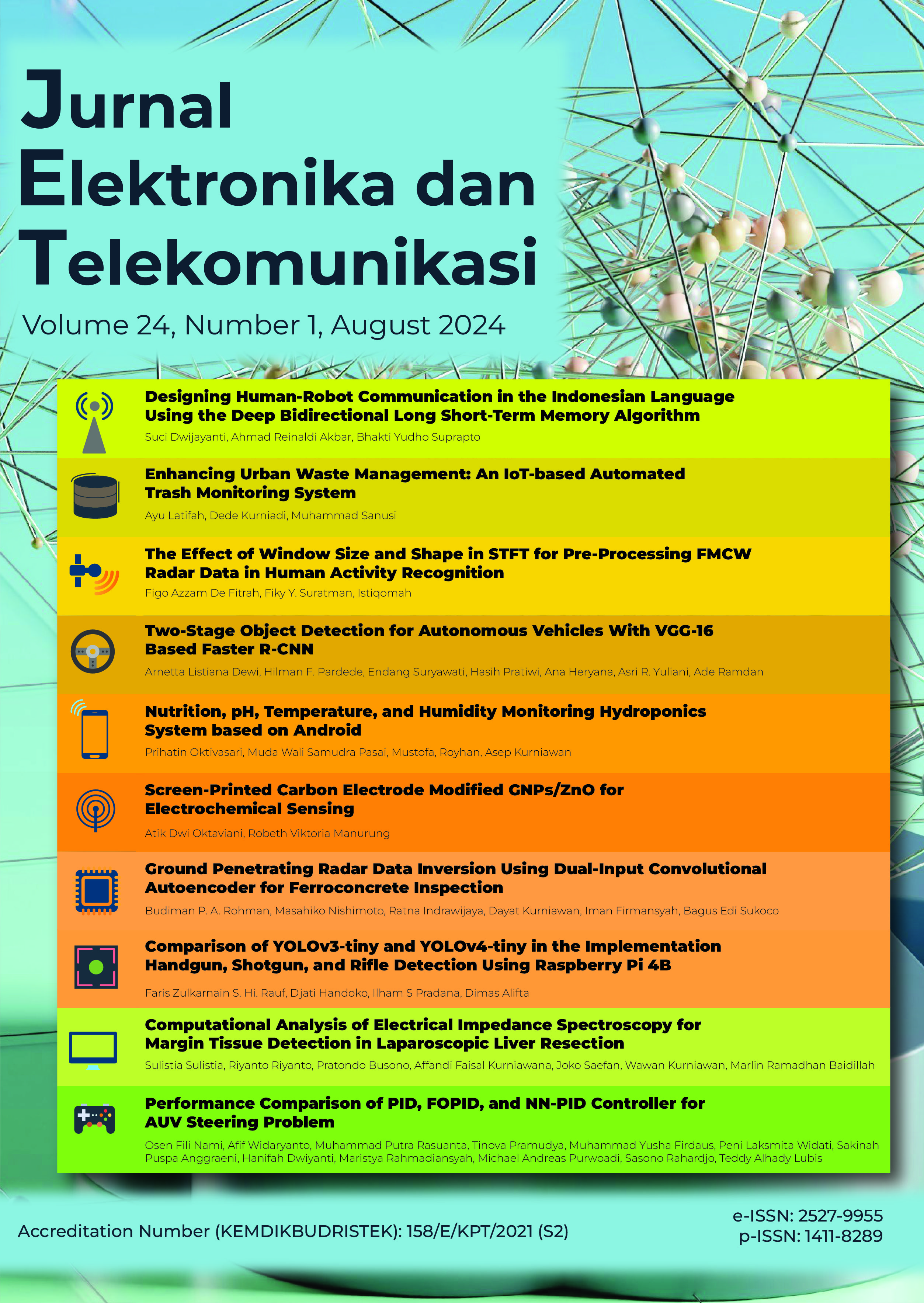
Ground Penetrating Radar Data Inversion Using Dual-Input Convolutional Autoencoder for Ferroconcrete Inspection
DOI:
https://doi.org/10.55981/jet.642Keywords:
signal processingAbstract
Ground penetrating radar (GPR) is a non-destructive tool for exploring an object buried underground. Currently, GPR is also considered for reinforced concrete inspection. However, the image produced by GPR can not be easily interpreted. Besides, the large observation of building concrete inspection also motivates the researchers to fastening and easing radar image interpretation. Thus, this research proposes a new method to translate GPR scattering data image to its internal structure visualization. The proposed employs a convolutional autoencoder model using amplitude and phase radar data as input of the algorithm. As evaluation, in this stage, we perform numerical analysis by using finite-difference time-domain-based synthetic data that considers three cases: concrete with rebar, concrete with crack, and concrete with rebar and crack. All of those cases are simulated with randomized dimensions and positions that is possible in the real applications. Compared with the baseline method, our method shows superiority, especially in the semantic segmentation perspective. The parameter size of the proposed model is also much smaller, around one-third of the previous method. Therefore, the method is feasible enough to be implemented in real applications addressing an automatic internal structure reinforced concrete visulaizationDownloads
References
H. M. Jol, Ground Penetrating Radar Theory and Applications, Elsevier. 2008.
A. Benedetto, and L. Pajewski, eds. Civil engineering applications of ground penetrating radar. Springer, 2015.
M. Nishimoto, B.P.A. Rohman, and Y. Naka. "Estimation of concrete corrosion state using ultra-wideband radar signatures." IGARSS 2019-2019 IEEE International Geoscience and Remote Sensing Symposium. IEEE, 2019.
B.P.A. Rohman, M. Nishimoto, and K. Ogata. "Material Permittivity Estimation Using Analytic Peak Ratio of Air-Coupled GPR Signatures." IEEE Access, vol. 10, pp. 13219-13228, 2022.
B. P. A. Rohman, M. Nishimoto, "Multi-scaled power spectrum based features for landmine detection using Ground Penetrating Radar," 2017 International Conference on Signals and Systems (ICSigSys), Bali, Indonesia, 2017, pp. 83-86.
S. Busch, et al. "Quantitative conductivity and permittivity estimation using full-waveform inversion of on-ground GPR data." Geophysics, vol. 77, no. 6, pp.H79-H91, 2012.
E. Forte, et al. "Velocity analysis from common offset GPR data inversion: theory and application to synthetic and real data." Geophysical Journal International, vol. 197, no. 3, pp. 1471-1483, 2014.
Z. Huang, J. Zhang. "Determination of parameters of subsurface layers using GPR spectral inversion method." IEEE Transactions on Geoscience and Remote Sensing, vol. 52, no. 12, pp. 7527-7533, 2014.
S. Jazayeri, et al. "Reinforced concrete mapping using full-waveform inversion of GPR data." Construction and Building Materials, vol. 229, pp. 117102, 2019.
M.T. Pham, S. Lefèvre. "Buried object detection from B-scan ground penetrating radar data using Faster-RCNN." IGARSS 2018-2018 IEEE International Geoscience and Remote Sensing Symposium. IEEE, 2018.
K. Dinh, N. Gucunski, T. H. Duong. "An algorithm for automatic localization and detection of rebars from GPR data of concrete bridge decks." Automation in Construction, vol. 89, pp. 292-298, 2018.
X. Xu, Y. Lei, and F. Yang. "Railway subgrade defect automatic recognition method based on improved Faster R-CNN." Scientific Programming, 2018.
Z. Tong, J. Gao, and H. Zhang. "Recognition, location, measurement, and 3D reconstruction of concealed cracks using convolutional neural networks." Construction and Building Materials, vol. 146, pp. 775-787, 2017.
R. Indrawijaya and B.P.A. Rohman, "Cognitive Linear Trajectory on GPR Imaging Using Lightweight Machine Learning," 2023 International Conference on Radar, Antenna, Microwave, Electronics, and Telecommunications (ICRAMET), Bandung, Indonesia, pp. 436-439, 2023.
J.K. Alvarez, S. Kodagoda. "Application of deep learning image-to-image transformation networks to GPR radargrams for sub-surface imaging in infrastructure monitoring." 2018 13th IEEE Conference on Industrial Electronics and Applications (ICIEA). IEEE, 2018.
B. Liu, et al. "GPRInvNet: Deep learning-based ground-penetrating radar data inversion for tunnel linings." IEEE Transactions on Geoscience and Remote Sensing, vol. 59, no. 10, pp. 8305-8325, 2021.
Y. Ji, et al. "Deep neural network-based permittivity inversions for ground penetrating radar data." IEEE Sensors Journal, vol. 21, no. 6, pp. 8172-8183, 2021
S. Yang, et al. "Defect segmentation: Mapping tunnel lining internal defects with ground penetrating radar data using a convolutional neural network." Construction and Building Materials, vol. 319, pp. 125658, 2022.
I. Goodfellow, Y. Bengio, and A. Courville. Deep Learning http://www.deeplearningbook.org, MIT Press, 2016. (accessed on 1 November 2020)
C. Warren, A. Giannopoulos, and I. Giannakis. “Gprmax: open source software to simulate electromagnetic wave propagation for ground penetrating radar,” Computer Physics Communications, vol. 209, pp. 163-170, 2016.
Downloads
Published
Issue
Section
License
Authors who publish with this journal agree to the following terms:
The copyright to this article is transferred to BRIN if and when the article is accepted for publication. The undersigned hereby transfers any and all rights in and to the paper including without limitation all copyrights to BRIN. The undersigned hereby represents and warrants that the paper is original and that he/she is the author of the paper, except for material that is clearly identified as to its original source, with permission notices from the copyright owners where required. The undersigned represents that he/she has the power and authority to make and execute this assignment. The copyright transfer form can be downloaded here.
The corresponding author signs for and accepts responsibility for releasing this material on behalf of any and all co-authors. This agreement is to be signed by at least one of the authors who have obtained the assent of the co-author(s) where applicable. After submission of this agreement signed by the corresponding author, changes of authorship or in the order of the authors listed will not be accepted.

This work is licensed under a Creative Commons Attribution-NonCommercial-ShareAlike 4.0 International License.