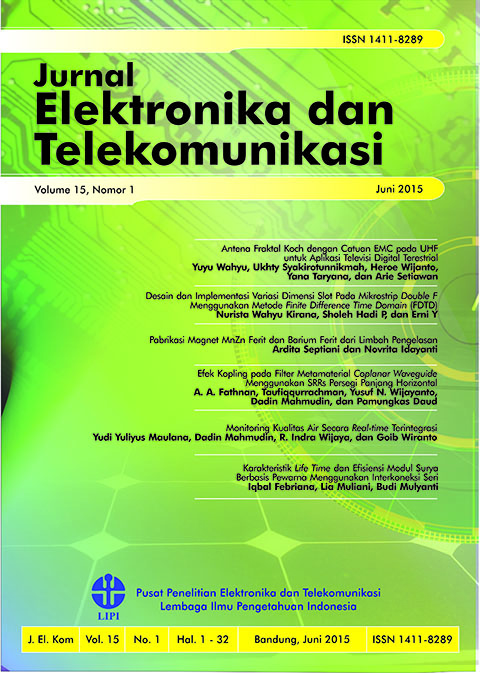
Efek Kopling pada Filter Metamaterial Coplanar Waveguide Menggunakan SRRs Persegi Panjang Horizontal
DOI:
https://doi.org/10.14203/jet.v15.18-22Keywords:
filter metamaterial, resonator cincin terbelah (SRRs) persegi panjang, coplanar waveguide, efek koplingAbstract
Dalam penelitian ini telah dilakukan pembuatan filter gelombang mikro menggunakan teknologi coplanar waveguide (CPW) yang dibebani dengan struktur metamaterial. Struktur metamaterial tersebut terdiri dari sepasang resonator cincin terbelah (split ring resonators/SRRs) berbentuk persegi panjang yang dicetak di belakang substrat dielektrik. Sementara itu, CPW dicetak dengan tambahan konektor kecil tepat di atas SRRs tersebut. Variasi panjang dan lebar dari SRRs persegi panjang (horizontal dan vertikal) telah dilakukan untuk melihat efek dari kopling antara saluran transmisi CPW ke SRRs. Variasi jarak antara sel-sel resonator (SRRs) juga telah disimulasikan untuk melihat efek dari kopling antara sel-sel yang berdekatan. Analisis dengan simulasi elektromagnetik dan data dari eksperimen telah menunjukkan bahwa kinerja bandwidth filter yang berbeda telah ditemukan dengan merubah struktur SRRs maupun dengan merubah jarak antara sel-sel resonator (SRRs). Telah ditemukan pula bahwa kontribusi yang signifikan dari kopling antara CPW ke SRRs menunjukkan bahwa SRRs persegi panjang horizontal dapat dimanfaatkan untuk meningkatkan performa filter. Hasil penelitian ini dapat digunakan untuk menganalisis konfigurasi geometris SRRs yang memberikan optimalisasi praktis paling baik untuk pembuatan filter metamaterial CPW.Downloads
References
J. Bonache, I. Gil, J. G. García, and F. Martín, “Novel microstrip bandpass filters based on complementary split-ring resonators”, IEEE Trans. Microw. Theory Tech., vol. 54, no. 1, pp. 265-271, Jan. 2006.
F. Martín, F. Falcone, J. Bonache, R. Marqués, and M. Sorolla, “Split ring resonator-based left-handed coplanar waveguide”, Appl. Phys. Lett., vol. 83, p. 4652, 2003.
G. V. Eleftheriades, A. K. Iyer, and P. C. Kremer, “Planar negative refractive index media using periodically L–C loaded transmission lines”, IEEE Trans. Microw. Theory Tech., vol. 50, no. 12, pp. 2702-2712, Dec. 2002.
M. A. Antoniades and G. V. Eleftheriades, “A broadband series power divider using zero-degree metamaterial phase shifting lines”, IEEE Microw. Wireless Compon. Lett., vol. 15, no. 11, pp. 808–810, Nov. 2005.
A. L. Borja, J. Carbonell, V. E. Boria, J. Cascon, and D. Lippens “2% bandwidth c-band filter using cascaded split ring resonators”, IEEE Antennas and Wireless Propagation Letters, vol. 9, pp 256-259, March 2010.
P. G. Balmaz and O. J. Martin “Electromagnetic resonances in individual and coupled split-ring resonators”, Journal of Appl. Phys., vol. 92, no. 5, p. 2929, Sept. 2002.
J. D. Baena, J. Bonache, F. Martín, R. Marqués, F. Falcone, T. Lopetegi, M.A.G. Laso, J. García, I Gil and M. Sorolla, “Equivalent circuit models for split ring resonators and complementary split rings resonators coupled to planar transmission lines”, IEEE Transactions on Microwave Theory and Techniques, vol. 53, pp. 1451-1461, April 2005.
F. Aznar, J. Bonache, and F. Martín “Improved circuit model for left-handed lines loaded with split ring resonators”, Appl. Phys. Lett. 92, 043512, 2008.
L. Su, J. Naqui, J. M. Contreras, and F. Martín “Modeling metamaterial transmission lines loaded with pairs of coupled split-ring resonators”, IEEE Antennas and Wireless Propagation Letters, vol. 14, pp. 68-71, 2015.
J. Naqui, A. F. Prieto, F. Mesa, F. Medina, and F. Martín “Effects of inter-resonator coupling in split ring resonator loaded metamaterial transmission lines,” Journal of Appl. Phys., 115, 194903, May 2014.
R. N. Simons, Coplanar Waveguide Circuits, Components and System, New York, NY-USA: John Willey and Sons, 2001, pp. 15-21.
Downloads
Published
Issue
Section
License
Authors who publish with this journal agree to the following terms:
The copyright to this article is transferred to BRIN if and when the article is accepted for publication. The undersigned hereby transfers any and all rights in and to the paper including without limitation all copyrights to BRIN. The undersigned hereby represents and warrants that the paper is original and that he/she is the author of the paper, except for material that is clearly identified as to its original source, with permission notices from the copyright owners where required. The undersigned represents that he/she has the power and authority to make and execute this assignment. The copyright transfer form can be downloaded here.
The corresponding author signs for and accepts responsibility for releasing this material on behalf of any and all co-authors. This agreement is to be signed by at least one of the authors who have obtained the assent of the co-author(s) where applicable. After submission of this agreement signed by the corresponding author, changes of authorship or in the order of the authors listed will not be accepted.

This work is licensed under a Creative Commons Attribution-NonCommercial-ShareAlike 4.0 International License.