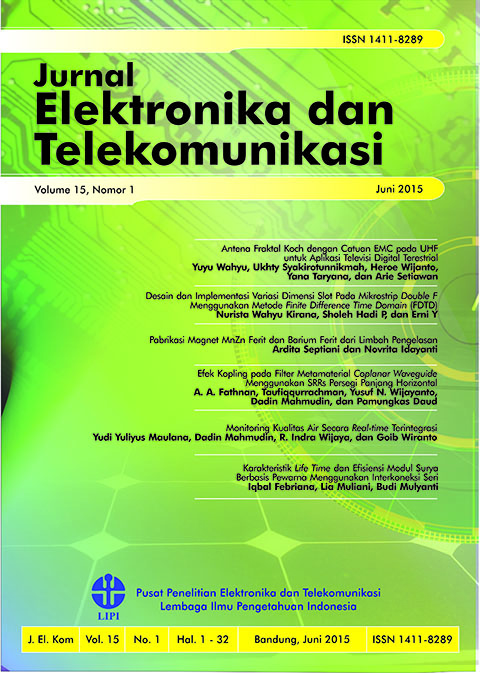
Desain dan Implementasi Variasi Dimensi Slot Pada Mikrostrip Double F Menggunakan Metode Finite Difference Time Domain (FDTD)
DOI:
https://doi.org/10.14203/jet.v15.6-13Keywords:
bandwidth, FDTD, returnloss, VSWR, gainAbstract
Pada penelitian ini dirancang antena mikrostrip dengan slot double F, di mana antena ini dapat digunakan untuk perangkat wireless yang bekerja pada frekuensi multiband. Antena mikrostrip double F dirancang dengan simulasi, dipabrikasi dan diukur secara riil. Finite Difference Time Domain (FDTD) digunakan untuk menganalisis karakteristik distribusi arus yang tersebar pada mikrostrip. Nilai parameter terbaik dari hasil simulasi untuk return loss adalah -31,09 dB pada frekuensi 2,4 GHz dan VSWR sebesar 1,057 sedangkan hasil pengukurannya sebesar -32,82 dB pada frekuensi 2,4 GHz dan VSWR sebesar 1,045. Penggunaan slot pada patch antena dan pencatuan proximity yang digunakan meningkatkan bandwidth antena sebesar 48,7% dan gain yang dihasilkan sebesar 5,97 dBi.
Downloads
References
T. Archevapanich, J. Nakasuwan, N. Songthanapitak, N. Anantrasirichai, and T. Wakabayashi “E-shaped slot antenna for WLAN applications”, PIERS Online, vol. 3, no. 7, pp. 1119-1123, 2007.
S. Kumar, A. K. Saurabh, and N. S. Beniwal, “Dual band H shaped rectangular microstrip patch antena for WLAN/WiMAX/bluetooth applications”, International Journal of Advanced Research in Electrical Electronics and Instrumentation Engineering, vol. 3, iss. 3, pp. 8220-8227, March 2014.
A. Haidery, R. Tawde, and T. Shaikh, “L-slot rectangular microstrip patch antena for WiMAX and WLAN applications”, International Journal of Emerging Technology and Advanced Engineering, vol. 3, iss. 10, pp. 471-474, Oct 2013.
M. Ravi and A. Janardhana “Design & performance analysis of double U-slot microstrip antena for WiMAX application”, International Journal of Advanced Research in Electronics and Communication Engineering (IJARECE), vol. 3, iss. 8, pp. 790- 795, August 2014.
R. S. Rathore, S. Baudha, and Shrikant Pandey, “A 2.4 GHz microstrip patch antena with a single slot for WLAN application”, International Journal of Advanced Research in Computer Engineering & Technology, vol. 1, iss. 4, pp. 139-141, June 2012.
B. Thili, “Design of double c-slot microstrip patch antena for WiMax application”, in Proceedings of 2010 IEEE Antennas and Propagation Society International Symposium (APSURSI), July 2010, pp. 1-4.
D. K. Karmokar and K. M. Morshed, “Analysis of inverted F and loaded inverted F antenna for 2,4 GHz ISM band application”, Journal of Electrical Engineering The Institution of Engineers Bangladesh, vol. EE 36, no. II, pp. 4-9, December 2009,
D. Sugumar, S. Sydney, D. Athina, and T. J. Selvahephzibah, “Bandwidth enhancement of coaxial feed U slotted microstrip antenna modeled with FDTD algorithm“, in Proceedings of IEEE International Conference on Computational Intelligence and Computing Research, 2010.
J. T. S Sumantyo, K. Ito, E. T. Rahardjo, dan K. Saito, Metoda Beda Hingga Kawasan Waktu, Bandung, Indonesia: Penerbit ITB, 2004.
A. N. Mahmud, S. S Obayya, A. A. Mitkees, and H. A. Elmikati, “FDTD analysis of a rectangular patch antena on a general uniaxial anisotropic dielectric substrate”. in Proceedings of Eighteen National Radio Science Conference, Mar 2001, pp. 131-141 (vol.1).
D. M. Sullivan, Electromagnetic Simulation Using The FDTD Method, New York, USA: John Wiley & Sons Inc., 2000.
N. Suherman, “Analisis dan pabrikasi mikrostrip horn dilengkapi reflektor parabola dengan metode FDTD”, Thesis, Institut Teknologi Sepuluh Nopember, Surabaya, Indonesia, 2008.
A. Hajiaboli, M. Popović, and F. H. Kashani, “Analysis of coaxial-fed electromagnetically coupled patch antenna using FDTD”, in Proceedings of IEEE 2005 Antennas and Propagation Society International Symposium, July 2005, pp. 138-141 (vol. 1A).
C. A. Balanis, Antena Theory: Analysis Design, 3rd ed., New Jersey, USA: John Wiley & Sons, Inc., 2005.
Downloads
Published
Issue
Section
License
Authors who publish with this journal agree to the following terms:
The copyright to this article is transferred to BRIN if and when the article is accepted for publication. The undersigned hereby transfers any and all rights in and to the paper including without limitation all copyrights to BRIN. The undersigned hereby represents and warrants that the paper is original and that he/she is the author of the paper, except for material that is clearly identified as to its original source, with permission notices from the copyright owners where required. The undersigned represents that he/she has the power and authority to make and execute this assignment. The copyright transfer form can be downloaded here.
The corresponding author signs for and accepts responsibility for releasing this material on behalf of any and all co-authors. This agreement is to be signed by at least one of the authors who have obtained the assent of the co-author(s) where applicable. After submission of this agreement signed by the corresponding author, changes of authorship or in the order of the authors listed will not be accepted.

This work is licensed under a Creative Commons Attribution-NonCommercial-ShareAlike 4.0 International License.