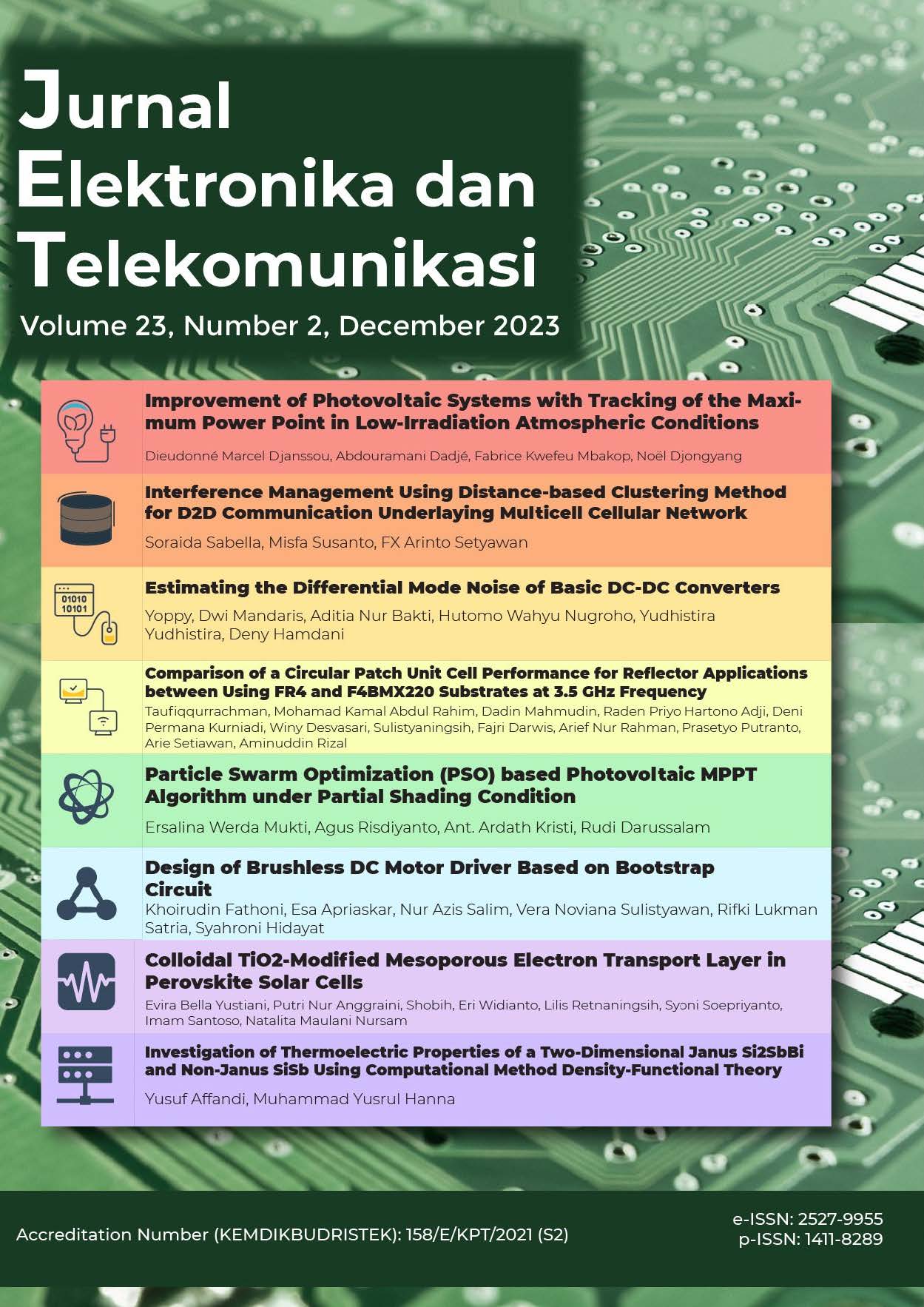
Investigation of Thermoelectric Properties of a Two-Dimensional Janus Si2SbBi and non-Janus SiSb using Computational Method Density-Functional Theory
DOI:
https://doi.org/10.55981/jet.567Keywords:
Thermoelectrics, electronicsAbstract
Two-dimensional materials are of considerable interest owing to their unique electronic and thermal properties. In this study, we investigate the thermoelectric (TE) potential of two-dimensional Janus Si2SbBi and compare it with that non-Janus SiSb based on the density-functional theory (DFT) calculations. According to the DFT calculations, both materials exhibit semiconductor properties with bandgaps of 0.728 eV (Janus Si2SbBi) and 0.82 eV (SiSb), respectively. Having information on the energy band structure, we evaluated TE properties using the Boltzmann transport equations as a function of Fermi energy as implemented in BoltzTraP2 code. We find a Seebeck coefficient of 1349 (1342) for -type ( -type) dopingat T = 300 K of the Si2SbBi monolayer. The results of our study present that the Janus Si2SbBi monolayer possesses a high Seebeck coefficient and electrical conductivity, leading to a substantial power factor (PF) of at 300 K. The PF increase with increase in temperature and has the highest peak value up to at 600 K. The results show that the Seebecek coefficient, electrical conductivity and power factor of the Janus Si2SbBi monolayer are greater compared to those of non-Janus SiSb monolayer. Our study presents Janus Si2SbBi as a potential thermoelectric candidate, highlighting its prospective use in advanced thermoelectric applications.
Downloads
References
M. A. Karri, E. F. Thacher, and B. T. Helenbrook, “Exhaust energy conversion by thermoelectric generator: two case studies,” Energy Convers. Manag., vol. 52, no. 3, pp. 1596–1611, 2011, doi: 10.1016/j.enconman.2010.10.013. Crossref
M. Aneke and M. Wang, “Energy storage technologies and real life applications – a state of the art review,” Appl. Energy, vol. 179, pp. 350–377, 2016, doi: 10.1016/j.apenergy.2016.06.097. Crossref
J. Yang et al., “On the tuning of electrical and thermal transport in thermoelectrics: an integrated theory-experiment perspective,” npj Comput. Mater., vol. 2, no. October 2015, 2016, doi: 10.1038/npjcompumats.2015.15. Crossref
Y. Tian and C. Y. Zhao, “A review of solar collectors and thermal energy storage in solar thermal applications,” Appl. Energy, vol. 104, pp. 538–553, 2013, doi: 10.1016/j.apenergy.2012.11.051. Crossref
D. G. Cahill et al., “Nanoscale thermal transport. ii. 2003-2012,” Appl. Phys. Rev., vol. 1, no. 1, 2014, doi: 10.1063/1.4832615. Crossref
B. Liao and G. Chen, “Nanocomposites for thermoelectrics and thermal engineering,” MRS Bull., vol. 40, no. 9, pp. 746–752, 2015, doi: 10.1557/mrs.2015.197. Crossref
Y. Affandi, M. A. U. Absor, and K. Abraha, “Effect of external electric field on spin-orbit splitting of the two-dimensional tungsten dichalcogenides wx 2 (x = s, se),” in J. Phys. Conf. Ser., 2018, vol. 1011, no. 1. doi: 10.1088/1742-6596/1011/1/012070. Crossref
Y. Affandi and M. A. Ulil Absor, “Electric field-induced anisotropic rashba splitting in two dimensional tungsten dichalcogenides wx2 (x: s, se, te): a first-principles study,” Phys. E Low-Dimensional Syst. Nanostructures, vol. 114, 2019, doi: 10.1016/j.physe.2019.113611. Crossref
M. Y. Hanna, E. H. Hasdeo, E. Suprayoga, and A. R. T. Nugraha, “Thermoelectric properties of two-dimensional hydrogenated borophene: a first-principles study,” AIP Conf. Proc., vol. 2256, no. September, 2020, doi: 10.1063/5.0014610. Crossref
K. Kaur, S. A. Khandy, S. Dhiman, U. B. Sharopov, and J. Singh, “Computational prediction of thermoelectric properties of 2d materials,” Electron. Struct., vol. 4, no. 2, 2022, doi: 10.1088/2516-1075/ac635b. Crossref
J. O. Morales-Ferreiro, D. E. Diaz-Droguett, D. Celentano, and T. Luo, “First-principles calculations of thermoelectric properties of iv–vi chalcogenides 2d materials,” Front. Mech. Eng., vol. 3, no. December, pp. 1–10, 2017, doi: 10.3389/fmech.2017.00015. Crossref
J. H. Yang, Q. Yuan, H. Deng, S. H. Wei, and B. I. Yakobson, “Earth-abundant and non-toxic six (x = s, se) monolayers as highly efficient thermoelectric materials,” J. Phys. Chem. C, vol. 121, no. 1, pp. 123–128, 2017, doi: 10.1021/acs.jpcc.6b10163. Crossref
R. N. Somaiya, Y. A. Sonvane, and S. K. Gupta, “Exploration of the strain and thermoelectric properties of hexagonal six (x= n, p, as, sb, and bi) monolayers,” Phys. Chem. Chem. Phys., vol. 22, no. 7, pp. 3990–3998, 2020. Crossref
S. Babaee Touski and N. Ghobadi, “Structural, electrical, and rashba properties of monolayer janus si2xy (x,y =p, as, sb, and bi),” Phys. Rev. B, vol. 103, no. 16, 2021, doi: 10.1103/PhysRevB.103.165404. Crossref
A. Lukmantoro and M. A. U. Absor, “Anisotropic rashba splitting dominated by out-of-plane spin polarization in two-dimensional janus xa_2 y (a= si, sn, ge; x,y= sb, bi) with surface imperfection,” pp. 1–28, 2023, [Online]. Available: http://arxiv.org/abs/2308.06761. Crossref
P. Giannozzi et al., “QUANTUM espresso: a modular and open-source software project for quantum simulations of materials,” J. Phys. Condens. Matter, vol. 21, no. 39, 2009, doi: 10.1088/0953-8984/21/39/395502. Crossref
G. K. H. Madsen and D. J. Singh, “BoltzTraP. a code for calculating band-structure dependent quantities,” Comput. Phys. Commun., vol. 175, no. 1, pp. 67–71, 2006, doi: 10.1016/j.cpc.2006.03.007. Crossref
J. P. Perdew, K. Burke, and M. Ernzerhof, “Generalized gradient approximation made simple,” Phys. Rev. Lett., vol. 77, no. 18, pp. 3865–3868, 1996, doi: 10.1103/PhysRevLett.77.3865. Crossref
D. Vanderbilt, “Soft self-consistent pseudopotentials in a generalized eigenvalue formalism,” Phys. Rev. B, vol. 41, no. 11, p. 7892, 1990. Crossref
M. Kawamura, Y. Gohda, and S. Tsuneyuki, “Improved tetrahedron method for the brillouin-zone integration applicable to response functions,” Phys. Rev. B - Condens. Matter Mater. Phys., vol. 89, no. 9, pp. 1–9, 2014, doi: 10.1103/PhysRevB.89.094515. Crossref
H. J. Goldsmid and others, Introduction to thermoelectricity, vol. 121. Springer, 2010.
M. Khazaei, M. Arai, T. Sasaki, M. Estili, and Y. Sakka, “Two-dimensional molybdenum carbides: potential thermoelectric materials of the mxene family,” Phys. Chem. Chem. Phys., vol. 16, no. 17, pp. 7841–7849, 2014. Crossref
K. Kaur, D. Murali, and B. R. K. Nanda, “Stretchable and dynamically stable promising two-dimensional thermoelectric materials: scp and scas,” J. Mater. Chem. A, vol. 7, no. 20, pp. 12604–12615, 2019. Crossref
A. F. Wani, B. Rani, S. Dhiman, U. B. Sharopov, and K. Kaur, “SiH monolayer: a promising two-dimensional thermoelectric material,” Int. J. Energy Res., vol. 46, no. 8, pp. 10885–10893, 2022, doi: 10.1002/er.7889. Crossref
A. Bafekry, F. Shojai, D. M. Hoat, M. Shahrokhi, M. Ghergherehchi, and C. Nguyen, “The mechanical, electronic, optical and thermoelectric properties of two-dimensional honeycomb-like of xsb (x = si, ge, sn) monolayers: a first-principles calculations,” RSC Adv., vol. 10, no. 51, pp. 30398–30405, 2020, doi: 10.1039/d0ra05587e. Crossref
M. G. Holland, “Analysis of lattice thermal conductivity,” Phys. Rev., vol. 132, no. 6, pp. 2461–2471, Dec. 1963, doi: 10.1103/PhysRev.132.2461. Crossref
M. Jonson and G. D. Mahan, “Mott’s formula for the thermopower and the wiedemann-franz law,” Phys. Rev. B, vol. 21, no. 10, pp. 4223–4229, May 1980, doi: 10.1103/PhysRevB.21.4223. Crossref
S. Nath, “Thermoelectric and optical properties of 2d hexagonal dirac material be 3 x 2 (x = c, si, ge, sn): a density functional theory study,” J. Appl. Phys., vol. 130, p. 55106, 2021, doi: 10.1063/5.0059942. Crossref
Downloads
Published
Issue
Section
License
Authors who publish with this journal agree to the following terms:
The copyright to this article is transferred to BRIN if and when the article is accepted for publication. The undersigned hereby transfers any and all rights in and to the paper including without limitation all copyrights to BRIN. The undersigned hereby represents and warrants that the paper is original and that he/she is the author of the paper, except for material that is clearly identified as to its original source, with permission notices from the copyright owners where required. The undersigned represents that he/she has the power and authority to make and execute this assignment. The copyright transfer form can be downloaded here.
The corresponding author signs for and accepts responsibility for releasing this material on behalf of any and all co-authors. This agreement is to be signed by at least one of the authors who have obtained the assent of the co-author(s) where applicable. After submission of this agreement signed by the corresponding author, changes of authorship or in the order of the authors listed will not be accepted.

This work is licensed under a Creative Commons Attribution-NonCommercial-ShareAlike 4.0 International License.