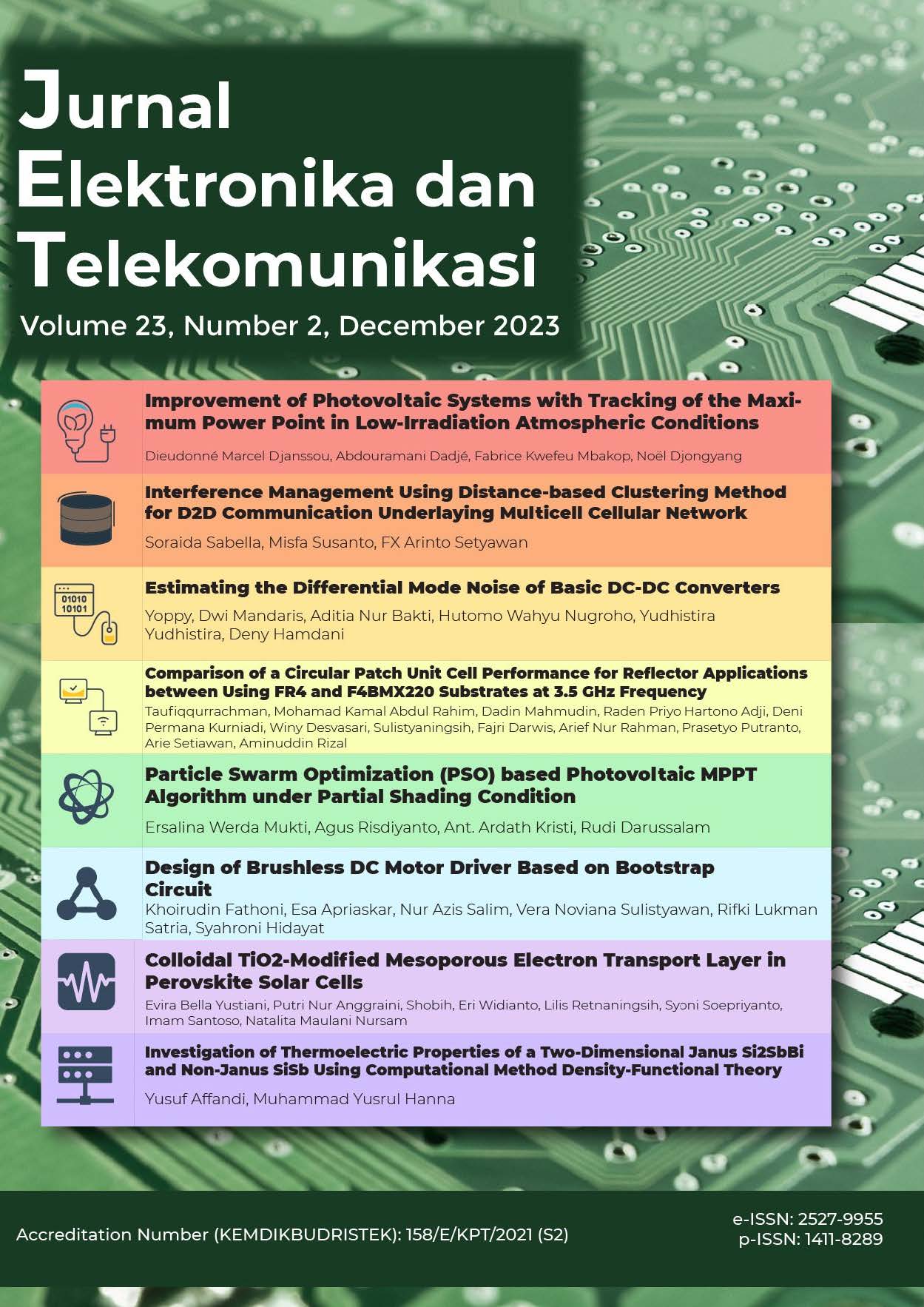
Interference Management Using Distance-based Clustering Method for D2D Communication Underlaying Multicell Cellular Network
DOI:
https://doi.org/10.55981/jet.566Keywords:
D2D communication, in-band underlay, multicell, clustering, downlink transmissionAbstract
Device-to-Device (D2D) communication is a technology candidate to support the next generation of cellular communication networks. D2D has the potential to boost the efficiency of frequency resources and system capacity. Generally, D2D performs in-band underlaying or shares frequency channels with traditional cellular users, which can cause co-channel interference problems between these two types of users. This paper offers a solution through a clustering technique for D2D users (DUEs) to reduce interference among DUEs. Clustering technique is performed on DUEs by allocating different frequency channels in a group, in order to reduce the interference effects experienced. Thus, it is expected that through this proposed method, both D2D and cellular users can experience better signal quality with minimal interference effects. Two systems have been considered i.e., the conventional/baseline system and the system with the proposed clustering method. The simulation results show that the SINR (Signal to Interference plus Noise Ratio) values and throughput for the proposed system compared to the baseline system has increased. The SINR result obtained is 16.8 dB for the baseline system and 17.68 dB for the proposed system, and resulting an improvement of 5.4%. Therefore, applying the proposed clustering method is able to increase acceptability of the desired signals for the observed DUEs. Then, the throughput value also increases by 5%, i.e., from 56.17 to 59 Mbps, which the system with the proposed clustering method provides a better increase in data transmission speed compared to the baseline system.Downloads
References
J. Tang, G. Chen, and J. P. Coon, “Joint coverage enhancement by power allocation in poisson clustered out-of-band D2D networks,” IEEE Trans Veh Technol, vol. 67, no. 12, pp. 11537–11548, 2018, doi: 10.1109/TVT.2018.2871065. Crossref
Y. Chen, B. Ai, Y. Niu, R. He, Z. Zhong, and Z. Han, “Resource allocation for device-to-device communications in multi-cell multi-band heterogeneous cellular networks,” IEEE Trans Veh Technol, vol. 68, no. 5, pp. 4760–4773, 2019, doi: 10.1109/TVT.2019.2903858. Crossref
J. Lyu, H.-M. Wang, and K.-W. Huang, “Physical layer security in D2d underlay cellular networks with poisson cluster process,” IEEE Transactions on Communications, vol. 68, no. 11, pp. 7123–7139, 2020, doi: 10.1109/TCOMM.2020.3017287. Crossref
L. Han, Y. Zhang, X. Zhang, and J. Mu, “Power control for full-duplex D2D communications underlaying cellular networks,” IEEE Access, vol. 7, pp. 111858–111865, 2019, doi: 10.1109/ACCESS.2019.2934479. Crossref
O. Hayat, R. Ngah, S. Z. Mohd Hashim, M. H. Dahri, R. Firsandaya Malik, and Y. Rahayu, “Device discovery in D2D communication: a survey,” IEEE Access, vol. 7, pp. 131114–131134, 2019, doi: 10.1109/ACCESS.2019.2941138. Crossref
M. I. Poulakis, A. G. Gotsis, and A. Alexiou, “Multicell device-to-device communication: a spectrum-sharing and densification study,” IEEE Vehicular Technology Magazine, vol. 13, no. 1, pp. 85–96, 2018, doi: 10.1109/MVT.2017.2782371. Crossref
M. Gharbieh, A. Bader, H. ElSawy, H.-C. Yang, M.-S. Alouini, and A. Adinoyi, “Self-organized scheduling request for uplink 5G networks: a D2D clustering approach,” IEEE Transactions on Communications, vol. 67, no. 2, pp. 1197–1209, 2019, doi: 10.1109/TCOMM.2018.2876008. Crossref
E. Turgut and M. C. Gursoy, “Uplink performance analysis in D2D-enabled millimeter-wave cellular networks with clustered users,” IEEE Trans Wirel Commun, vol. 18, no. 2, pp. 1085–1100, 2019, doi: 10.1109/TWC.2018.2889755. Crossref
L. Eslami, G. Mirjalily, and T. N. Davidson, “Spectrum-efficient QoS-aware resource assignment for FFR-based D2D-enabled heterogeneous networks,” IEEE Access, vol. 8, pp. 218186–218198, 2020, doi: 10.1109/ACCESS.2020.3041770. Crossref
H. A. Mustafa, A. R. Ekti, M. Z. Shakir, M. A. Imran, and R. Tafazolli, “Intracell interference characterization and cluster interference for D2D communication,” IEEE Trans Veh Technol, vol. 67, no. 9, pp. 8536–8548, 2018, doi: 10.1109/TVT.2018.2850820. Crossref
A. Ghazanfari, E. Björnson, and E. G. Larsson, “Power control for D2D underlay in multi-cell massive mimo networks,” in WSA 2018; 22nd International ITG Workshop on Smart Antennas, 2018, pp. 1–6. Crossref
M. S. M. Gismalla et al., “Survey on device to device (D2D) communication for 5GB/6G networks: concept, applications, challenges, and future directions,” IEEE Access, vol. 10, pp. 30792–30821, 2022, doi: 10.1109/ACCESS.2022.3160215. Crossref
A. Asadi, Q. Wang, and V. Mancuso, “A survey on device-to-device communication in cellular networks,” IEEE Communications Surveys & Tutorials, vol. 16, no. 4, pp. 1801–1819, 2014, doi: 10.1109/COMST.2014.2319555. Crossref
A. M. H. Alibraheemi et al., “A survey of resource management in D2D communication for B5G networks,” IEEE Access, vol. 11, pp. 7892–7923, 2023, doi: 10.1109/ACCESS.2023.3238799. Crossref
L. Nadeem et al., “Integration of D2D, network slicing, and MEC in 5G cellular networks: survey and challenges,” IEEE Access, vol. 9, pp. 37590–37612, 2021, doi: 10.1109/ACCESS.2021.3063104. Crossref
H. Wu, X. Gao, S. Xu, D. O. Wu, and P. Gong, “Proximate device discovery for D2D communication in LTE advanced: challenges and approaches,” IEEE Wirel Commun, vol. 27, no. 4, pp. 140–147, 2020, doi: 10.1109/MWC.001.1900497. Crossref
L. Han, R. Zhou, Y. Li, B. Zhang, and X. Zhang, “Power control for two-way af relay assisted D2D communications underlaying cellular networks,” IEEE Access, vol. 8, pp. 151968–151975, 2020, doi: 10.1109/ACCESS.2020.3017799. Crossref
S. W. H. Shah, A. N. Mian, S. Mumtaz, A. Al-Dulaimi, C.-L. I, and J. Crowcroft, “Statistical QoS analysis of reconfigurable intelligent surface-assisted D2D communication,” IEEE Trans Veh Technol, vol. 71, no. 7, pp. 7343–7358, 2022, doi: 10.1109/TVT.2022.3165467. Crossref
Z. Ma, N. Nuermaimaiti, H. Zhang, H. Zhou, and A. Nallanathan, “Deployment model and performance analysis of clustered D2D caching networks under cluster-centric caching strategy,” IEEE Transactions on Communications, vol. 68, no. 8, pp. 4933–4945, 2020, doi: 10.1109/TCOMM.2020.2992053. Crossref
L. Yang, D. Wu, Y. Cai, X. Shi, and Y. Wu, “Learning-based user clustering and link allocation for content recommendation based on D2D multicast communications,” IEEE Trans Multimedia, vol. 22, no. 8, pp. 2111–2125, 2020, doi: 10.1109/TMM.2019.2949434. Crossref
L. Yang, D. Wu, S. Xu, G. Zhang, and Y. Cai, “Social-energy-aware user clustering for content sharing based on D2D multicast communications,” IEEE Access, vol. 6, pp. 36092–36104, 2018, doi: 10.1109/ACCESS.2018.2849204. Crossref
S. Solaiman, L. Nassef, and E. Fadel, “User clustering and optimized power allocation for D2D communications at mmWave underlaying MIMO-NOMA cellular networks,” IEEE Access, vol. 9, pp. 57726–57742, 2021, doi: 10.1109/ACCESS.2021.3071992. Crossref
M. Alias, N. Saxena, and A. Roy, “Efficient cell outage detection in 5G HetNets using hidden markov model,” IEEE Communications Letters, vol. 20, no. 3, pp. 562–565, 2016, doi: 10.1109/LCOMM.2016.2517070. Crossref
M. Susanto, A. Abadi, Herlinawati, and A. Trisanto, “Uplink power control based on sinr for D2D enabled in cellular communication network,” J Phys Conf Ser, vol. 1376, no. 1, p. 12019, Nov. 2019, doi: 10.1088/1742-6596/1376/1/012019. Crossref
S. Sabella, M. Susanto, F. X. A. Setyawan, and F. Hamdani, “Soft FFR scheme for distributed D2D communication in multicell of cellular communication networks,” in 2022 IEEE International Conference on Communication, Networks and Satellite (COMNETSAT), 2022, pp. 456–462. doi: 10.1109/COMNETSAT56033.2022.9994505. Crossref
C. Padmaja and B. L. Malleswari, “Bit error rate analysis of 4G communication systems,” in 2016 Thirteenth International Conference on Wireless and Optical Communications Networks (WOCN), 2016, pp. 1–5. doi: 10.1109/WOCN.2016.7759874. Crossref
M. U. A. Siddiqui, F. Qamar, F. Ahmed, Q. N. Nguyen, and R. Hassan, “Interference management in 5G and beyond network: requirements, challenges and future directions,” IEEE Access, vol. 9, pp. 68932–68965, 2021, doi: 10.1109/ACCESS.2021.3073543. Crossref
J. Wang and S. Wang, “A resource allocation algorithm based on DILA for D2D communication in LTE-A multi-cell network,” in 2018 IEEE 3rd Advanced Information Technology, Electronic and Automation Control Conference (IAEAC), 2018, pp. 114–117. doi: 10.1109/IAEAC.2018.8577792. Crossref
Downloads
Published
Issue
Section
License
Authors who publish with this journal agree to the following terms:
The copyright to this article is transferred to BRIN if and when the article is accepted for publication. The undersigned hereby transfers any and all rights in and to the paper including without limitation all copyrights to BRIN. The undersigned hereby represents and warrants that the paper is original and that he/she is the author of the paper, except for material that is clearly identified as to its original source, with permission notices from the copyright owners where required. The undersigned represents that he/she has the power and authority to make and execute this assignment. The copyright transfer form can be downloaded here.
The corresponding author signs for and accepts responsibility for releasing this material on behalf of any and all co-authors. This agreement is to be signed by at least one of the authors who have obtained the assent of the co-author(s) where applicable. After submission of this agreement signed by the corresponding author, changes of authorship or in the order of the authors listed will not be accepted.

This work is licensed under a Creative Commons Attribution-NonCommercial-ShareAlike 4.0 International License.