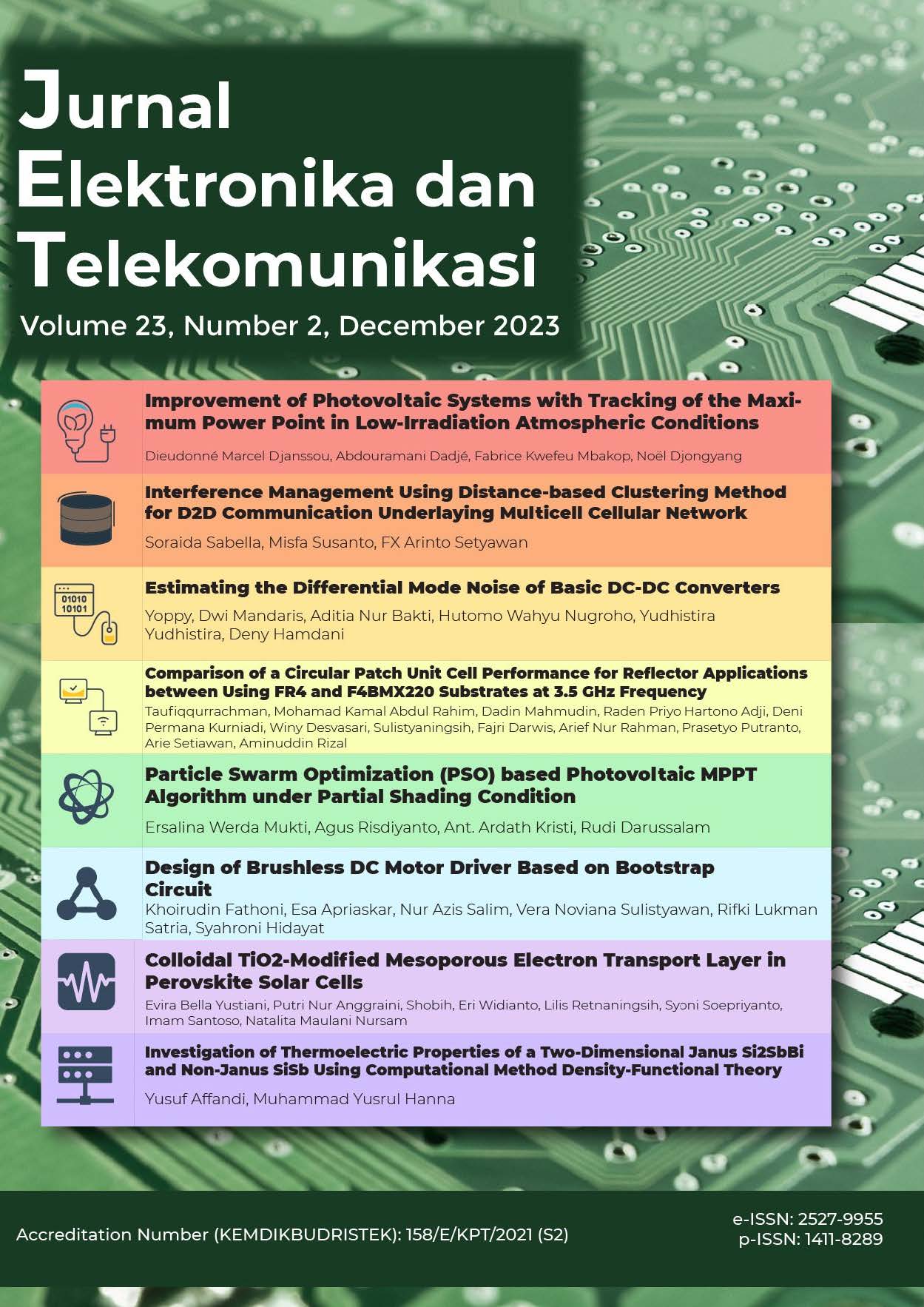
Estimating the Differential Mode Noise of a DC-DC Converter
DOI:
https://doi.org/10.55981/jet.558Keywords:
buck converter, boost converter, complex impedance, differential mode noise, input capacitorAbstract
Electromagnetic noise emission is inevitable in a DC-DC converter due to the employed switching technique. In low frequency, the noise propagating through cabling and conductive media is called a conducted emission. A conducted emission consists of differential mode and common mode noise. It is advantageous to know an estimate of emission level for each mode during the design phase so that suitable mitigation can be included earlier.. This paper aims to focus on a method to estimate the differential mode noise emission of a DC-DC converter. The estimation is computed using the input capacitor complex impedance and the current that flows through it. As a study case, a boost and buck converters are used for evaluation. The estimation and measurement results are compared. Despite differences at some frequencies, the estimated and measured results generally agree well. Because of its simplicity, the proposed method can be used as a practical tool in the EMC aspect of DC-DC converter design.Downloads
References
S. Wang, F. C. Lee, and W. G. Odendaal, “Characterization, evaluation, and design of noise separator for conducted emi noise diagnosis,” IEEE Transactions on Power Electronics, 2005, doi: 10.1109/TPEL.2005.850978. Crossref
C. R. Paul and K. B. Hardin, “Diagnosis and reduction of conducted noise emissions,” IEEE Transactions on Electromagnetic Compatibility, 1988, doi: 10.1109/15.8769. Crossref
T. Guo, D. Y. Chen, and F. C. Lee, “Separation of the common-mode- and differential-mode-conducted emi noise,” IEEE Transactions on Power Electronics, 1996, doi: 10.1109/63.491642. Crossref
A. Boyer, M. A. G. Sentis, C. Ghfiri, and A. Durier, “Modeling methodology of the conducted emission of a dc-dc converter board,” 2017. doi: 10.1109/EMCCompo.2017.7998085. Crossref
A. Hamouda, Z. Riah, F. Ndagijimana, and S. Serpaud, “Development of electronic board conducted emissions model ebem-ce using the bottom-up approach,” 2014. doi: 10.1109/EMCEurope.2014.6931004. Crossref
A. Durier, C. Marot, and O. Crepel, “Using the em simulation tools to predict the conducted emissions level of a dc/dc boost converter: introducing ebem-ce model,” 2013. doi: 10.1109/EMCCompo.2013.6735191. Crossref
P. Kong, Y. Jiang, and F. C. Lee, “Common mode emi noise characteristics of low-power ac-dc converters,” IEEE Transactions on Power Electronics, 2012, doi: 10.1109/TPEL.2011.2162100. Crossref
S. Zhang, B. Zhang, and M. Shoyama, “Modeling and prediction of common-mode conducted noise in boost converter with terminal port theory,” 2019. doi: 10.23919/icpe2019-ecceasia42246.2019.8797342. Crossref
E. Rogers, “Understanding boost power stages in switchmode power suppliies,” 1999.
J. Hubner, “Power supply design tutorial (part 1-2) – topologies and fundamentals,” 2018. https://www.powerelectronicsnews.com/power-supply-design-tutorial-part-1-2-topologies-and-fundamentals-continued/ (accessed Mar. 10, 2023).
Mayerhofer, “TBL0550-1 5µh line impedance stabilisation network manual,” 2021.
Mayerhofer, “TBLM1 lisn-mate user manual.” Tekbox, 2020.
Yoppy, D. Mandaris, A. N. Bakti, H. W. Nugroho, Y. Yudhistira, and D. Hamdani, “Estimating the differential mode emission of a boost converter based on the input capacitor series resistance.” 2023 IEEE 7th Global Electromagnetic Compatibility Conference (GEMCCON), Nusa Dua, Indonesia, 2023, pp. 68-69, doi: 10.1109/GEMCCON57842.2023.10078212. Crossref
Downloads
Published
Issue
Section
License
Authors who publish with this journal agree to the following terms:
The copyright to this article is transferred to BRIN if and when the article is accepted for publication. The undersigned hereby transfers any and all rights in and to the paper including without limitation all copyrights to BRIN. The undersigned hereby represents and warrants that the paper is original and that he/she is the author of the paper, except for material that is clearly identified as to its original source, with permission notices from the copyright owners where required. The undersigned represents that he/she has the power and authority to make and execute this assignment. The copyright transfer form can be downloaded here.
The corresponding author signs for and accepts responsibility for releasing this material on behalf of any and all co-authors. This agreement is to be signed by at least one of the authors who have obtained the assent of the co-author(s) where applicable. After submission of this agreement signed by the corresponding author, changes of authorship or in the order of the authors listed will not be accepted.

This work is licensed under a Creative Commons Attribution-NonCommercial-ShareAlike 4.0 International License.