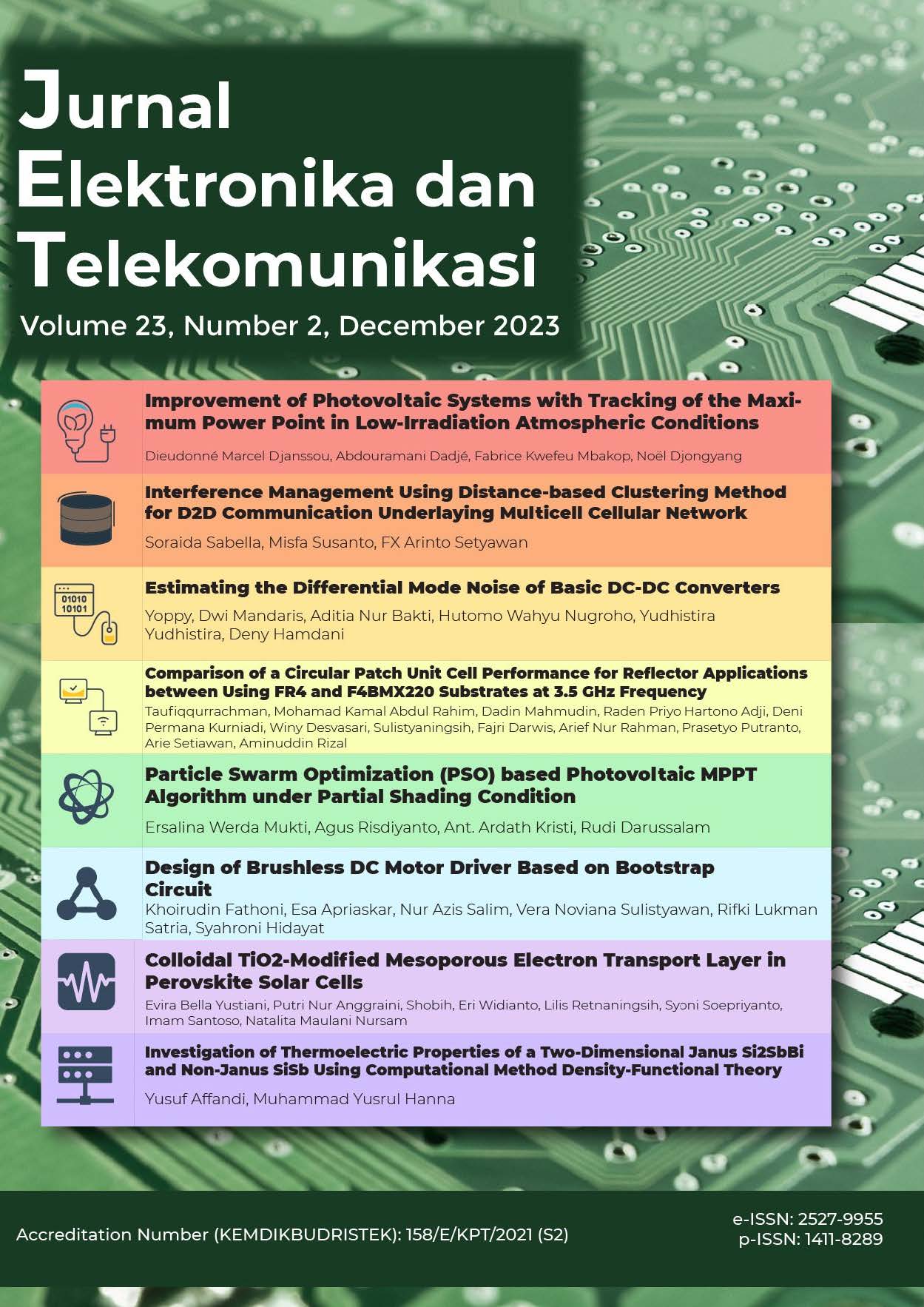
Improvement of photovoltaic systems with tracking of the maximum power point in low-irradiation atmospheric conditions
DOI:
https://doi.org/10.55981/jet.544Keywords:
low irradiation, MPPT, PI regulator, fuzzy logic, PSO, sliding mode.Abstract
This paper discusses the efficient use of photovoltaic energy in areas with low solar irradiation. To extract the maximum power at low irradiation, we used a maximum power point tracking (MPPT) algorithm based on the combination of fuzzy logic (FL) and the sliding mode (SM) associated with a Proportionnel-Intégral (PI) regulator. The system parameters are calculated using the particle swarm optimization (PSO) technique, which thus ensures the stability of the controller. The performance of the proposed technique is compared with the conventional perturb and observe (P&O) technique in terms of tracking time and tracking efficiency at low irradiation. The simulation results prove that the technique has high tracking efficiency and less convergence time under low irradiation, with fewer power oscillations, low ripple and no overshoot.
Downloads
References
R. Signerski, “Materials science in semiconductor processing effect of band gap on power conversion efficiency of single-junction semiconductor photovoltaic cells under white light phosphor-based led illumination,” vol. 107, no. November 2019, 2020, doi: 10.1016/j.mssp.2019.104812. https://doi.org/10.1016/j.mssp.2019.104812">Crossref
S. Sumathi, L. Ashok Kumar, and P. Surekha, Solar PV and Wind Energy Conversion Systems: Introduction to Theory, Modeling with MATLAB/SIMULINK, and the Role of Soft Computing Techniques. 2015. [Online]. Available: http://link.springer.com/10.1007/978-3-319-14941-7. Crossref
M. Kermadi and E. M. Berkouk, “Artificial intelligence-based maximum power point tracking controllers for photovoltaic systems: comparative study,” Renew. Sustain. Energy Rev., vol. 69, no. February 2016, pp. 369–386, 2017, doi: 10.1016/j.rser.2016.11.125. Crossref
A. Dadjé, N. Djongyang, J. D. Kana, and R. Tchinda, “Maximum power point tracking methods for photovoltaic systems operating under partially shaded or rapidly variable insolation conditions: a review paper,” Int. J. Sustain. Eng., vol. 9, no. 4, pp. 224–239, 2016, doi: 10.1080/19397038.2016.1149525. Crossref
M. Premkumar and R. Sowmya, “An effective maximum power point tracker for partially shaded solar photovoltaic systems,” Energy Reports, vol. 5, pp. 1445–1462, 2019, doi: 10.1016/j.egyr.2019.10.006. Crossref
S. Mohanty, B. Subudhi, and P. K. Ray, “A new mppt design using grey wolf optimization technique for photovoltaic system under partial shading conditions,” IEEE Trans. Sustain. Energy, vol. 7, no. 1, pp. 181–188, 2016, doi: 10.1109/TSTE.2015.2482120. Crossref
C. Huang, L. Wang, R. S. C. Yeung, Z. Zhang, H. S. H. Chung, and A. Bensoussan, “A prediction model-guided jaya algorithm for the pv system maximum power point tracking,” IEEE Trans. Sustain. Energy, vol. 9, no. 1, pp. 45–55, 2018, doi: 10.1109/TSTE.2017.2714705. Crossref
A. Badis, M. N. Mansouri, and M. H. Boujmil, “A genetic algorithm optimized mppt controller for a pv system with dc-dc boost converter,” Proc. - 2017 Int. Conf. Eng. MIS, ICEMIS 2017, vol. 2018-Janua, pp. 1–6, 2018, doi: 10.1109/ICEMIS.2017.8273010. Crossref
A. soufyane Benyoucef, A. Chouder, K. Kara, S. Silvestre, and O. A. Sahed, “Artificial bee colony based algorithm for maximum power point tracking (mppt) for pv systems operating under partial shaded conditions,” Appl. Soft Comput. J., vol. 32, pp. 38–48, 2015, doi: 10.1016/j.asoc.2015.03.047. Crossref
A. El Khateb, N. A. Rahim, J. Selvaraj, and M. N. Uddin, “Fuzzy logic controller based sepic converter of maximum power point tracking,” Conf. Rec. - IAS Annu. Meet. (IEEE Ind. Appl. Soc., pp. 1–9, 2012, doi: 10.1109/IAS.2012.6374024. Crossref
J. Ahmed and Z. Salam, “A critical evaluation on maximum power point tracking methods for partial shading in pv systems,” Renew. Sustain. Energy Rev., vol. 47, pp. 933–953, 2015, doi: 10.1016/j.rser.2015.03.080. Crossref
D. M. Djanssou, A. Dadjé, A. Tom, and N. Djongyang, “Improvement of the dynamic response of robust sliding mode mppt controller-based pso algorithm for pv systems under fast-changing atmospheric conditions,” Int. J. Photoenergy, vol. 2021, 2021, doi: 10.1155/2021/6671133. Crossref
A. Dadjé et al., “Journal of solar energy research ( jser ) modified social network search algorithm combined with halley ’ s method for parameter estimation in a photovoltaic cell , module , and array,” vol. 8, no. 2, pp. 1484–1496, 2023, doi: 10.22059/jser.2023.357161.1287.
D. M. Djanssou, A. Dadjé, and N. Djongyang, “Estimation of photovoltaic cell parameters using the honey badger algorithm,” Int. J. Eng. Adv. Technol., vol. 11, no. 5, pp. 109–124, 2022, doi: 10.35940/ijeat.e3552.0611522. Crossref
H. Yatimi and E. Aroudam, “Assessment and control of a photovoltaic energy storage system based on the robust sliding mode mppt controller,” Sol. Energy, vol. 139, pp. 557–568, 2016, doi: 10.1016/j.solener.2016.10.038. Crossref
A. Dadjé, F. K. Mbakop, D. M. Djanssou, and R. Z. Falama, “Modeling the behavior of a photovoltaic generator using a four-parameter electrical model 2 . modeling the photovoltaic generator using a four-parameter electrical model,” vol. 6, no. 1, pp. 5–12, 2022, doi: 10.11648/j.ep.20220601.12.
Y. A. Mindzie, J. Kenfack, V. Joseph, U. Nzotcha, D. M. Djanssou, and R. Mbounguen, “Dynamic performance improvement using model reference adaptive control of photovoltaic systems under fast-changing atmospheric conditions,” Int. J. Photoenergy, vol. 2023, 2023, doi: 10.1155/2023/5703727. Crossref
M. Kumar and A. Kumar, “An efficient parameters extraction technique of photovoltaic models for performance assessment,” Sol. Energy, vol. 158, no. September, pp. 192–206, 2017, doi: 10.1016/j.solener.2017.09.046. Crossref
J. Bai, S. Liu, Y. Hao, Z. Zhang, M. Jiang, and Y. Zhang, “Development of a new compound method to extract the five parameters of pv modules,” Energy Convers. Manag., vol. 79, pp. 294–303, 2014, doi: 10.1016/j.enconman.2013.12.041. Crossref
C. C. Ahmed, M. Cherkaoui, and M. Mokhlis, “MPPT control for photovoltaic system using hybrid method under variant weather condition,” 2019 Int. Conf. Wirel. Technol. Embed. Intell. Syst. WITS 2019, pp. 1–5, 2019, doi: 10.1109/WITS.2019.8723854. Crossref
M. R. Mojallizadeh, M. Badamchizadeh, S. Khanmohammadi, and M. Sabahi, “Designing a new robust sliding mode controller for maximum power point tracking of photovoltaic cells,” Sol. Energy, vol. 132, pp. 538–546, 2016, doi: 10.1016/j.solener.2016.03.038. Crossref
C. Lascu, I. Boldea, and F. Blaabjerg, “Direct torque control of sensorless induction motor drives: a sliding-mode approach,” IEEE Trans. Ind. Appl., vol. 40, no. 2, pp. 582–590, 2004, doi: 10.1109/TIA.2004.824441. Crossref
M. O. Okwu and L. K. Tartibu, “Particle swarm optimisation,” Stud. Comput. Intell., vol. 927, pp. 5–13, 2021, doi: 10.1007/978-3-030-61111-8_2. Crossref
Downloads
Published
Issue
Section
License
Authors who publish with this journal agree to the following terms:
The copyright to this article is transferred to BRIN if and when the article is accepted for publication. The undersigned hereby transfers any and all rights in and to the paper including without limitation all copyrights to BRIN. The undersigned hereby represents and warrants that the paper is original and that he/she is the author of the paper, except for material that is clearly identified as to its original source, with permission notices from the copyright owners where required. The undersigned represents that he/she has the power and authority to make and execute this assignment. The copyright transfer form can be downloaded here.
The corresponding author signs for and accepts responsibility for releasing this material on behalf of any and all co-authors. This agreement is to be signed by at least one of the authors who have obtained the assent of the co-author(s) where applicable. After submission of this agreement signed by the corresponding author, changes of authorship or in the order of the authors listed will not be accepted.

This work is licensed under a Creative Commons Attribution-NonCommercial-ShareAlike 4.0 International License.