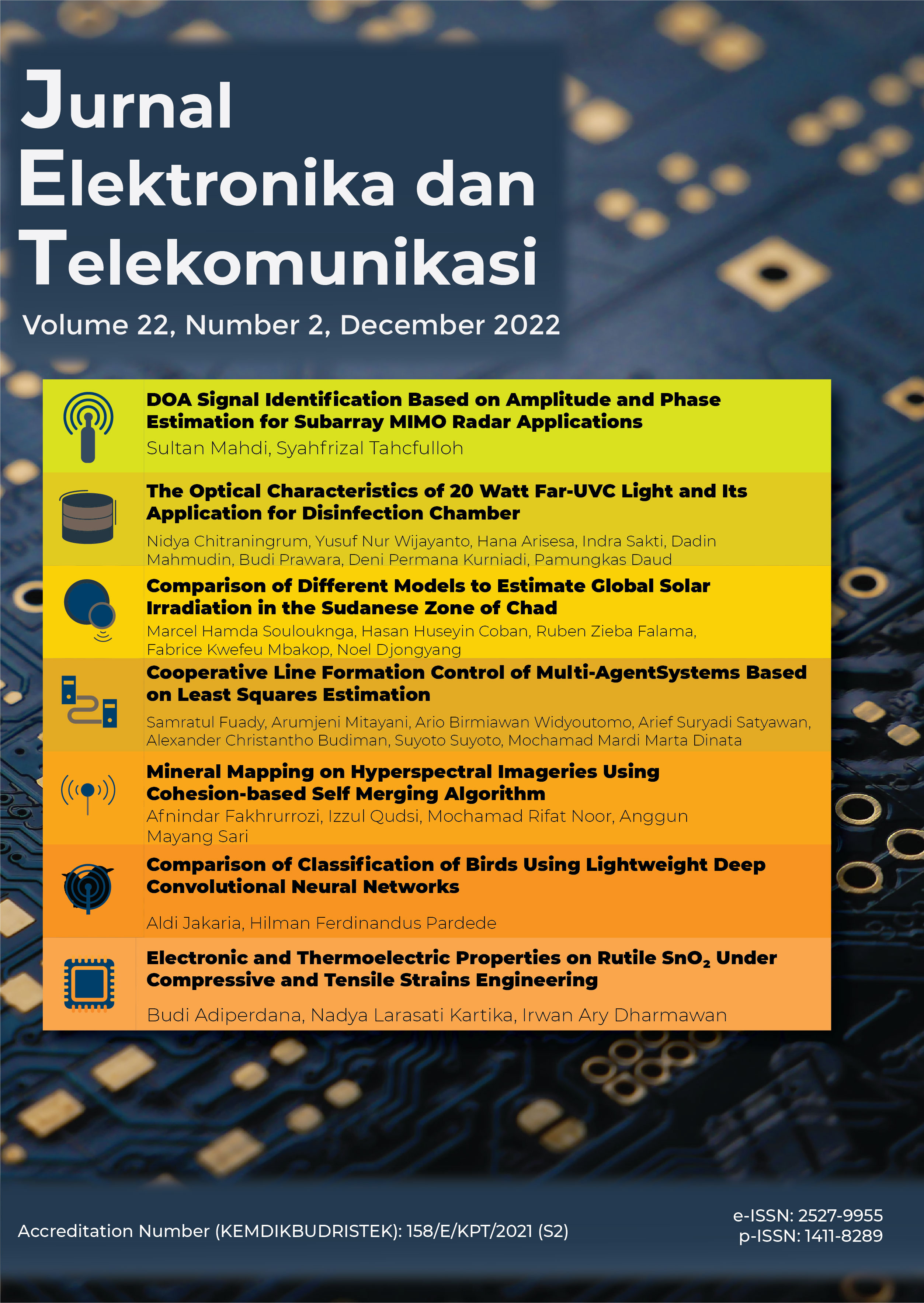
Comparison of Different Models to Estimate Global Solar Irradiation in the Sudanese Zone of Chad
DOI:
https://doi.org/10.55981/jet.508Keywords:
renewable energy, empirical models, statistical indicators, solar radiation, Sudanese zone.Abstract
Sustainable future development relies on solar radiation, which is the main source of renewable energy. Thus, in this article, the monthly average global solar irradiation of four sites in the Sudanian zone region of Chad is estimated using different empirical models. The data used in this study were collected at the General Directorate of Meteorology of Chad. The reliability and accuracy of six models estimating global solar radiation were validated and compared by statistical indicators identifying the most accurate model. The results obtained show that the Allen model has the best performance for the Moundou site (5.760 kWh/m²/d, R2=0.843), the Angstrom Prescott model for the Sarh sites (5.658 kWh/m²/d, R2=0.805) and Pala (5.793 kWh/m²/d, R²=0.889), the Sabbagh model for the Bongor site (5.657 kWh/m²/d, R²=0.888). These models are validated against NASA data. The results show that the Sudanian zone of Chad has good solar potential and is therefore suitable for possible exploitation.
Downloads
References
B. Brahma and R. Wadhvani, “Solar Irradiance Forecasting Based on Deep Learning Methodologies and Multi-Site Data,” Symmetry., vol. 12, no. 11, p. 1830, Nov. 2020, doi: 10.3390/sym12111830. Crossref
S. E. Berrizbeitia, E. Jadraque Gago, and T. Muneer, “Empirical Models for the Estimation of Solar Sky-Diffuse Radiation. A Review and Experimental Analysis,” Energies, vol. 13, no. 3, p. 701, Feb. 2020, doi: 10.3390/en13030701. Crossref
R. A. Rajagukguk, R. A. A. Ramadhan, and H.-J. Lee, “A Review on Deep Learning Models for Forecasting Time Series Data of Solar Irradiance and Photovoltaic Power,” Energies, vol. 13, no. 24, p. 6623, Dec. 2020, doi: 10.3390/en13246623. Crossref
G. E. Hassan, M. E. Youssef, M. A. Ali, Z. E. Mohamed, and A. I. Shehata, “Performance assessment of different day-of-the-year-based models for estimating global solar radiation - Case study: Egypt,” J. Atmos. Sol. Terr. Phys., vol. 149, pp. 69–80, Nov. 2016, doi: 10.1016/j.jastp.2016.09.011. Crossref
D. Guijo-Rubio et al., “Evolutionary artificial neural networks for accurate solar radiation prediction,” Energy J., vol. 210, p. 118374, Nov. 2020, doi: 10.1016/j.energy.2020.118374. Crossref
T. Ahmad and H. Chen, “A review on machine learning forecasting growth trends and their real-time applications in different energy systems,” Sustain. Cities Soc., vol. 54, p. 102010, Mar. 2020, doi: 10.1016/j.scs.2019.102010. Crossref
J. Fan, B. Chen, L. Wu, F. Zhang, X. Lu, and Y. Xiang, “Evaluation and development of temperature-based empirical models for estimating daily global solar radiation in humid regions,” Energy J., vol. 144, pp. 903–914, Feb. 2018, doi: 10.1016/j.energy.2017.12.091. Crossref
S. G. Gouda, Z. Hussein, S. Luo, and Q. Yuan, “Model selection for accurate daily global solar radiation prediction in China,” J. Clean. Prod., vol. 221, pp. 132–144, Jun. 2019, doi: 10.1016/j.jclepro.2019.02.211. Crossref
K. Samy A, A M Shaffle, and A. H A S, “Comparative and Evaluate of Empirical Models for Estimation Global Solar Radiation in Al-Baha, KSA,” J. Earth Sci. Clim. Chang., vol. 09, no. 09, 2018, doi: 10.4172/2157-7617.1000492. Crossref
O. M. Bamigbola and S. E. Atolagbe, “Empirical Models for Predicting Global Solar Radiation on the African Continent Based on Factors of Location and Season,” Open J. Model. Simul., vol. 09, no. 01, pp. 59–73, 2021, doi: 10.4236/ojmsi.2021.91004. Crossref
T. A. Woldegiyorgis, A. Admasu, N. E. Benti, and A. A. Asfaw, “A Comparative Evaluation of Artificial Neural Network and Sunshine Based models in prediction of Daily Global Solar Radiation of Lalibela, Ethiopia,” Cogent Eng., vol. 9, no. 1, Dec. 2022, doi: 10.1080/23311916.2021.1996871. Crossref
M. H. Soulouknga, O. Coulibaly, S. Y. Doka, and T. C. Kofane, “Evaluation of global solar radiation from meteorological data in the Sahelian zone of Chad,”, Renew. Wind. Water, Sol., vol. 4, no. 1, p. 4, Dec. 2017, doi: 10.1186/s40807-017-0041-0. Crossref
F. Wang et al., “A minutely solar irradiance forecasting method based on real-time sky image-irradiance mapping model,” Energy Convers. Manag., vol. 220, p. 113075, Sep. 2020, doi: 10.1016/j.enconman.2020.113075. Crossref
Solar resource maps of Chad, The World Bank Solar resource data: Solargis, Glob. Sol. Atlas 2.0, 2022. [Online]. Available: https://solargis.com/maps-and-gis-data/download/chad.
D. V. S. K. Rao K, M. Premalatha, and C. Naveen, “Analysis of different combinations of meteorological parameters in predicting the horizontal global solar radiation with ANN approach: A case study,” Renew. Sustain. Energy Rev., vol. 91, pp. 248–258, Aug. 2018, doi: 10.1016/j.rser.2018.03.096. Crossref
K. Skeiker, “Correlation of global solar radiation with common geographical and meteorological parameters for Damascus province, Syria,” Energy Convers. Manag., vol. 47, no. 4, pp. 331–345, Mar. 2006, doi: 10.1016/j.enconman.2005.04.012. Crossref
A. A. El-Sebaii, A. A. Al-Ghamdi, F. S. Al-Hazmi, and A. S. Faidah, “Estimation of global solar radiation on horizontal surfaces in Jeddah, Saudi Arabia,” Energy Policy, vol. 37, no. 9, pp. 3645–3649, Sep. 2009, doi: 10.1016/j.enpol.2009.04.038. Crossref
S. Kirmani, M. Jamil, and M. Rizwan, “Empirical correlation of estimating global solar radiation using meteorological parameters,” Int. J. Sustain. Energy, vol. 34, no. 5, pp. 327–339, May 2015, doi: 10.1080/14786451.2013.826222. Crossref
M. N. I. Sarkar, “Estimation of solar radiation from cloud cover data of Bangladesh,” Renew. Wind. Water, Sol., vol. 3, no. 1, p. 11, Dec. 2016, doi: 10.1186/s40807-016-0031-7. Crossref
T. R. Ayodele and A. S. O. Ogunjuyigbe, “Prediction of monthly average global solar radiation based on statistical distribution of clearness index,” Energy J., vol. 90, pp. 1733–1742, Oct. 2015, doi: 10.1016/j.energy.2015.06.137. Crossref
P. I. Cooper, “The absorption of radiation in solar stills,” Sol. Energy, vol. 12, no. 3, pp. 333–346, 1969, doi: 10.1016/0038-092X(69)90047-4. Crossref
A. A. M. Sayigh, Solar Energy Engineering. London, UK: Academic Press, INC, 1977. doi: 10.1016/B978-0-12-620850-4.X5001-7. Crossref
G. H. Hargreaves and Z. A. Samani, “Estimating Potential Evapotranspiration,” J. Irrig. Drain. Div., vol. 108, no. 3, pp. 225–230, Sep. 1982, doi: 10.1061/JRCEA4.0001390. Crossref
R. G. Allen, “Self-Calibrating Method for Estimating Solar Radiation from Air Temperature,” J. Hydrol. Eng., vol. 2, no. 2, pp. 56–67, Apr. 1997, doi: 10.1061/(ASCE)1084-0699(1997)2:2(56). Crossref
J. A. Sabbagh, A. A. M. Sayigh, and E. M. A. El-Salam, “Estimation of the total solar radiation from meteorological data,” Sol. Energy, vol. 19, no. 3, pp. 307–311, 1977, doi: 10.1016/0038-092X(77)90075-5. Crossref
A. J., J. N., B. N., and A. R., “Software for missing data error analysis of Penman-Monteith reference evapotranspiration,” Irrig. Sci., vol. 21, no. 2, pp. 57–67, Mar. 2002, doi: 10.1007/s002710100047. Crossref
A. K. Katiyar and C. K. Pandey, “A Review of Solar Radiation Models—Part I,” J. Renew. Energy, vol. 2013, pp. 1–11, 2013, doi: 10.1155/2013/168048. Crossref
M.-F. Li, X.-P. Tang, W. Wu, and H.-B. Liu, “General models for estimating daily global solar radiation for different solar radiation zones in mainland China,” Energy Convers. Manag., vol. 70, pp. 139–148, Jun. 2013, doi: 10.1016/j.enconman.2013.03.004. Crossref
R. J. Stone, “Improved statistical procedure for the evaluation of solar radiation estimation models,” Sol. Energy, vol. 51, no. 4, pp. 289–291, Oct. 1993, doi: 10.1016/0038-092X(93)90124-7. Crossref
M. Despotovic, V. Nedic, D. Despotovic, and S. Cvetanovic, “Review and statistical analysis of different global solar radiation sunshine models,” Renew. Sustain. Energy Rev., vol. 52, pp. 1869–1880, Dec. 2015, doi: 10.1016/j.rser.2015.08.035. Crossref
O. Behar, A. Khellaf, and K. Mohammedi, “Comparison of solar radiation models and their validation under Algerian climate – The case of direct irradiance,” Energy Convers. Manag., vol. 98, pp. 236–251, Jul. 2015, doi: 10.1016/j.enconman.2015.03.067. Crossref
O. O. Ajayi, O. D. Ohijeagbon, C. E. Nwadialo, and O. Olasope, “New model to estimate daily global solar radiation over Nigeria,” Sustain. Energy Technol. Assess., vol. 5, pp. 28–36, Mar. 2014, doi: 10.1016/j.seta.2013.11.001. Crossref
N. Ghazouani et al., “Performance Evaluation of Temperature-Based Global Solar Radiation Models—Case Study: Arar City, KSA,” Sustainability, vol. 14, no. 1, p. 35, Dec. 2021, doi: 10.3390/su14010035. Crossref
G. Grillone, C. Agnese, and F. D’Asaro, “Estimation of Daily Solar Radiation from Measured Air Temperature Extremes in the Mid-Mediterranean Area,” J. Irrig. Drain. Eng., vol. 138, no. 10, pp. 939–947, Oct. 2012, doi: 10.1061/(ASCE)IR.1943-4774.0000480. Crossref
Downloads
Published
Issue
Section
License
Authors who publish with this journal agree to the following terms:
The copyright to this article is transferred to BRIN if and when the article is accepted for publication. The undersigned hereby transfers any and all rights in and to the paper including without limitation all copyrights to BRIN. The undersigned hereby represents and warrants that the paper is original and that he/she is the author of the paper, except for material that is clearly identified as to its original source, with permission notices from the copyright owners where required. The undersigned represents that he/she has the power and authority to make and execute this assignment. The copyright transfer form can be downloaded here.
The corresponding author signs for and accepts responsibility for releasing this material on behalf of any and all co-authors. This agreement is to be signed by at least one of the authors who have obtained the assent of the co-author(s) where applicable. After submission of this agreement signed by the corresponding author, changes of authorship or in the order of the authors listed will not be accepted.

This work is licensed under a Creative Commons Attribution-NonCommercial-ShareAlike 4.0 International License.