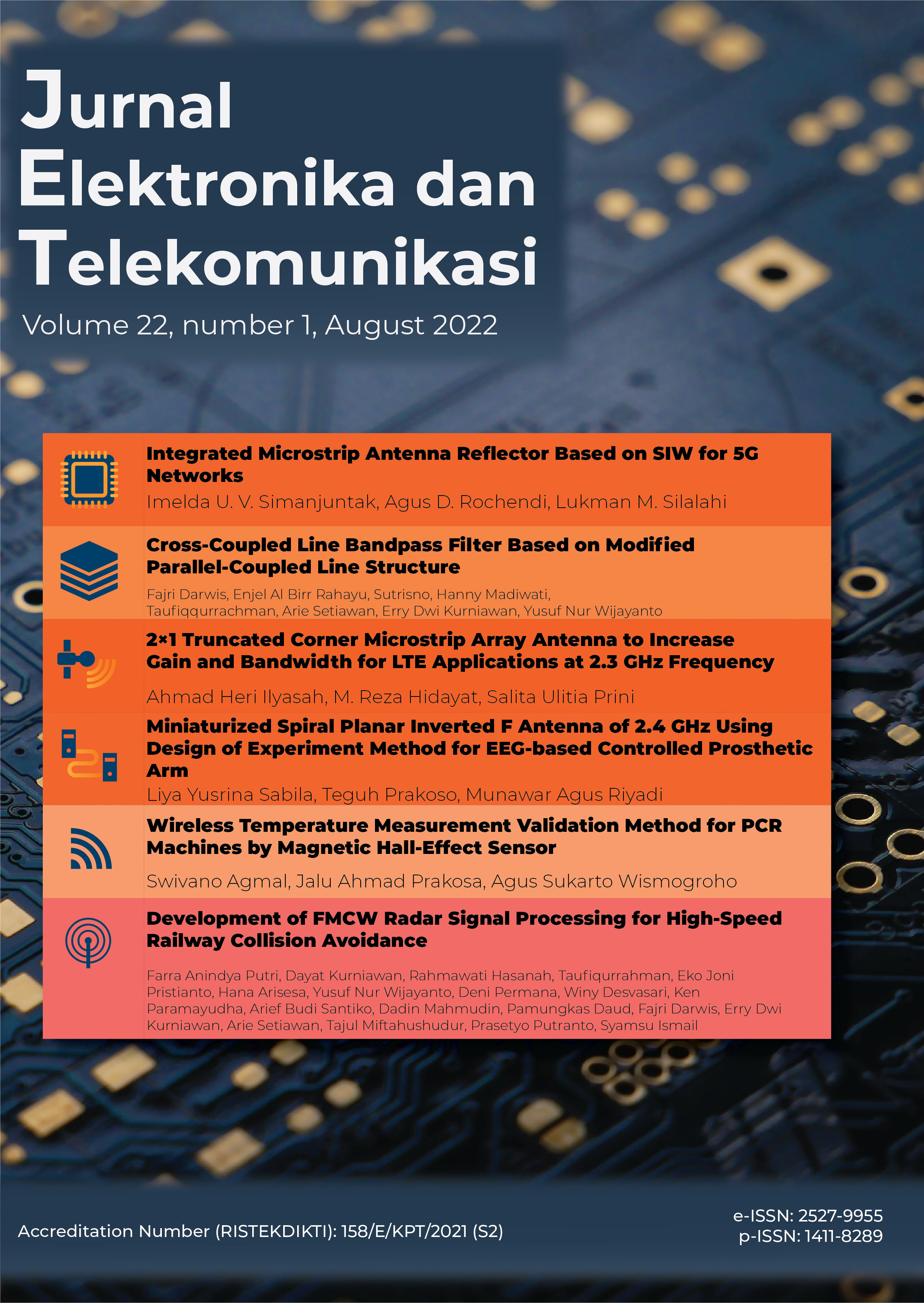
Development of FMCW Radar Signal Processing for High-Speed Railway Collision Avoidance
DOI:
https://doi.org/10.55981/jet.482Keywords:
railway system, FMCW radar, collision avoidance, clutter removal, 2D-CFAR, RPCAAbstract
Collision is the main issue in safe transportation, including in the railway system. Sensor systems have been developed to detect obstacles to prevent a collision, such as using cameras. One disadvantage of the camera systems is that performance detection decreases in a not clean environment, like the target position behind the fogs. This paper discusses the development of frequency modulated continuous wave (FMCW) radar signal processing for high-speed railway collision avoidance. The development of radar signal processing combines a two-dimensional constant false alarm rate (2D-CFAR) and robust principal component analysis (RPCA) to detect moving targets under clutter. Cell average (CA) and Greatest of CA (GOCA) CFAR are evaluated under a cluttered wall environment along the railway track. From the experiment, the development of FMCW radar can detect stationary or moving obstacles around 675 meters in front of the locomotive. Combining 2D-CFAR and RPCA algorithm outperforms average background subtraction in extracting moving targets from strong clutter signals along the railway track.
Downloads
References
T. Dhanabalu, S. Sugumar, S. Suryaprakash, and A. Vijayanand, “Sensor based identification system for train collision avoidance,” ICIIECS 2015 - 2015 IEEE Int. Conf. Innov. Information, Embed. Commun. Syst., pp. 0–3, 2015. Crossref
Y. Gao, H. Xu, J. Gao, and J. Du, “Research of sds-twr ranging based on collision avoidance of anti-collision warning system in urban rail train,” in 2017 12th IEEE Conf. Ind. Electron. Appl., 2017, pp. 218–220. Crossref
S. S. Bhavsar and A. N. Kulkarni, “Train collision avoidance system by using rfid,” in 2016 Int. Conf. Comput. Anal. Secur. Trends, 2016, pp. 30–34. Crossref
B. Mishra, “TMCAS: an mqtt based collision avoidance system for railway networks,” in 2018 18th Int. Conf. Comput. Sci. Appl., 2018, pp. 1–6. Crossref
F. Shouyong, Z. Jimin, X. Lichao, Z. Zhenhai, and L. Jinnan, “Rail identification using camera and millimeter-wave radar data,” in 2021 Int. Conf. Inf. Technol. Biomed. Eng., 2021, pp. 150–154. Crossref
A. K. Kyatsandra, R. K. Saket, S. Kumar, K. Sarita, A. S. S. Vardhan, and A. S. S. Vardhan, “Development of trinetra: a sensor based vision enhancement system for obstacle detection on railway tracks,” IEEE Sens. J., vol. 22, no. 4, pp. 3147–3156, 2022. Crossref
M. Karaduman, “Image processing based obstacle detection with laser measurement in railways,” in 2017 10th Int. Conf. Electr. Electron. Eng., 2017, pp. 899–903.
H. Mukojima et al., “Moving camera background-subtraction for obstacle detection on railway tracks,” in 2016 IEEE Int. Conf. Image Process., 2016, pp. 3967–3971. Crossref
C. Wisultschew, G. Mujica, J. M. Lanza-Gutierrez, and J. Portilla, “3D-lidar based object detection and tracking on the edge of iot for railway level crossing,” IEEE Access, vol. 9, pp. 35718–35729, 2021. Crossref
K. Lee, E. Chae, S. Oh, and J. Hwang, “Study on train collision avoidance system for securing safe distance between trains,” in 2013 Int. Conf. Electr. Mach. Syst., 2013, pp. 1342–1344. Crossref
J. Yanwei and D. Yu, “Research on railway obstacle detection method based on radar,” Proc. - 2021 7th Int. Symp. Mechatronics Ind. Informatics, ISMII 2021, pp. 222–226, 2021. Crossref
A. Liu, Q. Yang, X. Zhang, and W. Deng, “Collision avoidance radar system for the bullet train: implementation and first results,” IEEE Aerosp. Electron. Syst. Mag., vol. 32, no. 5, pp. 4–17, 2017. Crossref
L. He, “Study on brake mode for 300km/h electric motor train unit with distributed power,” Railw. Locomot. & Car, 2003.
H. M. Finn, “Adaptive detection mode with threshold control as a function of spatially sampled clutter level estimates,” 1968.
M. K. Uner and P. K. Varshney, “CFAR processing in nonhomogeneous background,” in Proc. MELECON ’94. Mediterr. Electrotech. Conf., 1994, pp. 156–159 vol.1. Crossref
V. G. Hansen and J. H. Sawyers, “Detectability loss due to ‘greatest of’ selection in a cell-averaging cfar,” IEEE Trans. Aerosp. Electron. Syst., vol. AES-16, no. 1, pp. 115–118, 1980. Crossref
M. A. Richards, Fundamentals Of Radar Signal Processing. McGraw-Hill Education (India) Pvt Limited, 2005. [Online]. Available: https://books.google.co.id/books?id=qizdSv8MEngC
J. Su et al., “A novel multi-scan joint method for slow-moving target detection in the strong clutter via rpca,” in 2021 IEEE Int. Geosci. Remote Sens. Symp. IGARSS, 2021, pp. 4787–4789. Crossref
D. Yang, G. Liao, S. Zhu, and X. Yang, “RPCA based moving target detection in strong clutter background,” in 2015 IEEE Radar Conf., 2015, pp. 1487–1490. Crossref
J. Abdullah and M. S. Kamal, “Multi-targets detection in a non-homogeneous radar environment using modified ca-cfar,” in 2019 IEEE Asia-Pacific Conf. Appl. Electromagn., 2019, pp. 1–5. Crossref
M. Kronauge and H. Rohling, “Fast two-dimensional cfar procedure,” IEEE Trans. Aerosp. Electron. Syst., vol. 49, no. 3, pp. 1817–1823, 2013. Crossref
X. Song, D. Xiang, K. Zhou, and Y. Su, “Improving rpca-based clutter suppression in gpr detection of antipersonnel mines,” IEEE Geosci. Remote Sens. Lett., vol. 14, no. 8, pp. 1338–1342, 2017. Crossref
T. Zhou and D. Tao, “GoDec: randomized lowrank & sparse matrix decomposition in noisy case.,” in Proc. 28th Int. Conf. Mach. Learn. ICML 2011, 2011, pp. 33–40.
Downloads
Published
Issue
Section
License
Authors who publish with this journal agree to the following terms:
The copyright to this article is transferred to BRIN if and when the article is accepted for publication. The undersigned hereby transfers any and all rights in and to the paper including without limitation all copyrights to BRIN. The undersigned hereby represents and warrants that the paper is original and that he/she is the author of the paper, except for material that is clearly identified as to its original source, with permission notices from the copyright owners where required. The undersigned represents that he/she has the power and authority to make and execute this assignment. The copyright transfer form can be downloaded here.
The corresponding author signs for and accepts responsibility for releasing this material on behalf of any and all co-authors. This agreement is to be signed by at least one of the authors who have obtained the assent of the co-author(s) where applicable. After submission of this agreement signed by the corresponding author, changes of authorship or in the order of the authors listed will not be accepted.

This work is licensed under a Creative Commons Attribution-NonCommercial-ShareAlike 4.0 International License.