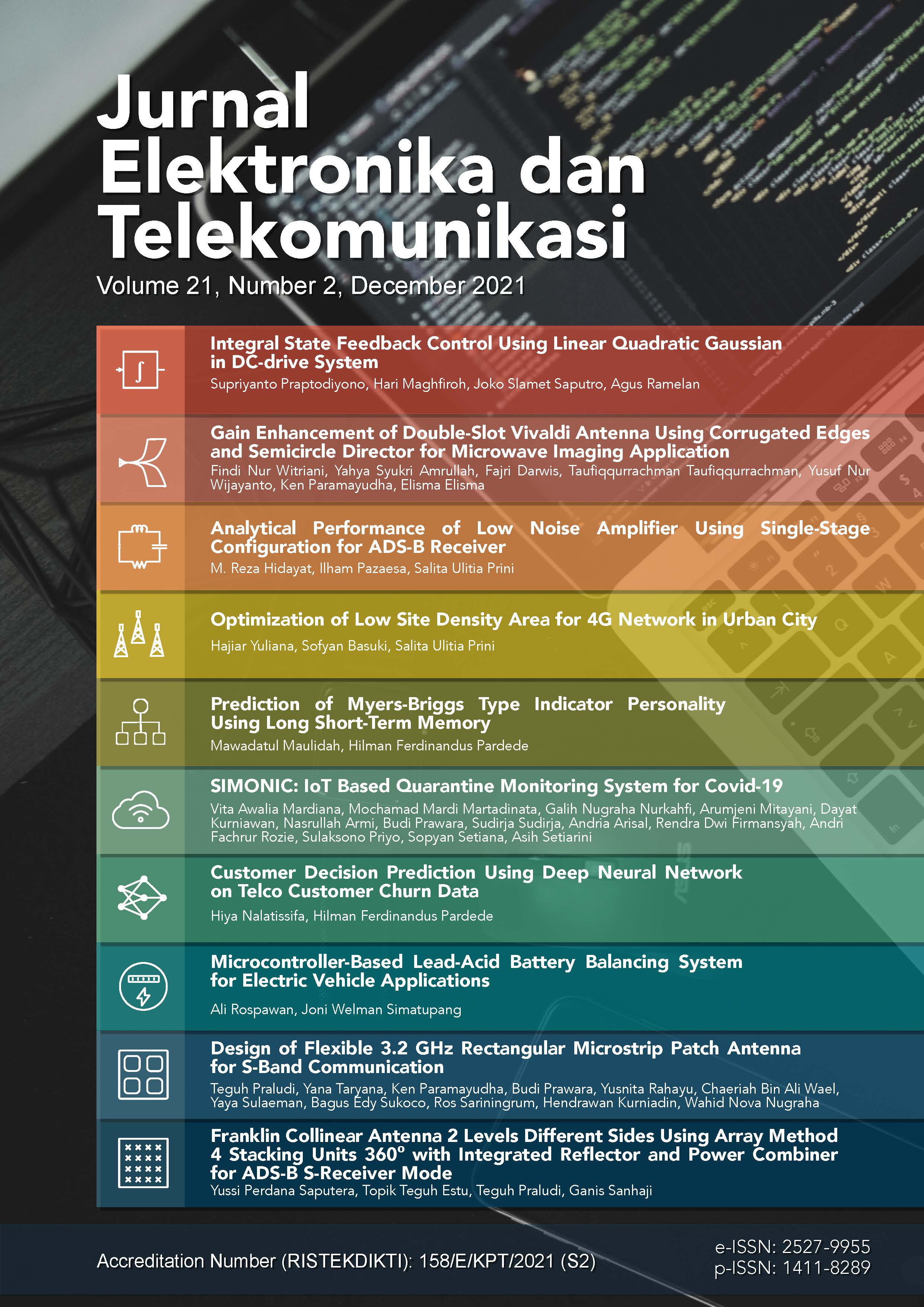
Microcontroller-Based Lead-Acid Battery Balancing System for Electric Vehicle Applications
DOI:
https://doi.org/10.14203/jet.v21.128-139Keywords:
Battery balancing system, electric vehicle, LTC3305, microcontroller, NUCLEO F767ZI, voltage imbalanceAbstract
In application of lead-acid batteries for electrical vehicle applications, 48 V of four 12 V batteries in a series configuration are required. However, the battery stack is repeatedly charged and discharged during operation. Hence, differences in charging and discharging speeds may result in a different state-of-charge of battery cells. Without proper protection, it may cause an excessive discharge that leads to premature degradation of the battery. Therefore, a lead-acid battery requires a battery management system to extend the battery lifetime. Following the LTC3305 balancing scheme, the battery balancing circuit with auxiliary storage can employ an imbalance detection algorithm for sequential battery. It happens by comparing the voltage of a battery on the stack and the auxiliary storage. In this paper, we have replaced the function of LTC3305 by a NUCLEO F767ZI microcontroller, so that the balancing process, the battery voltage, the drawn current to or from the auxiliary battery, and the surrounding temperature can be fully monitored. The prototype of a microcontroller-based lead-acid battery balancing system for electrical vehicle application has been fabricated successfully in this work. The batteries voltage monitoring, the auxiliary battery drawn current monitoring, the overcurrent and overheat protection system of this device has also successfully built. Based on the experimental results, the largest voltage imbalance is between battery 1 and battery 2 with a voltage imbalance of 180 mV. This value is still higher than the target of voltage imbalance that must be lower than 12.5 mV. The balancing process for the timer mode operation is faster 1.5 times compared to the continuous mode operation. However, there were no overcurrent or overtemperature occurred during the balancing process for both timer mode and continuous mode operation. Furthermore, refinement of this device prototype is required in the future to improve the performance significantly.
Downloads
References
D. Setiawan, N. A. Mahardiono, and I. Purnama, “A time improvement technique of lead-acid battery balancing system,” in Proceedings of the 2nd International Conference on Automation, Cognitive Science, Optics, Micro Electro-Mechanical System, and Information Technology, ICACOMIT 2017, Jakarta, 2017. Crossref
D. A. Asfani et al., “Electric Vehicle Research in Indonesia: A Road map, Road tests, and Research Challenges,” IEEE Electrification Magazine, vol. 8, no. 2, pp. 44–51, Jun. 2020. Crossref
J. Raharjo, A. Wikarta, I. Sidharta, M. N. Yuniarto, M. I. Firdaus, and M. F. B. Zulhaimi, “Environmental testing for reliable battery management system in electric vehicle,” Journal of Physics: Conference Series, vol. 1517, no. 1, p. 012025, Apr. 2020. Crossref
Z. B. Omariba, L. Zhang, and D. Sun, “Review of Battery Cell Balancing Methodologies for Optimizing Battery Pack Performance in Electric Vehicles,” IEEE Access, vol. 7, 2019. Crossref
V. T. Liu and J. R. Chen, “Balancing for Lead-Acid Batteries of Electric Motorcycles,” Applied Mechanics and Materials, vol. 764–765, 2015. Crossref
L. Technology Corporation, “LTC3305 - Lead-Acid Battery Balancer”, Accessed: Dec. 03, 2021. [Online]. Available: http://www.linear.com/tapeandreel/.
M. Daowd, M. Antoine, N. Omar, P. van den Bossche, and J. van Mierlo, “Single switched capacitor battery balancing system enhancements,” Energies, vol. 6, no. 4, 2013. Crossref
M. Daowd, M. Antoine, N. Omar, P. Lataire, P. van den Bossche, and J. van Mierlo, “Battery management system-balancing modularization based on a single switched capacitor and bi-directional DC/DC converter with the auxiliary battery,” Energies, vol. 7, no. 5, 2014. Crossref
D. Cadar, D. Petreus, T. Patarau, and N. PALAGHITA, “Active Balancing Method for Battery Cell Equalization,” Acta Technica Napocensis, vol. 51, no. 2, 2010.
Y. Lee, S. Jeon, H. Lee, and S. Bae, “Comparison on cell balancing methods for energy storage applications,” Indian Journal of Science and Technology, vol. 9, no. 17, 2016. Crossref
A. Tsapras, C. Balas, K. Kalaitzakis, and J. Chatzakis, “A new equalization scheme for series connected battery cells,” EPE Journal (European Power Electronics and Drives Journal), vol. 19, no. 3, 2009. Crossref
G. J. May, A. Davidson, and B. Monahov, “Lead batteries for utility energy storage: A review,” Journal of Energy Storage, vol. 15, pp. 145-147, 2018. Crossref
“NUCLEO-F767ZI - STM32 Nucleo-144 development board with STM32F767ZI MCU, supports Arduino, ST Zio and morpho connectivity - STMicroelectronics.” [Online] https://www.st.com (accessed Dec. 03, 2021).
S. Kazadi, M. Thokozile, and K. A. Ogudo, “Design and Monitoring of a Voltage battery sensor of an Uninterruptible Power Supply (UPS) by means of an Arduino,” in 2020 IEEE PES/IAS PowerAfrica, Nairobi, 2020. Crossref
Arduino, “Arduino Nano - Arduino Official Store,” Store.Arduino.Cc/Usa/. 2017.
Allegro MicroSystems, “Thermally Enhanced, Fully Integrated, Hall-Effect-Based High-Precision Linear Current Sensor IC with 100 µΩ Current Conductor ACS770xCB 2,” Feb. 2020. [Online]. Available: www.allegromicro.com.
I. Ihsan and A. wahyu Aditya, “Rancang Bangun Battery Monitoring System (BMS) berbasis LabVIEW,” JTT (Jurnal Teknologi Terpadu), vol. 9, no. 1, 2021
B. O. Oyebola and V. T. Odueso, “LM35 Based Digital Room Temperature Meter: A Simple Demonstration,” Equatorial Journal of Computational and Theoretical Science, vol. 2, no. 1, 2017.
A. Rospawan, J. W. Simatupang, and I. Purnama, “A Simple, Cheap and Precise Microcontroller Based DDS Function Generator,” Journal of Electrical and Electronics Engineering, vol. 3, no. 2, pp. 118–121, 2019.
A. Laurentius Michael and S. Joni Welman, “Design and Implementation of AC Mains Voltage Fluctuation Indicator for Home Appliances,” International Journal of Electronics and Device Physics, vol. 2, no. 1, Dec. 2018.
“B21NH series.” https://zh-tw.echin.com.tw/b21nh-series.html (accessed Dec. 03, 2021).
Downloads
Published
Issue
Section
License
Authors who publish with this journal agree to the following terms:
The copyright to this article is transferred to BRIN if and when the article is accepted for publication. The undersigned hereby transfers any and all rights in and to the paper including without limitation all copyrights to BRIN. The undersigned hereby represents and warrants that the paper is original and that he/she is the author of the paper, except for material that is clearly identified as to its original source, with permission notices from the copyright owners where required. The undersigned represents that he/she has the power and authority to make and execute this assignment. The copyright transfer form can be downloaded here.
The corresponding author signs for and accepts responsibility for releasing this material on behalf of any and all co-authors. This agreement is to be signed by at least one of the authors who have obtained the assent of the co-author(s) where applicable. After submission of this agreement signed by the corresponding author, changes of authorship or in the order of the authors listed will not be accepted.

This work is licensed under a Creative Commons Attribution-NonCommercial-ShareAlike 4.0 International License.