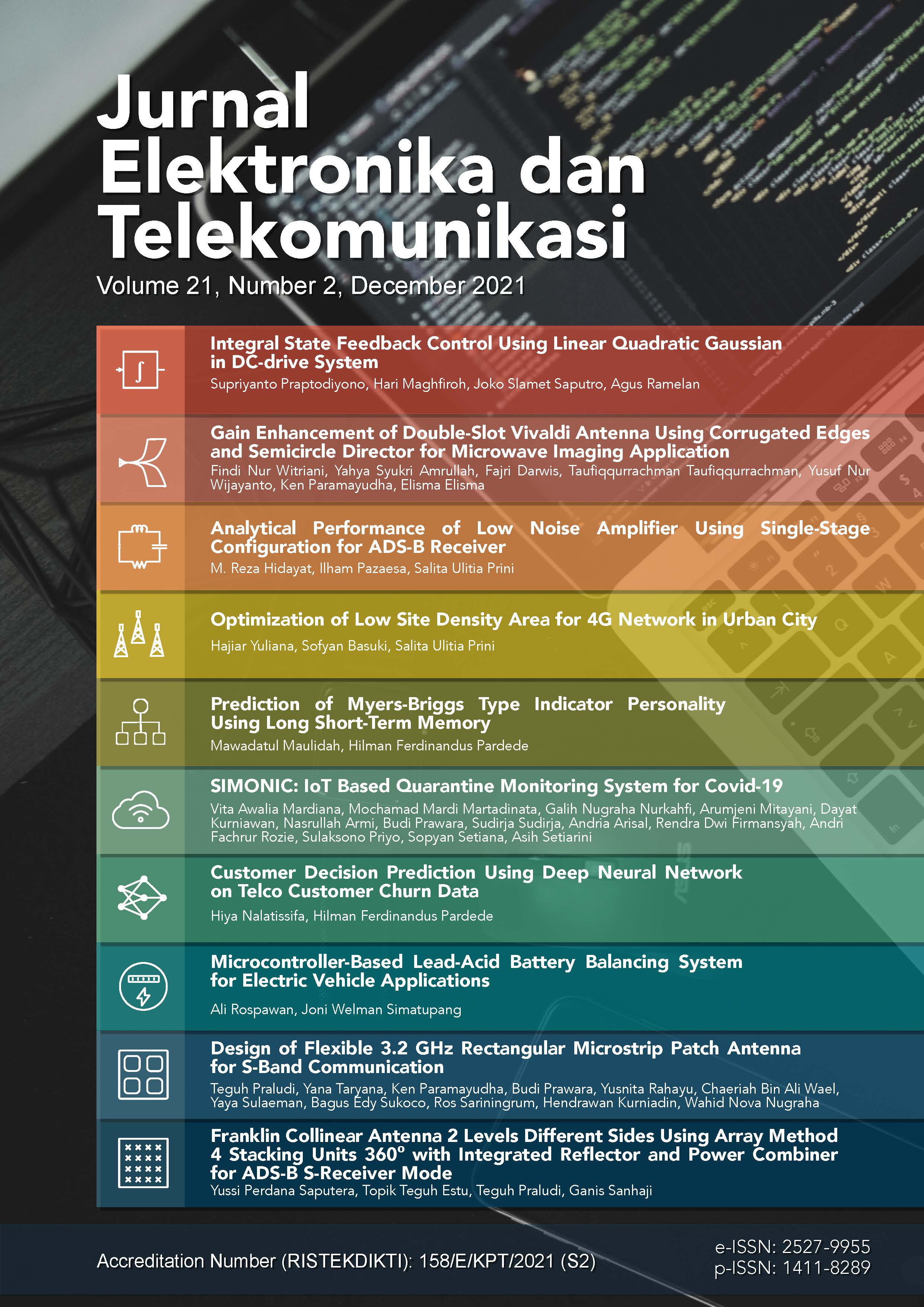
Gain Enhancement of Double-Slot Vivaldi Antenna using Corrugated Edges and Semicircle Director for Microwave Imaging Application
DOI:
https://doi.org/10.14203/jet.v21.85-90Keywords:
Vivaldi Antenna, Ultrawideband (UWB), Microwave ImagingAbstract
Microwave imaging, such as images for radiological inspection in the medical profession, is one of the applications utilized in ultra-wideband (UWB) frequency ranges. The Vivaldi antenna is one of the most popular antennas for this purpose. The antenna is utilized because of its simple, lightweight, and compact design, as well as its excellent efficiency and gain capabilities. In this work, we present a high-gain Vivaldi antenna for microwave imaging applications. The proposed Vivaldi antenna is designed using a double-slot structure method with the addition of corrugated edges and a semicircle director aimed at improving the gain. The antenna is designed to operate at frequencies ranging from 3.1 to 10.6 GHz. Based on the modeling findings, the suggested antenna attain a bandwidth of 7.5 GHz with operating frequencies from 3.1 GHz to 10.6 GHz for a VSWR of less than two. In comparison to a typical single slot antenna, the suggested antenna provides a substantial boost in gain performance. The increase in gain is proportional to the frequency of operation. The constructed antenna has a lower bandwidth than the simulated one, with operating frequencies of 3.5 GHz – 3.75 GHz and 4.25 – 10.89 GHz, respectively, and useable bandwidths of 250 MHz and 6.64 GHz. All these results suggest that the antenna is suitable for microwave imaging applications.
Downloads
References
J. J. Estrada, "Microwave object detection and image reconstruction with a synthetic circular aperture", Master Thesis, University of Oslo, Oslo, Norway, 2018.
D. A. Kharisma, "Radiasi ionizing dan non ionizing", Universitas Jember, Jember, Indonesia, 2014.
D. Achmad Alwan Arseno and A. D. Setiawan, “Perancangan dan realisasi antena mikrostrip dengan frekuensi 1,4-4,4 Ghz untuk ground penetrating radar,” e-Proceeding of Engineering, vol. 6, pp. 988-994, 2019.
Y.-W. Wang, G.-M. Wang and B.-F. Zong, “Directivity improvement of vivaldi antenna using double-slot structure,” IEEE Antennas and Wireless Propagation Letters, vol. 12, pp. 1380-1383, October 2013. Crossref
C. Uyanik, A. O. Ertay, S. Dogu, I. Akduman and H. Sahinturk, “A coplanar vivaldi antenna design with improved frequency response for microwave breast imaging,” in IEEE Conference on Antenna Measurements and Applications (CAMA), Syracuse, New York, 2016. Crossref
L. C. Paul, M. N. Hossain, M. M. U. Rashid, M. M. Mowla, M. Z. Mahmud and M. T. Islam, “A novel miniaturized coplanar waveguide fed tapered slot ultra wide band vivaldi antena for microwave imaging applications,” in 10th International Conference on Computing, Communication and Networking Technologies (ICCCNT), Kanpur, 2019. Crossref
M. Yumnisari, B. S. Nugroho and P. Daud, “Perancangan dan simulasi antena mikrostrip ultra wideband untuk deteksi kanker payudara,” in Seminar Nasional Inovasi Dan Aplikasi Teknologi Di Industri, Malang, 2017.
M. A. Saputra, H. Wijanto and Y. Wahyu, “Antena vivaldi antipodal sirkular ultra wide-band (UWB) untuk radar tembus tembok,” in Seminar Nasional Sains dan Teknologi, Jakarta, 2018.
M. T. Islam, M. Z. Mahmud, N. Misran, J. Takada and M. Cho, “Microwave breast phantom measurement system with compact side slotted directional antenna,” IEEE Access, vol. 5, pp. 5321-5330, April 2017. Crossref
F. Oktafiani, Y. S. Amrullah, Y. P. Saputera, Y. Wahyu and Y. N. Wijayanto, “Analysis of corrugated edge variations on balanced antipodal Vivaldi antennas,” in 2015 International Conference on Radar, Antenna, Microwave, Electronics and Telecommunications, Bandung, 2015. Crossref
Y. Zhang, E. Li, C. Wang and G. Guo, “Radiation enhanced vivaldi antenna with double-antipodal structure,” IEEE Antenna and Wireless Propagation Letters, vol. 16, pp. 561-564, July 2016. Crossref
Downloads
Published
Issue
Section
License
Authors who publish with this journal agree to the following terms:
The copyright to this article is transferred to BRIN if and when the article is accepted for publication. The undersigned hereby transfers any and all rights in and to the paper including without limitation all copyrights to BRIN. The undersigned hereby represents and warrants that the paper is original and that he/she is the author of the paper, except for material that is clearly identified as to its original source, with permission notices from the copyright owners where required. The undersigned represents that he/she has the power and authority to make and execute this assignment. The copyright transfer form can be downloaded here.
The corresponding author signs for and accepts responsibility for releasing this material on behalf of any and all co-authors. This agreement is to be signed by at least one of the authors who have obtained the assent of the co-author(s) where applicable. After submission of this agreement signed by the corresponding author, changes of authorship or in the order of the authors listed will not be accepted.

This work is licensed under a Creative Commons Attribution-NonCommercial-ShareAlike 4.0 International License.