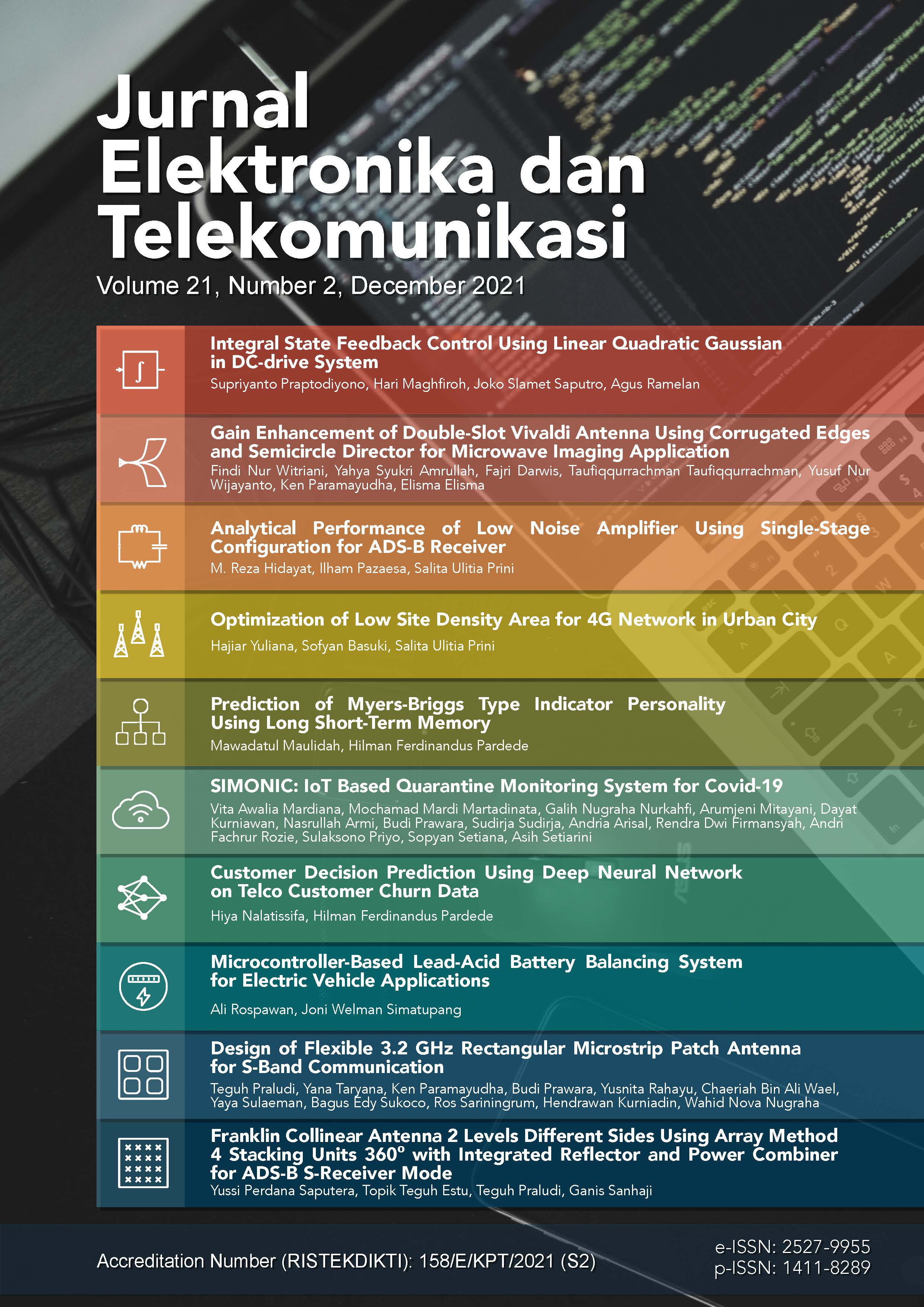
Optimization of Low Site Density Area for 4G Network in Urban City
DOI:
https://doi.org/10.14203/jet.v21.98-103Keywords:
low site density, optimization, coverage, new site, RSRPAbstract
The development of telecommunications is currently growing rapidly, especially in urban areas. To obtain optimal data services for users, the performances of 4G network services must continue to be optimized. It is known that many users are scattered in urban areas, but sometimes it is not balanced with an even distribution of the site in this area. This condition occurs because the distribution of the site is not evenly optimal distributed, either due to licensing constraints, limited land access for site development, or in terms of plans that have not been made. Balanced with the requirement of a 4G network, which is required, this "empty space" condition or low site density condition must find a solution or optimize it. Many optimization methods can optimize the area with low site density possibility. This study will optimize the area by adding a new site proposal based on coverage planning. We need to analyze Reference Signal Received Power (RSRP) coverage signal distribution using Atoll Planning Software. After optimization, the RSRP level below or equal -80 dBm increased from 75.195% to 94.08%. Furthermore, the percentage calculation for inadequate coverage (below -80 dBm) decreased from 24.816% to 5.931%. This RSRP signal level also shows that the condition after optimization with a new site can improve the signal level condition from areas with low site density possibility.
Downloads
References
H. Yuliana and S. Basuki, “Optimasi Jaringan Seluler XL LTE Di Area Kampus Unjani Cimahi,” LPPM Unjani, Cimahi, 2019.
H. Yuliana, S. Basuki and H. R. Iskandar, “Peningkatan Kualitas Sinyal Pada Jaringan 4G LTE Dengan Menggunakan Metode Antenna Physical Tuning,” in Seminar Nasional Sains Dan Teknologi, Jakarta, 2019.
M. Sousa, A. Martins and P. Vieira, “Self-diagnosing low coverage and high interference in 3G/4G radio access networks based on automatic RF measurement extraction,” in Proceedings of the 13th International Joint Conference on e-Business and Telecommunications, Lisbon, 2016.
H. Yuliana and R. R. Meilani, “Perencanaan Newsite Untuk Jaringan 4G Dengan Metode Coverage Area Planning Di Area Manonjaya Tasikmalaya,”, Undergraduate Thesis, Universitas Jenderal Achmad Yani, Cimahi, Indonesia, 2020.
L. Wardhana, B. F. Aginsa, A. Dewantoro, I. Harto, G. Mahardika and A. Hikmaturokhman, "4G Handbook Edisi Bahasa Indonesia", Jakarta Selatan, Indonesia: www.nulisbuku.com, 2015.[Online]. Availabe: http://www.nulisbuku.com.
J. Yu, B. Zhang, W. Chen and J. Zhang, “4G TD-LTE radio coverage model optimization design under complex inland river environment,” in 2015 International Conference on Transportation Information and Safety (ICTIS), Wuhan, 2015.
J. Chen, “Network Analysis Based on 2/4G Common Coverage Research in Rural Area,” in 2018 IEEE International Conference on Internet of Things (iThings) and IEEE Green Computing and Communications (GreenCom) and IEEE Cyber, Physical and Social Computing (CPSCom) and IEEE Smart Data (SmartData), Halifax, 2018.
S. Shetty, S. Lacković and S. Z. Pilinsky, “4G coverage analysis of Croatian main roads,” in 2017 International Symposium ELMAR, Zadar, 2017. Crossref
C. Yanyun, H. Alexis, X. Hui and Y. Xingxiu, “Coverage and Capacity Optimization for 4G LTE Networks Using Differential Evolution,” in 2018 5th IEEE International Conference on Cloud Computing and Intelligence Systems (CCIS), Nanjing, 2018. Crossref
M. Ayad, S. Medjedoub, B. Mourad, K. Saoudi and A. Arabi, “Evaluation of 4G / LTE mobile network performances based on experimental data,” in 2020 2nd International Workshop on Human-Centric Smart Environments for Health and Well-being (IHSH), Boumerdes, 2021.
Downloads
Published
Issue
Section
License
Authors who publish with this journal agree to the following terms:
The copyright to this article is transferred to BRIN if and when the article is accepted for publication. The undersigned hereby transfers any and all rights in and to the paper including without limitation all copyrights to BRIN. The undersigned hereby represents and warrants that the paper is original and that he/she is the author of the paper, except for material that is clearly identified as to its original source, with permission notices from the copyright owners where required. The undersigned represents that he/she has the power and authority to make and execute this assignment. The copyright transfer form can be downloaded here.
The corresponding author signs for and accepts responsibility for releasing this material on behalf of any and all co-authors. This agreement is to be signed by at least one of the authors who have obtained the assent of the co-author(s) where applicable. After submission of this agreement signed by the corresponding author, changes of authorship or in the order of the authors listed will not be accepted.

This work is licensed under a Creative Commons Attribution-NonCommercial-ShareAlike 4.0 International License.