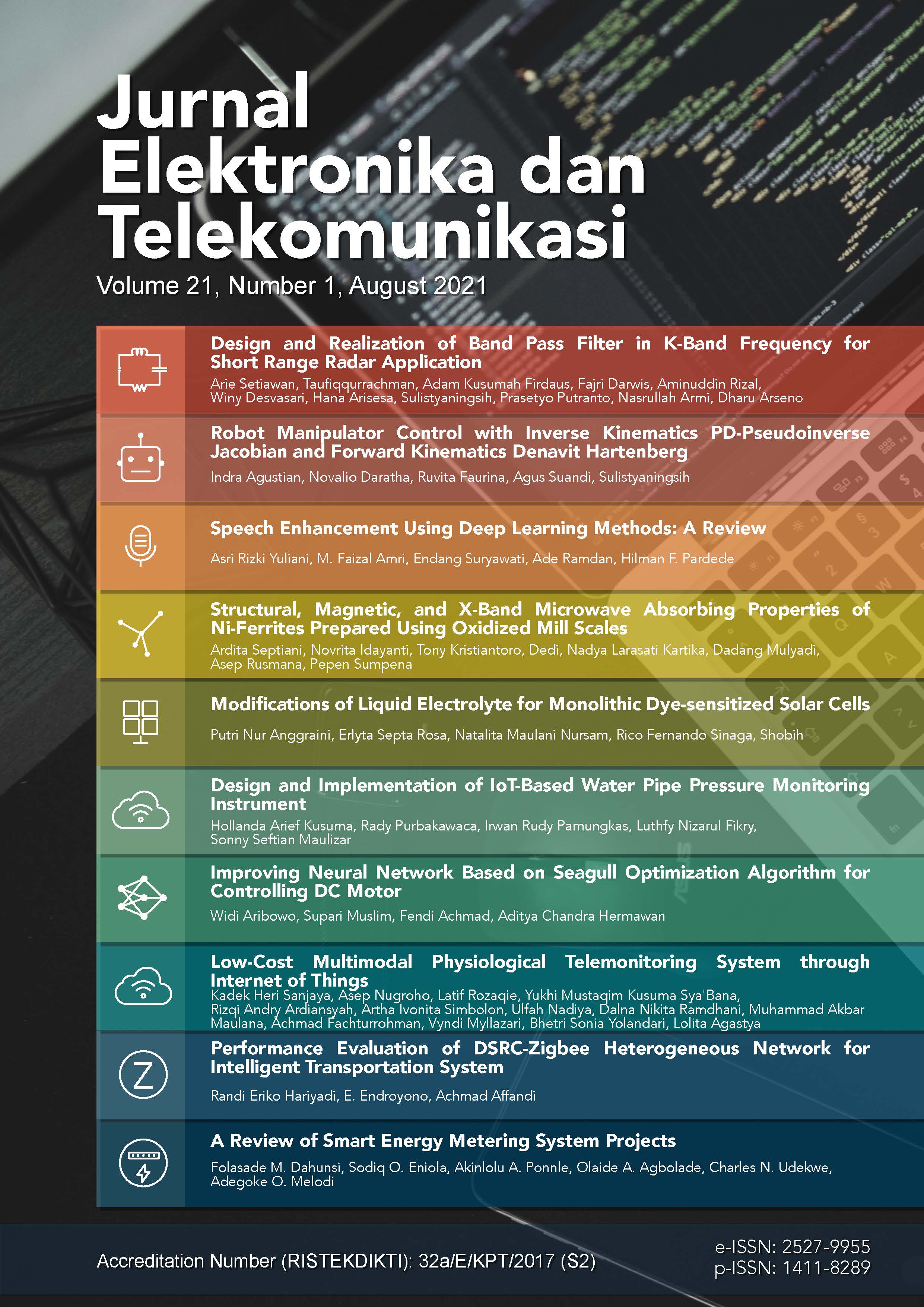
Low-Cost Multimodal Physiological Telemonitoring System through Internet of Things
DOI:
https://doi.org/10.14203/jet.v21.55-63Keywords:
telemedicine, COVID-19, electrocardiography, oxygen saturation, respiratory, body temperature, web applicationAbstract
The objective of this study is to develop and test a patient telemonitoring system. This study was encouraged by the high number of health workers fatalities in Indonesia due to physical contact without proper protection. Based on the symptoms of COVID-19 it consists of electrocardiogram (ECG) sensors, body temperature sensors, respiratory rate sensors, and pulse oximeter. The physiological data were captured by the sensors and collected by a microcontroller then it sends the data to a cloud system so that health workers can access the data. The experiments were performed to test both the offline and online protocol to compare data sent via a direct connection and data sent via Wi-Fi. In the offline testing, there were several limitations observed such as the low sampling frequency of the ECG signals that reduce the fidelity of the signals. Such problems were also observed on respiratory rate data. Furthermore, the system is also very prone to subjects’ movement-related noise. The measurements of peripheral oxygen saturation (SpO2) and body temperature, on the other hand, have been detected the slight change up to 0.1% and 0.5oC respectively. In the online testing, the data transmission to the cloud is sent per 30 seconds so that morphologically the ECG signal data are not representative. The system requires a lot of improvements and future study should be directed to improve signals acquisition and processing while maintaining the concept of low-cost. Design improvement should also include a better attachment design to the human body as well as greater data transmission for the online system.
Downloads
References
Z. Li, Y. Wang, and K. S. Wang, “Intelligent predictive maintenance for fault diagnosis and prognosis in machine centers: Industry 4.0 scenario,” Adv. Manuf., vol. 5, no. 4, pp. 377–387, 2017. Crossref
K. H. Sanjaya, L. Rozaqi, G. Y. W. Simanungkalit, A. N. Iksan, and M. Y. Yuriis, “Design of pressure measurement instrument for smart footwear,” Internetworking Indonesia J., vol. 12, no. 1, pp. 3–8, 2020.
“Society 5.0,” 2018. [Online]. Available: https://www8.cao.go.jp/cstp/english/society5_0/index.html (accessed May 5, 2021).
Keidanren, “Healthcare in society 5.0,” Japan Business Federation, Japan, 2018.
G. Ioppolo, F. Vazquez, M. G. Hennerici, and E. Andrès, “Medicine 4.0: New technologies as tools for a society 5.0,” J. Clin. Med., vol. 9, no. 7, Jul. 2020, Art no. 2198. Crossref
G. Aceto, V. Persico, and A. Pescapé, “Industry 4.0 and health: Internet of things, big data, and cloud computing for healthcare 4.0,” J. Ind. Inf. Integr., vol. 18, Jun. 2020, Art no. 100129. Crossref
A. I. Simbolon, K. H. Sanjaya, and A. Widyotriatmo, “EMG patterns of healthy subjects with shoulder rehabilitation robot,” in Proc. 2019 IEEE 4th Int. Conf. Technology, Informatics, Management, Engineering and Environment, Nov. 2019, pp. 67–71. Crossref
WHO Indonesia, “Coronavirus Disease 2019 (COVID-19) Situation Report,” 2021. [Online]. Available: https://www.who.int/indonesia/news/novel-coronavirus/situation-reports
C. Kanchanachitra et al., “Human resources for health in southeast Asia: Shortages, distributional challenges, and international trade in health services,” Lancet, vol. 377, no. 9767, pp. 769–781, 2011. Crossref
A. U. Morgan et al., “Remote monitoring of patients with Covid-19: Design, implementation, and outcomes of the first 3,000 patients in COVID Watch,” New England J. Medicine Catal., pp. 1–12, Jul. 2020.
N. N. Sari, M. N. Gani, R. A. M. Yusuf, and R. Firmando, “Telemedicine for silent hypoxia: Improving the reliability and accuracy of Max30100-based system,” Indones. J. Electr. Eng. Comput. Sci., vol. 22, no. 3, pp. 1419-1426, Jun. 2021. Crossref
E. A. Suprayitno, M. R. Marlianto, and M. I. Mauliana, “Measurement device for detecting oxygen saturation in blood, heart rate, and temperature of human body,” in J. Phys. Conf. Ser., vol. 1402, no. 3, Dec. 2019, Art no. 033110. Crossref
Pedoman Tatalaksana Covid-19 (Guidelines for the Management of COVID-19), Kemenkes RI (Indonesian Health Ministry), 2020.
O. Heriana and A. M. Al Misbah, “Comparison of wavelet family performances in ECG signal denoising,” Jurnal Elektronika dan Telekomunikasi, vol. 17, no. 1, pp. 1-6, Aug. 2017. Crossref
A. N. Kochi, A. P. Tagliari, G. B. Forleo, G. M. Fassini, and C. Tondo, “Cardiac and arrhythmic complications in patients with COVID-19,” J. Cardiovasc. Electrophysiol., vol. 31, no. 5, pp. 1003–1008, May 2020. Crossref
A. Bhatla et al., “COVID-19 and cardiac arrhythmias,” Hear. Rhythm, vol. 17, no. 9, pp. 1439–1444, Sep. 2020. Crossref
D. K. L. Lewis. “COVID-19 and the heart: What have we learned.” Harvard Health Publishing Harvard Medical School. https://www.health.harvard.edu/blog/covid-19-and-the-heart-what-have-we-learned-2021010621603 (accessed May 03, 2021).
M. J. Tobin, A. Jubran, and F. Laghi, “Misconceptions of pathophysiology of happy hypoxemia and implications for management of COVID-19,” Respir. Res., vol. 21, Sep. 2020, Art. no. 249. Crossref
A. González-Duarte and L. Norcliffe-Kaufmann, “Is ‘happy hypoxia’ in COVID-19 a disorder of autonomic interoception? A hypothesis,” Clin. Auton. Res., vol. 30, no. 4, pp. 331–333, Jul. 2020. Crossref
A. Widysanto et al., “Happy hypoxia in critical COVID-19 patient: A case report in Tangerang, Indonesia,” Physiol. Rep., vol. 8, no. 20, pp. 1–5, Oct. 2020, Art. no. 14619. Crossref
“ECG: Cardiology | Heart Sounds | Research | BIOPAC.” https://www.biopac.com/application/ecg-cardiology/advanced-feature/heart-sounds/ (accessed May 24, 2016).
D. R. P. Patnaikuni, “A Comparative study of Arduino, Raspberry Pi and ESP8266 as IoT development board,” Int. J. Adv. Res. Comput. Sci., vol. 8, no. 5, pp. 2350–2352, Jun. 2017.
J. Mesquita, D. Guimaraes, C. Pereira, F. Santos, and L. Almeida, “Assessing the ESP8266 WiFi module for the internet of things,” in IEEE Int. Conf. Emerging Technologies and Factory Automation, Oct. 2018, pp. 784–791. Crossref
R. K. Kodali and K. S. Mahesh, “A low cost implementation of MQTT using ESP8266,” in Proc. 2016 2nd Int. Conf. Contemporary Computing and Informatics, 2016, pp. 404–408. Crossref
A. Škraba, A. Kolozvari, D. Kofjac, R. Stojanovic, E. Semenkin, and V. Stanovov, “Prototype of group heart rate monitoring with ESP32,” in Proc. 2019 8th Mediterranean Conf. Embedded Computing, Jun. 2019. Crossref
G. Sun et al., “Vital-SCOPE: Design and evaluation of a smart vital sign monitor for simultaneous measurement of pulse rate, respiratory rate, and body temperature for patient monitoring,” J. Sensors, vol. 2018, 2018, Art. no. 4371872. Crossref
P. Oktivasari, R. Riandini, R. A. Fitri, and S. I. Malaon, “Active filter analysis on designing electronic stethoscope,” Jurnal Elektronika dan Telekomunikasi, vol. 19, no. 2, pp. 51-56, Dec. 2019. Crossref
J. P. J. Pinel, Biopsychology, Bahasa Ind. Yogyakarta: Pustaka Pelajar, 2015.
J. J. Bailey et al., “Recommendations for standardization and specifications in automated electrocardiography: Bandwidth and digital signal processing. A report for health professionals by an ad hoc writing group of the committee on electrocardiography and cardiac electrophysiology of the council on clinical cardiology, American heart association,” Circulation, vol. 81, no. 2, pp. 730–739, 1990. Crossref
H. Carter, “Cardiology- the ABC’s of the PQRST,” Bush Veterinary Neurology Service, 2018.
D. J. Miller et al., “Analyzing changes in respiratory rate to predict the risk of COVID-19 infection,” PLoS One, vol. 15, no. 12, Dec.2020, Art. no. 0243693. Crossref
S. Tharakan, K. Nomoto, S. Miyashita, and K. Ishikawa, “Body temperature correlates with mortality in COVID-19 patients,” Crit. Care, vol. 24, Jun. 2020, Art. no. 246. Crossref
K. H. Sanjaya, L. Rozaqi, K. A. Damayanti, M. M. Laurentius, and Hamilaturrohmah, “Design of Smart Footwear Information System for Measuring Gait Parameters,” in 2019 Int. Conf. Computer, Control, Informatics and its Applications: Emerging Trends in Big Data and Artificial Intelligence, 2019, pp. 76-81. Crossref
E. D. Kurniawan, A. Adam, M. I. Salik, and P. L. Gareso, “Programmable Syringe Pump for Selective Micro Droplet Deposition,” Jurnal Elektronika dan Telekomunikasi, vol. 19, no. 2, pp. 75-82, Dec. 2019. Crossref
Downloads
Published
Issue
Section
License
Authors who publish with this journal agree to the following terms:
The copyright to this article is transferred to BRIN if and when the article is accepted for publication. The undersigned hereby transfers any and all rights in and to the paper including without limitation all copyrights to BRIN. The undersigned hereby represents and warrants that the paper is original and that he/she is the author of the paper, except for material that is clearly identified as to its original source, with permission notices from the copyright owners where required. The undersigned represents that he/she has the power and authority to make and execute this assignment. The copyright transfer form can be downloaded here.
The corresponding author signs for and accepts responsibility for releasing this material on behalf of any and all co-authors. This agreement is to be signed by at least one of the authors who have obtained the assent of the co-author(s) where applicable. After submission of this agreement signed by the corresponding author, changes of authorship or in the order of the authors listed will not be accepted.

This work is licensed under a Creative Commons Attribution-NonCommercial-ShareAlike 4.0 International License.