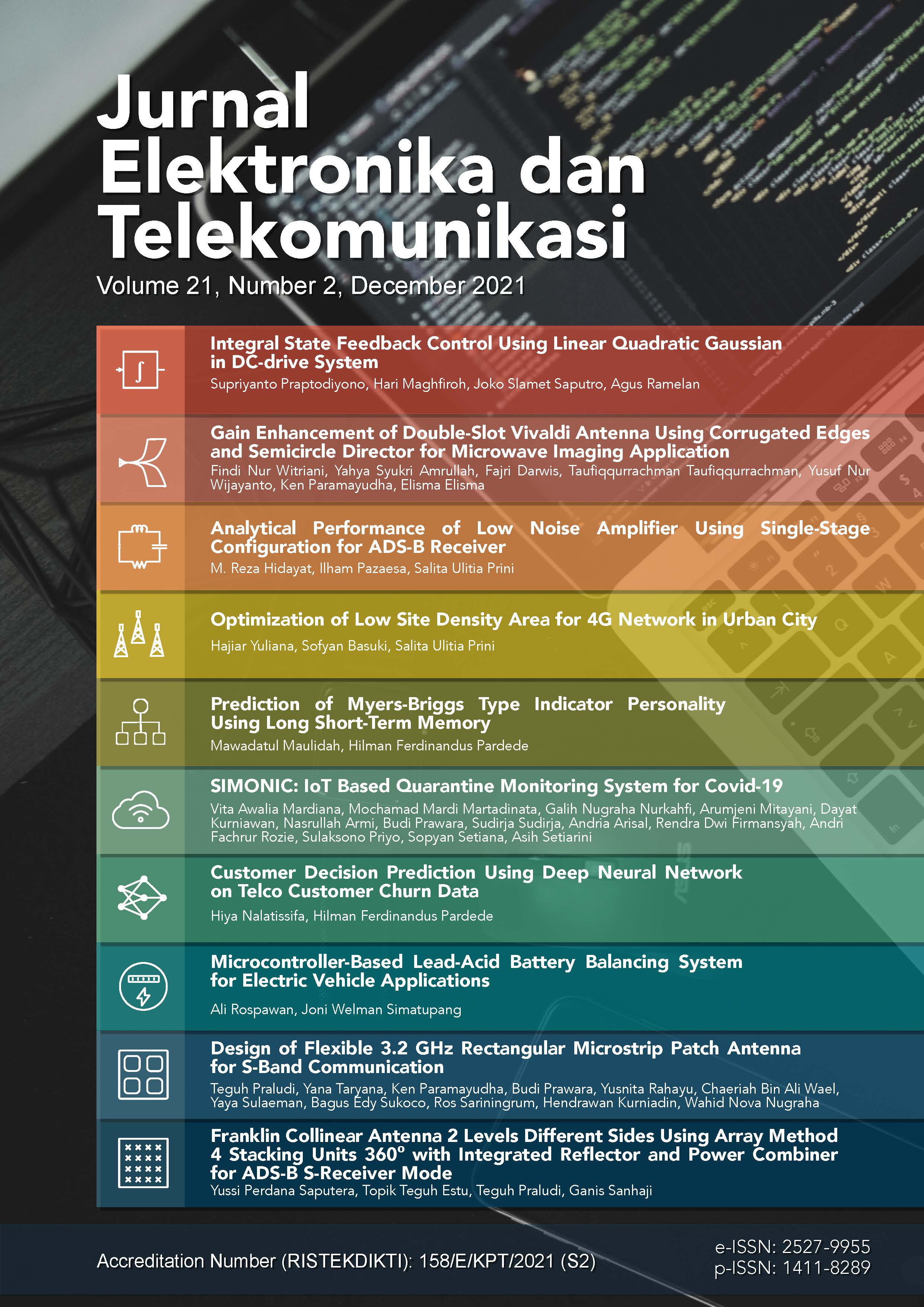
Integral State Feedback Control Using Linear Quadratic Gaussian in DC-drive System
DOI:
https://doi.org/10.14203/jet.v21.79-84Keywords:
DC motor, speed control, integral state feedback, LGGAbstract
The electric motor is one of the technological developments which can support the production process. DC motor has some advantages compared to AC motor especially on the easier way to control its speed or position as well as its widely adjustable range. The main issue in the DC motor is controlling the angular speed with uncertainty and disturbance. The alternative solution of a control method with simple, easy to design, and implementable in a multi-input multi-output system is integral state feedback such as linear quadratic Gaussian (LQG). It is a combination between linear quadratic regulator and Kalman filter. One of the advantages of this method is the usage of fewer sensors compared with the original linear quadratic regulator method which uses sensors as many as the state in the system model. The design, simulation, and experimental study of the application of LQG as state feedback control in a DC-drive system have been done. Both performance and energy were analyzed and compared with conventional proportional integral derivative (PID). The gain of LQG was determined by trial whereas the PID gain is determined from MATLAB autotuning without fine-tuning. The load test and tracking test were carried out in the experiment. Both simulation and hardware tests showed the same result which LQG is superior in integral absolute error (IAE) by up to 74.37 % in loading test compared to PID. On the other side, LQG needs more energy, it consumes higher energy by 6.34 % in the load test.
Downloads
References
A. Faramarzi and K. Sabahi, “Recurrent Fuzzy Neural Network for DC- motor control,” in 2011 Fifth International Conference on Genetic and Evolutionary Computing, 2011, pp. 93–96. Crossref
U. K. Bansal and R. Narvey, “Speed Control of DC Motor Using Fuzzy PID Controller,” Adv. Electron. Electr. Eng., vol. 3, no. 9, pp. 1209–1220, 2013.
C. A. Kumar, B. R. Harijan, M. K. Kumar, and M. Bharathi, “BLDC Motor Speed Control using Fuzzy Logic PID Controller and Comparing It With PI Controller,” Int. J. Eng. Adv. Technol., vol. 9, no. 2, pp. 4917–4922, 2019. Crossref
A. Hughes and B. Drury, Electric Motor and Drives: Fundamental, Types and Applications, 5th ed. Elsevier, 2019.
S. N. Al-bargothi, G. M. Qaryouti, and Q. M. Jaber, “Speed control of DC motor using conventional and adaptive PID controllers,” Indones. J. Electr. Eng. Comput. Sci., vol. 16, no. 3, pp. 1221–1228, 2019. Crossref
S. Zhang, W. Gu, Y. Hu, J. Du, and H. Chen, “Angular speed control of brushed DC motor using nonlinear method: Design and experiment,” Chinese Control Conf. CCC, vol. 2016-Augus, pp. 1045–1050, 2016. Crossref
H. Maghfiroh, M. Gunawan, and M. Anwar, “Optimal energy control of DC-drive conveyor using LQR method Optimal Energy Control of DC-drive Conveyor Using LQR Method,” in ICIMECE 2019, 2020. Crossref
E. H. Dursun and A. Durdu, “Speed Control of a DC Motor with Variable Load Using Sliding Mode Control,” Int. J. Comput. Electr. Eng., vol. 8, no. 3, pp. 219–226, 2016. Crossref
A. Ma’arif and N. R. Setiawan, “Control of DC Motor Using Integral State Feedback and Comparison with PID: Simulation and Arduino Implementation,” J. Robot. Control, vol. 2, no. 5, pp. 456–461, 2021. Crossref
I. Ajiprasetyo and D. Wibawa, “Design and Implementation Control LQG for DC Motor Velocity,” e-Proceeding Eng., vol. 2, no. 2, 2015.
D. Somwanshi, M. Bundele, G. Kumar, and G. Parashar, “Comparison of fuzzy-PID and PID controller for speed control of DC motor using LabVIEW,” Procedia Comput. Sci., vol. 152, pp. 252–260, 2019. Crossref
A. Ma’Arif, H. Nabila, Iswanto, and O. Wahyunggoro, “Application of Intelligent Search Algorithms in Proportional-Integral-Derivative Control of Direct-Current Motor System,” J. Phys. Conf. Ser., vol. 1373, no. 1, 2019. Crossref
M. A. Shamseldin and A. A. El-Samahy, “Speed control of BLDC motor by using PID control and self-tuning fuzzy PID controller,” 2014 15th Int. Work. Res. Educ. Mechatronics, REM 2014, no. September, 2014. Crossref
K. S. Pawar, M. V. Palwe, S. B. Ellath, and S. Y. Sondkar, “Comparison of Performance of PID Controller and State Feedback Controller for Flow Control Loop,” Proc. - 2018 4th Int. Conf. Comput. Commun. Control Autom. ICCUBEA 2018, no. August, pp. 1–5, 2018. Crossref
A. Ramelan, J. S. Saputro, C. Hermanu, M. H. Ibrahim, and S. Pramono, “Desain and Simulation Linear Quadratic Gaussian ( LQG ) for Pan-Tilt Face Tracking Camera Servos,” in AIP Conference Proceedings, 2020. Crossref
N. H. M. Nasir, K. K. Ib, and M. K. I. Ahmad, “Comparative Study on Mathematical and Black Box Modelling Approaches of Musculoskeletal System,” in International Seminar on the Application of Science & Mathematics, 2011, pp. 1–8.
Ilham, "KENDALI KECEPATAN MOTOR INDUKSI 3 PHASA MENGGUNAKAN LQR ( LINEAR QUADRATIC REGULATOR ),” Inspir. J. Teknol. Inf. dan Komun., vol. 3, no. 1, pp. 61–68, 2013.
M. Swargiary, J. Dey, and T. K. Saha, “Optimal Speed Control of Induction Motor Based on Linear Quadratic Regulator Theory,” in 2015 Annual IEEE India Conference (INDICON), 2015. Crossref
O. S. Ebrahim, M. F. Salem, P. K. Jain, and M. A. Badr, “Application of linear quadratic regulator theory to the stator field-oriented control of induction motors,” IET Electr. Power Appl., vol. 4, no. 8, p. 637, 2010. Crossref
T. Abut, “Modeling and Optimal Control of a DC Motor,” Int. J. od Eng. Trends Technol., vol. 32, no. 3, pp. 146–150, 2016. Crossref
W. M. W. Syahidah, O. Rosli, M. A. Joraimee, and A. Norhidayah, “Linear Quadratic Gaussian ( LQG ) Controller Design for Servo Motor,” AENSI J., vol. 8, no. 4, pp. 700–713, 2014.
H. Maghfiroh, C. Hermanu, M. H. Ibrahim, M. Anwar, and A. Ramelan, “Hybrid fuzzy-PID like optimal control to reduce energy consumption,” TELKOMNIKA, vol. 18, no. 4, pp. 2053–2061, 2020. Crossref
N. K. Roy, H. R. Pota, M. A. Mahmud, and M. J. Hossain, “Voltage control of emerging distribution systems with induction motor loads using robust LQG approach,” Int Trans. Electr. Energy Syst., no. April 2013, pp. 927–943, 2014. Crossref
Downloads
Published
Issue
Section
License
Authors who publish with this journal agree to the following terms:
The copyright to this article is transferred to BRIN if and when the article is accepted for publication. The undersigned hereby transfers any and all rights in and to the paper including without limitation all copyrights to BRIN. The undersigned hereby represents and warrants that the paper is original and that he/she is the author of the paper, except for material that is clearly identified as to its original source, with permission notices from the copyright owners where required. The undersigned represents that he/she has the power and authority to make and execute this assignment. The copyright transfer form can be downloaded here.
The corresponding author signs for and accepts responsibility for releasing this material on behalf of any and all co-authors. This agreement is to be signed by at least one of the authors who have obtained the assent of the co-author(s) where applicable. After submission of this agreement signed by the corresponding author, changes of authorship or in the order of the authors listed will not be accepted.

This work is licensed under a Creative Commons Attribution-NonCommercial-ShareAlike 4.0 International License.