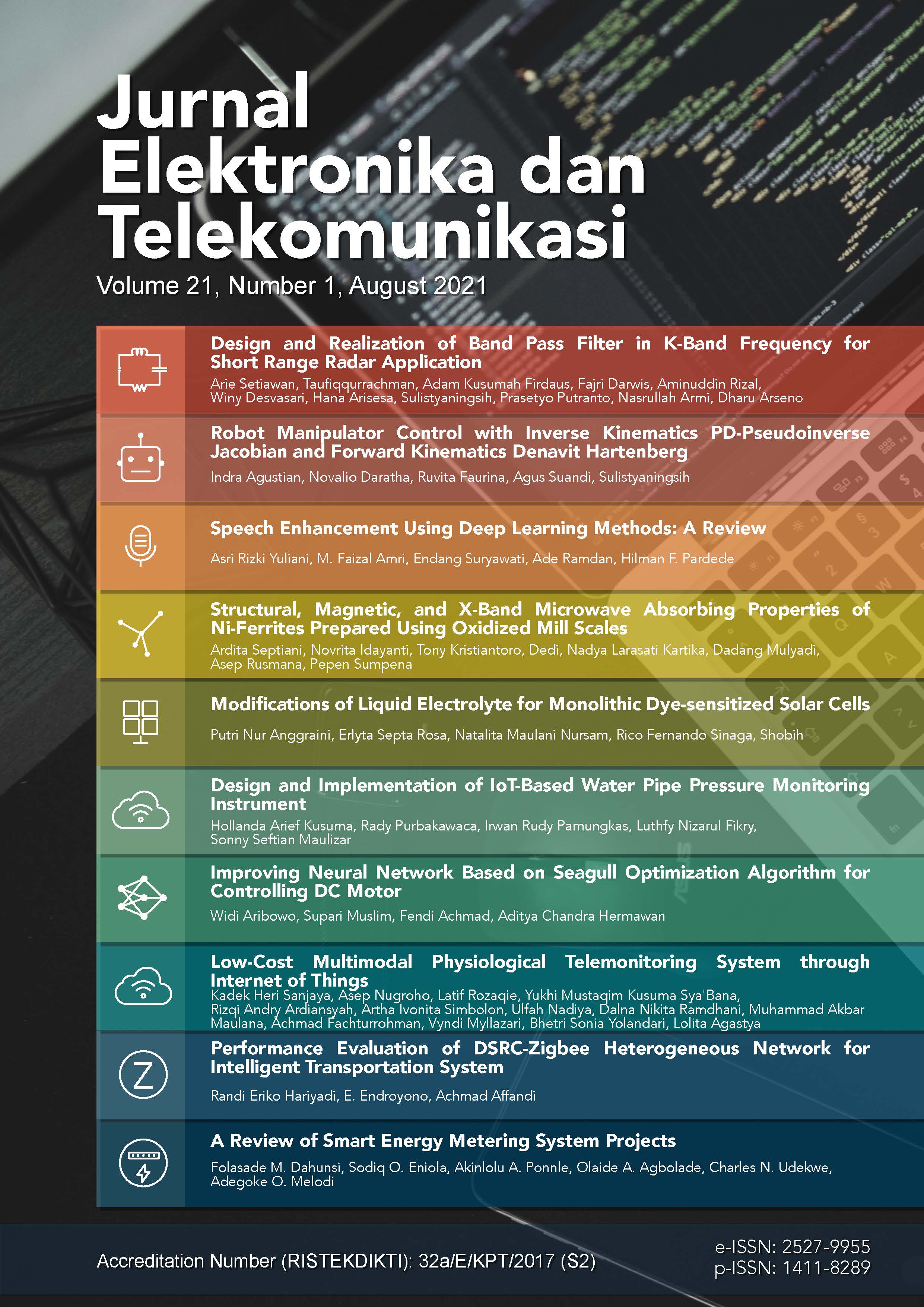
Robot Manipulator Control with Inverse Kinematics PD-Pseudoinverse Jacobian and Forward Kinematics Denavit Hartenberg
DOI:
https://doi.org/10.14203/jet.v21.8-18Keywords:
robot manipulator, robotic arm, inverse kinematics, proportional derivative, pseudoinverse jacobian, forward kinematics, denavit hartenberg, color sortingAbstract
This paper presents the development of vision-based robotic arm manipulator control by applying Proportional Derivative-Pseudoinverse Jacobian (PD-PIJ) kinematics and Denavit Hartenberg forward kinematics. The task of sorting objects based on color is carried out to observe error propagation in the implementation of manipulator on real system. The objects image captured by the digital camera were processed based on HSV-color model and the centroid coordinate of each object detected were calculated. These coordinates are end effector position target to pick each object and were placed to the right position based on its color. Based on the end effector position target, PD-PIJ inverse kinematics method was used to determine the right angle of each joint of manipulator links. The angles found by PD-PIJ is the input of DH forward kinematics. The process was repeated until the square end effector reached the target. The experiment of model and implementation to actual manipulator were analyzed using Probability Density Function (PDF) and Weibull Probability Distribution. The result shows that the manipulator navigation system had a good performance. The real implementation of color sorting task on manipulator shows the probability of success rate cm is 94.46% for euclidian distance error less than 1.2 cm.Downloads
References
R. Kelly, V. S. Davila and J. A. L. Perez, Control of Robot Manipulators in Joint Space, London: Springer Science & Business Media, 2006.
I. O. Standardization, ISO 8373: 2012 (en): Robots and Robotic Devices—Vocabulary, 2012.
P. Corke, Robotics, Vision and Control: Fundamental Algorithms in MATLAB® Second, Completely Revised, vol. 118, NY: Springer, 2017.
B. Siciliano and O. Khatib, Springer Handbook of Robotics, Berlin: Springer, 2016.
E. Abele, M. Weigold and S. Rothenbücher, “Modeling and identification of an industrial robot for machining applications,” Cirp Annals-manuf. Technol., vol. 56, pp. 387-390, 2007. Crossref
M. W. Spong, S. Hutchinson and M. Vidyasagar, Robot Dynamics and Control, 2nd ed., New York, NY, USA: John Wiley & Sons, 2004.
Sumardi, L. Febriramadhan and A. Triwiyatno, “Design of color based object sorting through arm manipulator with inverse kinematics method,” in 2016 3rd Int. Conf. Inform. Technol., Comput. Elect. Eng., 2016. Crossref
G. I. E. Panie and A. B. Mutiara, “Development of robotic arm for color based goods sorter in factory using TCS3200 sensor with a web-based monitoring system,” in 2018 Third Int. Conf. Informatics Computing, 2018. Crossref
M. Nkomo and M. Collier, “A color-sorting SCARA robotic arm,” in 2012 2nd Int. Conf. Consumer Electron. Commun. Netw., 2012. Crossref
S. A. Khan, T. Z. Anika, N. Sultana, F. Hossain and M. N. Uddin, “Color sorting robotic arm,” in 2019 Int. Conf. Robot. Elect. Signal Process. Techniques, 2019. Crossref
A. Djajadi, F. Laoda, R. Rusyadi, T. Prajogo and M. Sinaga, “A model vision of sorting system application using robotic manipulator,” TELKOMNIKA Telecomunn. Computing Electron. Control, vol. 8, pp. 137-148, 2010. Crossref
R. Szabo and I. Lie, “Automated colored object sorting application for robotic arms,” in 2012 10th Int. Symp. Electron. Telecommun., 2012. Crossref
A. A. Ata, S. F. Rezeka, A. El-Shenawy and M. Diab, “Design and development of 5-DOF color sorting manipulator for industrial applications,” World Academy Sci. Eng. Technol. Int. J. Mech. Aerosp. Ind. Mechatron. Manuf. Eng., vol. 7, pp. 2457-2464, 2013. Crossref
S. KuCuk and Z. Bingul, “The inverse kinematics solutions of industrial robot manipulators,” in Proc. the IEEE Int. Conf. Mechatron. 2004, 2004. Crossref
C.-Y. Tsai, C.-C. Wong, C.-J. Yu, C.-C. Liu and T.-Y. Liu, “A hybrid switched reactive-based visual servo control of 5-DOF robot manipulators for pick-and-place tasks,” IEEE Syst. J., vol. 9, pp. 119-130, 2014. Crossref
Y. Jia, G. Yang and J. Saniie, “Real-time color-based sorting robotic arm system,” in 2017 IEEE Int. Conf. Electro Inform. Technol., 2017. Crossref
A. C. Abad, D. D. Ligutan, E. P. Dadios, L. J. S. Cruz, M. C. D. P. Del Rosario, and J. N. S. Kudhal, “Fuzzy logic-controlled 6-DOF robotic arm color-based sorter with machine vision feedback,” Int. J. Adv. Comput. Sci. Appl, vol. 9, pp. 21-31, 2018. Crossref
B. Gray, "Introducing the MeArm," Mime Industries, June 14, 2019. [Online]. Available: https://mearm.com/2019/06/14/welcome-to-my-blog/. [Accessed 25 July 2019].
R. C. Gonzalez, R. E. Woods and S. L. Eddins, Digital Image Processing using MATLAB, Gatesmark Publishing, pp. 99-101, 2009.
C. Solomon and T. Breckon, Fundamentals of Digital Image Processing: A practical approach with examples in Matlab, John Wiley & Sons, 2011.
J. Denavit and R. S. Hartenberg, “Kinematic modelling for robot calibration,” Trans. American Soc. Mech. Eng. J. Appl. Mechanics, vol. 22, pp. 215-221, 1955.
D. E. Whitney, “Resolved motion rate control of manipulators and human prostheses,” IEEE Trans. Man-Mach. Syst., vol. 10, pp. 47-53, 1969. Crossref
D. E. Whitney, “The mathematics of coordinated control of prosthetic arms and manipulators,” American Soc. Mech. Eng. J. Dyn. Syst. Meas. Control, vol. 94, pp. 303-309, 1972. Crossref
K. J. Åström and T. Hägglund, PID Controllers: Theory, Design, And Tuning, vol. 2, NC: ISA: The Instrumentation, Systems, and Automation Society, 1995.
K. J. Åström, T. Hägglund and K. J. Astrom, Advanced PID Control, vol. 461, NC: ISA-The Instrumentation, Systems, and Automation Society, 2006.
S. R. Buss and J.-S. Kim, “Selectively damped least squares for inverse kinematics,” J. Graph. Tools, vol. 10, pp. 37-49, 2005. Crossref
W. M. Elawady, Y. Bouteraa and A. Elmogy, “An adaptive second order sliding mode inverse kinematics approach for serial kinematic chain robot manipulators,” Robot., vol. 9, p. 4, 2020. Crossref
S. Kucuk and Z. Bingul, “Robot kinematics: Forward and inverse kinematics”, in Industrial Robotics: Theory, Modelling and Control, InTech, 2006. Crossref
L.-C. T. Wang and C.-C. Chen, “A combined optimization method for solving the inverse kinematics problems of mechanical manipulators,” IEEE Trans. Robot Autom., vol. 7, pp. 489-499, 1991. Crossref
A. Aristidou and J. Lasenby, “Inverse kinematics: a review of existing techniques and introduction of a new fast iterative solver,” Cambridge Univ. Dept. Eng. Tech. Rep., 2009.
W. A. Wolovich and H. Elliott, “A computational technique for inverse kinematics,” in 23rd IEEE Conf. Decision and Control, 1984. Crossref
I. Dulęba and M. Opałka, “A comparison of Jacobian-based methods of inverse kinematics for serial robot manipulators,” Int. J. Appl. Math. Comput. Sci., vol. 23, pp. 373-382, 2013. Crossref
R. Penrose, “A generalized inverse for matrices,” Math. Proc. Cambridge Philosoph. Soc., vol. 51, p. 406–413, 1955. Crossref
A. Dresden, “The fourteenth western meeting of the American Mathematical Society,” Bull. Amer. Math. Soc., vol. 26, pp. 385-396, 6 1920.
E. R. Vimina and K. P. Jacob, “Content based image retrieval using low level features of automatically extracted regions of interest,” J. Image Graph., vol. 1, pp. 7-11, 2013. Crossref
Z. Liu, W. Chen, Y. Zou and C. Hu, “Regions of interest extraction based on HSV color space,” in IEEE 10th Int. Conf. Ind. Informatics, 2012. Crossref
M. P. Kaminskiy and V. V. Krivtsov, “A simple procedure for Bayesian estimation of the Weibull distribution,” IEEE Trans. Rel., vol. 54, pp. 612-616, 2005. Crossref
Downloads
Published
Issue
Section
License
Authors who publish with this journal agree to the following terms:
The copyright to this article is transferred to BRIN if and when the article is accepted for publication. The undersigned hereby transfers any and all rights in and to the paper including without limitation all copyrights to BRIN. The undersigned hereby represents and warrants that the paper is original and that he/she is the author of the paper, except for material that is clearly identified as to its original source, with permission notices from the copyright owners where required. The undersigned represents that he/she has the power and authority to make and execute this assignment. The copyright transfer form can be downloaded here.
The corresponding author signs for and accepts responsibility for releasing this material on behalf of any and all co-authors. This agreement is to be signed by at least one of the authors who have obtained the assent of the co-author(s) where applicable. After submission of this agreement signed by the corresponding author, changes of authorship or in the order of the authors listed will not be accepted.

This work is licensed under a Creative Commons Attribution-NonCommercial-ShareAlike 4.0 International License.