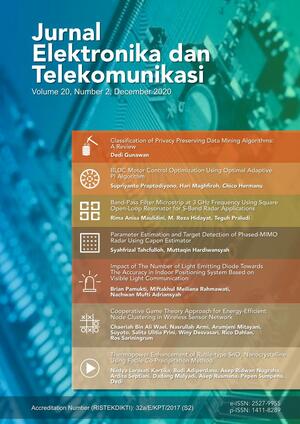
Impact of The Number of Light Emitting Diode Towards The Accuracy in Indoor Positioning System Based on Visible Light Communication
DOI:
https://doi.org/10.14203/jet.v20.70-75Keywords:
visible light communication, light emitting diode, received signal strength, accuracy, positioning errorAbstract
This research detects the random position with received signal strength (RSS) method based on the received power in the room with a size of 5×5×3 cubic meter and several numbers of light emitting diode (LEDs). The first scenario uses 4 LEDs, the second scenario uses 6 LEDs and the third scenario uses 8 LEDs. Random points as the detector are placed spread at the room as many as 25 points. The simulation result shows that the use of more LEDs reduces the positioning error and increases the accuracy. If the accuracy reduces, the positioning error increase and affect the detection results. Using 8 LEDs, the number of the detected random point increases 30%, the positioning error is 47%, and the accuracy increase from 33%. In addition, our research is useful for finding the locations of small items such as sensors that are scattered in a closed room.Downloads
References
S. Yang, E. Jung and S. Han, “Indoor Location Estimation Based on LED Visible light communication using multiple optical receivers,” IEEE Communications Letters, vol. 17, no. 9, pp. 1834-1837, September 2013. Crossref
H. Lv, L. Feng, A. Yang, P. Guo, H. Huang, and S. Chen, “High accuracy VLC indoor positioning system with differential detection,” IEEE Photonics Journal, vol. 9, no. 3, pp. 1–13, 2017. Crossref
K. Okusa and T. Kamakura, “Indoor location estimation based on the rss method using radial log-normal distribution,” 16th IEEE International Symposium on Computational Intelligence and Informatics (CINTI), 2015, pp. 29–34. Crossref
S. Shawky, M. A. El-Shimy, Z. A. El-Sahn, M. R. Rizk, and M. H. Aly, “Improved VLC-based indoor positioning system using a regression approach with conventional RSS techniques,” in 2017 13th International Wireless Communications and Mobile Computing Conference (IWCMC), 2017, pp. 904–909. Crossref
Z. Cui, Y. Wang and X. Fu, “Research on indoor positioning system based on VLC,” 2020 Prognostics and Health Management Conference (PHM-Besançon), 2020, pp. 360-365. Crossref
J. Wang, H. Li, X. Zhang and R. Wu, “VLC-based indoor positioning algorithm combined with OFDM and particle filter,” in China Communications, vol. 16, no. 1, pp. 86-96, Jan. 2019.
O.R.Popoola,S.Sinanovic ́,W.O.Popoola,and R.Ramirez-Iniguez, “Optical boundaries for led-based indoor positioning system,” Computation, vol. 7, no. 1, p. 7, 2019. Crossref
D. Darlis, A. R. Darlis, and M. H. Abibi, “Implementasi sistem penyiaran musik digital di kafe menggunakan visible light communication,” TELKOMIKA: Jurnal Teknik Energi Elektrik, Teknik Telekomunikasi, & Teknik Elektronika, vol. 5, no. 1, p. 60, 2017. Crossref
Z. Ghassemlooy, W. Popoola, and S. Rajbhandari, Optical Wireless Communications: System and Channel Modelling with MATLAB®. CRC press, 2019.
C. Wang, L. Wang, X. Chi, S. Liu, W. Shi, and J. Deng, “The research of indoor positioning based on visible light communication,” China Communications, vol. 12, no. 8, pp. 85–92, 2015.
Downloads
Published
Issue
Section
License
Authors who publish with this journal agree to the following terms:
The copyright to this article is transferred to BRIN if and when the article is accepted for publication. The undersigned hereby transfers any and all rights in and to the paper including without limitation all copyrights to BRIN. The undersigned hereby represents and warrants that the paper is original and that he/she is the author of the paper, except for material that is clearly identified as to its original source, with permission notices from the copyright owners where required. The undersigned represents that he/she has the power and authority to make and execute this assignment. The copyright transfer form can be downloaded here.
The corresponding author signs for and accepts responsibility for releasing this material on behalf of any and all co-authors. This agreement is to be signed by at least one of the authors who have obtained the assent of the co-author(s) where applicable. After submission of this agreement signed by the corresponding author, changes of authorship or in the order of the authors listed will not be accepted.

This work is licensed under a Creative Commons Attribution-NonCommercial-ShareAlike 4.0 International License.