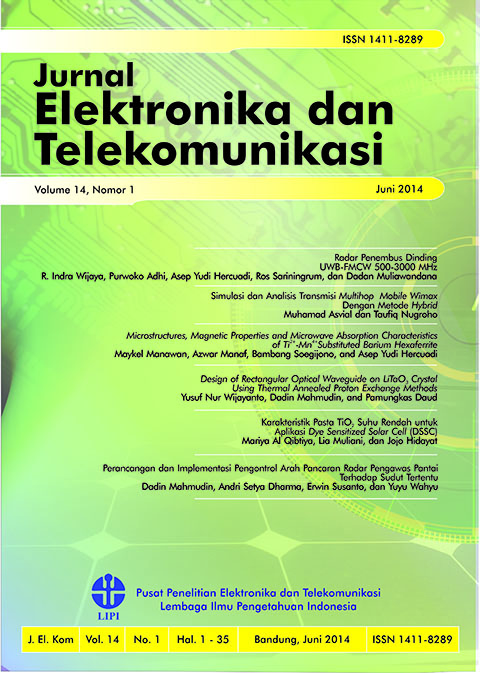
Radar Penembus Dinding UWB-FMCW 500-3000 MHz
DOI:
https://doi.org/10.14203/jet.v14.1-7Keywords:
radar, penembus dinding, pembangkit chirp UWB, akuisisi data berkecepatan tinggi, deteksi objek, FMCWAbstract
Radar penembus dinding memiliki potensi untuk dapat digunakan dalam penanganan pasca bencana dan gangguan keamanan.Tulisan ini membahas hasil perancangan dan pembuatan sistem Radar Penembus Dinding Ultra Wide Band Frequency Modulated Continous Wave (UWB-FMCW) yang digunakan untuk mendeteksi keberadaan suatu objek di balik dinding. Dalam penelitian ini dikembangkan pembangkit chirp UWB menggunakan kombinasi DDS dan VCO sebagai komponen utama pembangkit gelombang FMCW untuk mendapatkan linearitas yang tinggi, merealisasikan tranceiver dalam arsitektur homodyne, mengembangkan modul akuisisi, serta merealisasikan perangkat lunak untuk melakukan pengolahan sinyal dan menampilkannya dalam bentuk citra secara real time menggunakan MS Visual C++. Sistem radar penembus dinding didesain untuk memiliki resolusi 6 cm dan jarak tidak ambigu 30 m, pada rentang pita frekuensi kerja 500 - 3000 MHz. Dari hasil pengujian dalam skala laboratorium radar ini mampu melakukan identifikasi objek dibalik dinding yang terbuat dari kayu setebal 3 cm pada jarak 4 m dan menampilkannya dalam bentuk citra A-Scan dan B-Scan secara real time.
Downloads
References
M. Aftanas, “Through Wall Imaging with UWB Radar System”, Disertasi, Technical University of Kosice, August, 2009.
A. Nezirovic, “Trapped-Victim Detection in Post-Disaster Scenarios using Ultra-Wideband Radar”, Disertasi, International Recearch Center for Telecommunications and Radar, Delft University of Technology, 2010.
S. E. Hamran, T. Berger, L. Hanssen, and M. J. Oyan, “Gated UWB FMCW/SF radar for ground penetration and through the wall applications”, Sensors and Electronics Panel (SET) Specialists´ Meeting, MP-SET-120-01, NATO Research and Technology Organisation, Toulouse, France, 27-28 October 2008.
FCC, “Revision of part 15 of the commission’s rules regarding ultrawideband transmission systems”, First report and order, ET Docket 98-153, FCC 02-48, Feb. 2002, pp. 1–118.
E. Staderini. (2001) Everything you always wanted to know about UWB radar: A practical introduction to the Ultra Wideband Technology. [Online] Available: http://www.uniroma2.it/fismed/faculty/Stadero/papers/osee.pdf.
N. Maaref, P. Millot, C. Pichot, and O. Picon, “A study of UWB FMCW radar for the detection of human beings in motion inside a building”, IEEE Transactions on Geoscience and Remote Sensing, in press.
X. Zhuge, T. G. Savelyev, A. G. Yarovoy, “Assessment of electromagnetic requirements for UWB through-wall radar”,. ICEAA 2007, in proc. International Conference on Electromagnetics in Advanced Applications, 2007, 17-21 Sept. 2007, pp.923-926.
A. Wojtkiewicz, J. Misiurewicz, M. Nałecz, K. Jedrzejewski, and K. Kulpa, “Two-dimensional signal processing in FMCW radars”, in Proc. XX KKTOiUE, Kołobrzeg, Poland, 1997, pp. 475–480.
R. H. Khan and D. K. Mitchell, “Waveform analysis for highfrequency
FMICW radar”, Radar and Signal Processing, IEE Proceedings F , vol.138, no.5, Oct 1991, pp.411-419.
A. Y. Hercuadi, “Pengembangan Perangkat Dielectric Resonance Oscilator”, Laporan Akhir Program Insentif Peneliti dan Perekayasa LIPI Tahun 2011, 2011.
P. Adhi, “Pembangkitan chirp untuk radar FM CW menggunakan DDS”, Prosiding Seminar Radar Nasional III, 2009, hal. 143-146.
Downloads
Published
Issue
Section
License
Authors who publish with this journal agree to the following terms:
The copyright to this article is transferred to BRIN if and when the article is accepted for publication. The undersigned hereby transfers any and all rights in and to the paper including without limitation all copyrights to BRIN. The undersigned hereby represents and warrants that the paper is original and that he/she is the author of the paper, except for material that is clearly identified as to its original source, with permission notices from the copyright owners where required. The undersigned represents that he/she has the power and authority to make and execute this assignment. The copyright transfer form can be downloaded here.
The corresponding author signs for and accepts responsibility for releasing this material on behalf of any and all co-authors. This agreement is to be signed by at least one of the authors who have obtained the assent of the co-author(s) where applicable. After submission of this agreement signed by the corresponding author, changes of authorship or in the order of the authors listed will not be accepted.

This work is licensed under a Creative Commons Attribution-NonCommercial-ShareAlike 4.0 International License.