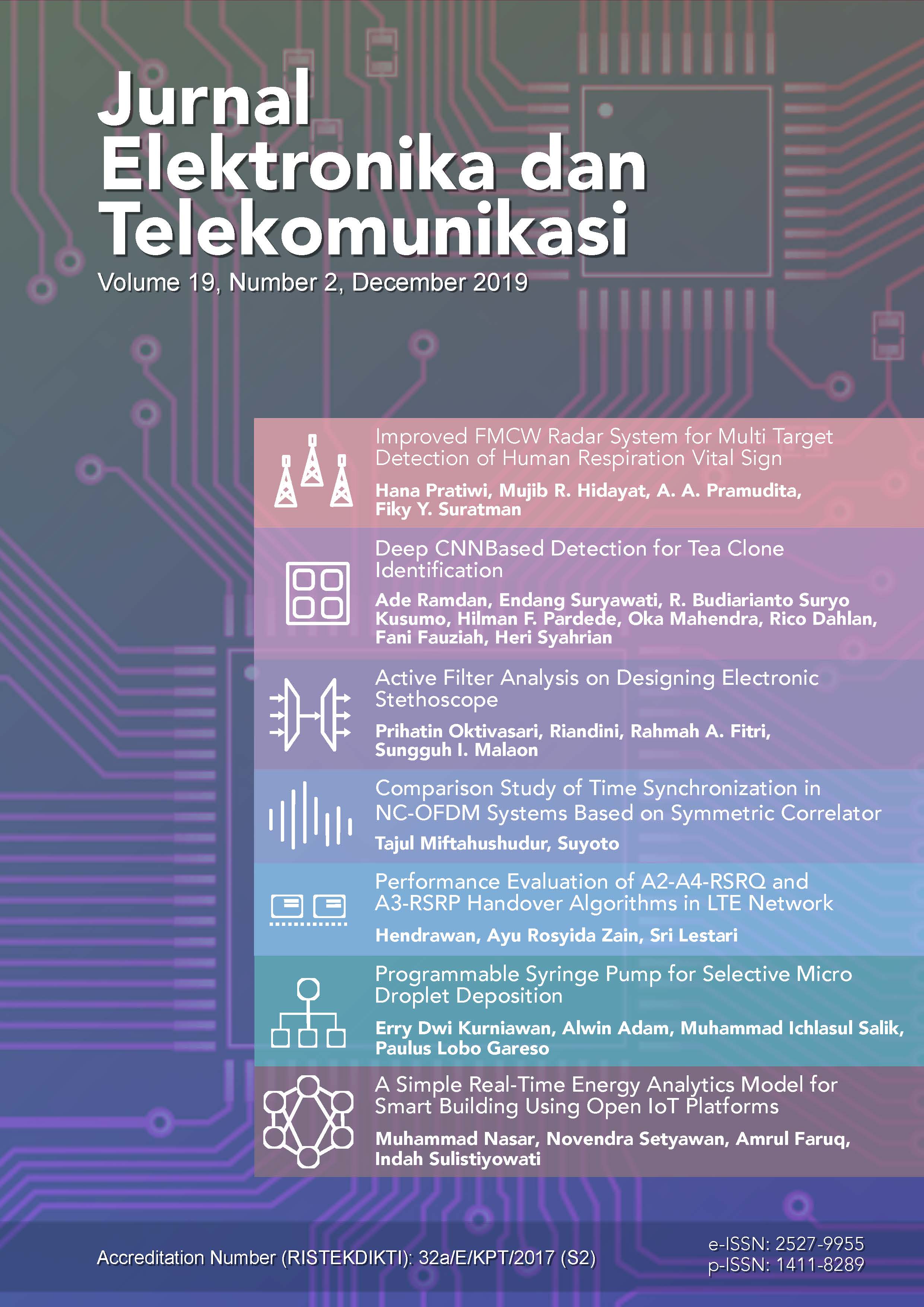
Improved FMCW Radar System for Multi-Target Detection of Human Respiration Vital Sign
DOI:
https://doi.org/10.14203/jet.v19.38-44Keywords:
Human respiration, FMCW, small displacements, multi-target detectionAbstract
Frequency Modulated Continuous Wave (FMCW) radar system has been developed and applied for various needs. Based on the conventional FMCW radar concept, a large bandwidth is needed to detect small displacements in the chest wall or abdomen related with respiratory activity. To overcome the need for large bandwidths in detecting vital respiratory signs, several improvements to the FMCW system are proposed in this paper. The phase-detection concept has been elaborated in improving the capability of FMCW to detect the small displacement. In developing multi-target detection capability, range detection capability through beat frequency output needs to be combined with the phase-detection method. Theoretical and simulation studies were performed to investigate the concept of combining range detection and phase detection for detecting respiration on multi-target. The results show that the proposed method is well-performed in detecting the multi-target respiration in high noise reflection.
Downloads
References
F.T.Z. Khanam, A. Al-Naji, and J. Chahl, "Remote Monitoring of Vital Signs in Diverse Non-Clinical and Clinical Scenarios Using Computer Vision Systems: A Review," Applied Sciences, 9(20), p.4474, 2019. Crossref
S. Pisa, E. Pittella, and E. Piuzzi, "A survey of radar systems for medical applications," IEEE Aerospace and Electronic Systems Magazine, vol. 31, no. 11. Institute of Electrical and Electronics Engineers Inc., pp. 64–81, 01-Nov-2016. Crossref
B. S. and H. S. M. Leib, W. Menzel, "Vital signs monitoring with a UWB radar based on a correlation receiver," in Proc. of the Fourth European Conference on Antennas and Propagation, 2010, pp. 1–5.
C. H. Hsieh, Y. F. Chiu, Y. H. Shen, T. S. Chu, and Y. H. Huang, "A UWB Radar Signal Processing Platform for Real-Time Human Respiratory Feature Extraction Based on Four-Segment Linear Waveform Model," IEEE Trans. Biomed. Circuits Syst., vol. 10, no. 1, pp. 219-230, Feb. 2016. Crossref
J. Tu and J. Lin, "Fast acquisition of heart rate in noncontact vital sign radar measurement using time-window-variation technique," IEEE Trans. Instrum. Meas., vol. 65, no. 1, pp. 112–122, Jan. 2016. Crossref
D. Zhang, M. Kurata, and T. Inaba, "FMCW radar for small displacement detection of vital signal using projection matrix method," Int. J. Antennas Propag., vol. 2013, 2013. Crossref
K. Van Loon, M.J.M. Breteler, L. Van Wolfwinkel, A.R. Leyssius, S. Kossen, C.J. Kalkman, B van Zaane, B. and L.M. Peelen, "Wireless non-invasive continuous respiratory monitoring with FMCW radar: a clinical validation study," Journal of clinical monitoring and computing, 30(6), pp.797-805, 2016. Crossref
C. Li, W. Chen, G. Liu, R. Yan, and Y. Qi, "A noncontact fmcw radar sensor for displacement measurement in structural health monitoring," Sensors (Switzerland), vol. 15, no. 4, pp. 7412–7433, Mar. 2015. Crossref
K. A. C. De Macedo, F. L. G. Ramos, C. Gaboardi, J. R. Moreira, F. Vissirini, and M. S. Da Costa, "A Compact Ground-Based Interferometric Radar for Landslide Monitoring: The Xerém Experiment," IEEE J. Sel. Top. Appl. Earth Obs. Remote Sens., vol. 10, no. 3, pp. 975–986, Mar. 2017. Crossref
ICNIRP, Guidelines For Limiting Exposure To Time-Varying Electric, Magnetic, And Electromagnetic Fields (up to 300 GHz) International Commission On Non-Ionizing Radiation Protection. 1998.
"Council Recommendation 1999/519/EC on the limitation of exposure of the general public to electromagnetic fields (0 Hz to 300 GHz) - Safety and health at work - EU-OSHA," [Online]. Available: https://osha.europa.eu/en/legislation/guidelines/council-recommendation-1999-519-ec-on-the-limitation-of-exposure-of-the-general-public-to-electromagnetic-fields-0-hz-to-300-ghz. [Accessed: 19-Nov-2019].
B. R. Mahafza, Radar systems analysis and design using MATLAB. CRC Press, 2013.
B. K. Park, O. Boric-Lubecke, and V. M. Lubecke, "Arctangent demodulation with DC offset compensation in quadrature Doppler radar receiver systems," IEEE Trans. Microw. Theory Tech., vol. 55, no. 5, pp. 1073–1078, May 2007. Crossref
D. Girbau, A. Lázaro, Á. Ramos, and R. Villarino, "Remote sensing of vital signs using a doppler radar and diversity to overcome null detection," IEEE Sens. J., vol. 12, no. 3, pp. 512–518, 2012. Crossref
R. Ambarini, A. A. Pramudita, E. Ali, and A. D. Setiawan, "Single-Tone Doppler Radar System for Human Respiratory Monitoring," in Proc. 5th International Conference on Electrical Engineering, Computer Science and Informatics (EECSI), 2019, pp. 571–575. doi: 10.1109/EECSI.2018.8752871 Crossref
A. A. Pramudita, F. Y. Suratman, D. Arseno, and E. Ali, "FMCW Radar Post Processing Method for Small Displacement Detection," in Proc. of the 2018 IEEE International Conference on Aerospace Electronics and Remote Sensing Technology, 2018, pp. 61–65. Crossref
Downloads
Published
Issue
Section
License
Authors who publish with this journal agree to the following terms:
The copyright to this article is transferred to BRIN if and when the article is accepted for publication. The undersigned hereby transfers any and all rights in and to the paper including without limitation all copyrights to BRIN. The undersigned hereby represents and warrants that the paper is original and that he/she is the author of the paper, except for material that is clearly identified as to its original source, with permission notices from the copyright owners where required. The undersigned represents that he/she has the power and authority to make and execute this assignment. The copyright transfer form can be downloaded here.
The corresponding author signs for and accepts responsibility for releasing this material on behalf of any and all co-authors. This agreement is to be signed by at least one of the authors who have obtained the assent of the co-author(s) where applicable. After submission of this agreement signed by the corresponding author, changes of authorship or in the order of the authors listed will not be accepted.

This work is licensed under a Creative Commons Attribution-NonCommercial-ShareAlike 4.0 International License.