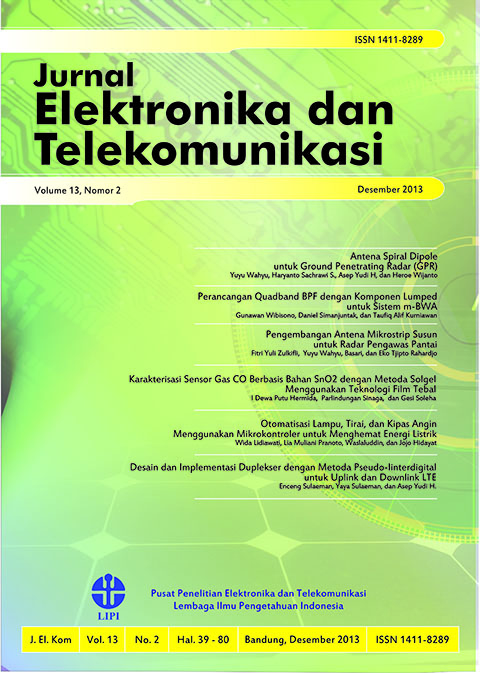
Karakterisasi Sensor Gas CO Berbasis Bahan SnO2 dengan Metoda Solgel Menggunakan Teknologi Film Tebal
DOI:
https://doi.org/10.14203/jet.v13.60-65Keywords:
sensor gas CO, SnO2, teknologi film tebal, solgelAbstract
Sensor gas SnO2 termasuk sensor yang paling banyak digunakan dan dikembangkan di pasaran, tapi sampai saat ini belum bisa menghasilkan sensitivitas yang tinggi. Dalam penelitian ini dibahas mengenai karakterisasi sensor gas CO dengan teknologi film tebal yang berbahan SnO2 dan diharapkan dapat menghasilkan sensor dengan sensitivitas yang tinggi. Hasil XRD menunjukan bahwa struktur dari SnO2 adalah rutile tetragonal. Dari pola difraksi terlihat puncak-puncak 110 dan 101 yang menunjukkan pola difraksi yang dibentuk oleh kristal SnO2. Hasil SEM menunjukkan bahwa ukuran sensor dapat mencapai 264 nanometer. Hasil EDS (Energy Dispersive X Ray Spectroscopy) menunjukkan bahwa lapisan sensor yang terbentuk memiliki komposisi O2 (Oksigen) dengan persen massa 21,23% dan Sn (Stanum) dengan persen massa 78,77%. Pengujian sensor dilakukan untuk mengetahui pengaruh perubahan temperatur operasional dan konsentrasi gas terhadap resistansi sensor. Perubahan yang terjadi dalam sensor gas ini, berupa resitansi yang menurun dengan bertambahnya temperatur dan konsentrasi gas CO. Dari hasil pengujian tersebut diketahui bahwa komponen-komponen penyusun sensor dapat merespon adanya gas CO. Nilai sensitivitas yang baik didapat dari hasil pengujian untuk rentang konsentrasi gas 0-500 ppm adalah 9,10-3/ppm.Downloads
References
A. V . Patil, C. G. Dighavkar , S. K.Sonawane , S. J. Patila, R. Y. Borsea, “Effect of firing temperature on electrical and structural characteristic of screen printed ZnO thick film”, Journal of Optoelectronic and Biomedical Materials, vol. 1, issue 2, pp. 226 – 233, June 2009.
Retnaningsih L dan Hermida I. D. P (2006), “Karakterisasi Sensor Gas Karbon Monoksida (CO) Berbasis Bahan SnO2”, Prosiding Seminar Nasional VIII – Jaringan Kerjasama Kimia Indonesia, 26-27 April 2005, Yogyakarta, ISSN 0854-4778.
M. R. Haskard, Thick Film Hybrid: Manufacture and Design, Sydney, Australia: Prentice Hall, 1988.
N. Barsan and U. Weimar, “Understanding the fundamental principles of metal oxide based gas sensors; the example of CO sensing with SnO2 sensors in the presence of humidity”, Journal of Physics: Condensed Matter, vol. 15, pp. R813-R839, 2003.
B. Licznerski, “Thick-film gas microsensors based on tin dioxide”, Bulletin of The Polish Academy of Sciences Technical Sciences, vol. 52, no. 1, pp. 37-42, 2004.
A. Fluerasu, N. Barsan, and K. K. Chin “Reducing gas sensing mechanisms in thick porous SnO2 layers”, Bulletin of the American Physical Society, March 20-24, 2000.
C. J. Brinker and G. W. Scherer, Sol-Gel Science - The Physics and Chemistry of Sol-Gel Processing, New York, USA: Academic Press, 1990.
Downloads
Published
Issue
Section
License
Authors who publish with this journal agree to the following terms:
The copyright to this article is transferred to BRIN if and when the article is accepted for publication. The undersigned hereby transfers any and all rights in and to the paper including without limitation all copyrights to BRIN. The undersigned hereby represents and warrants that the paper is original and that he/she is the author of the paper, except for material that is clearly identified as to its original source, with permission notices from the copyright owners where required. The undersigned represents that he/she has the power and authority to make and execute this assignment. The copyright transfer form can be downloaded here.
The corresponding author signs for and accepts responsibility for releasing this material on behalf of any and all co-authors. This agreement is to be signed by at least one of the authors who have obtained the assent of the co-author(s) where applicable. After submission of this agreement signed by the corresponding author, changes of authorship or in the order of the authors listed will not be accepted.

This work is licensed under a Creative Commons Attribution-NonCommercial-ShareAlike 4.0 International License.