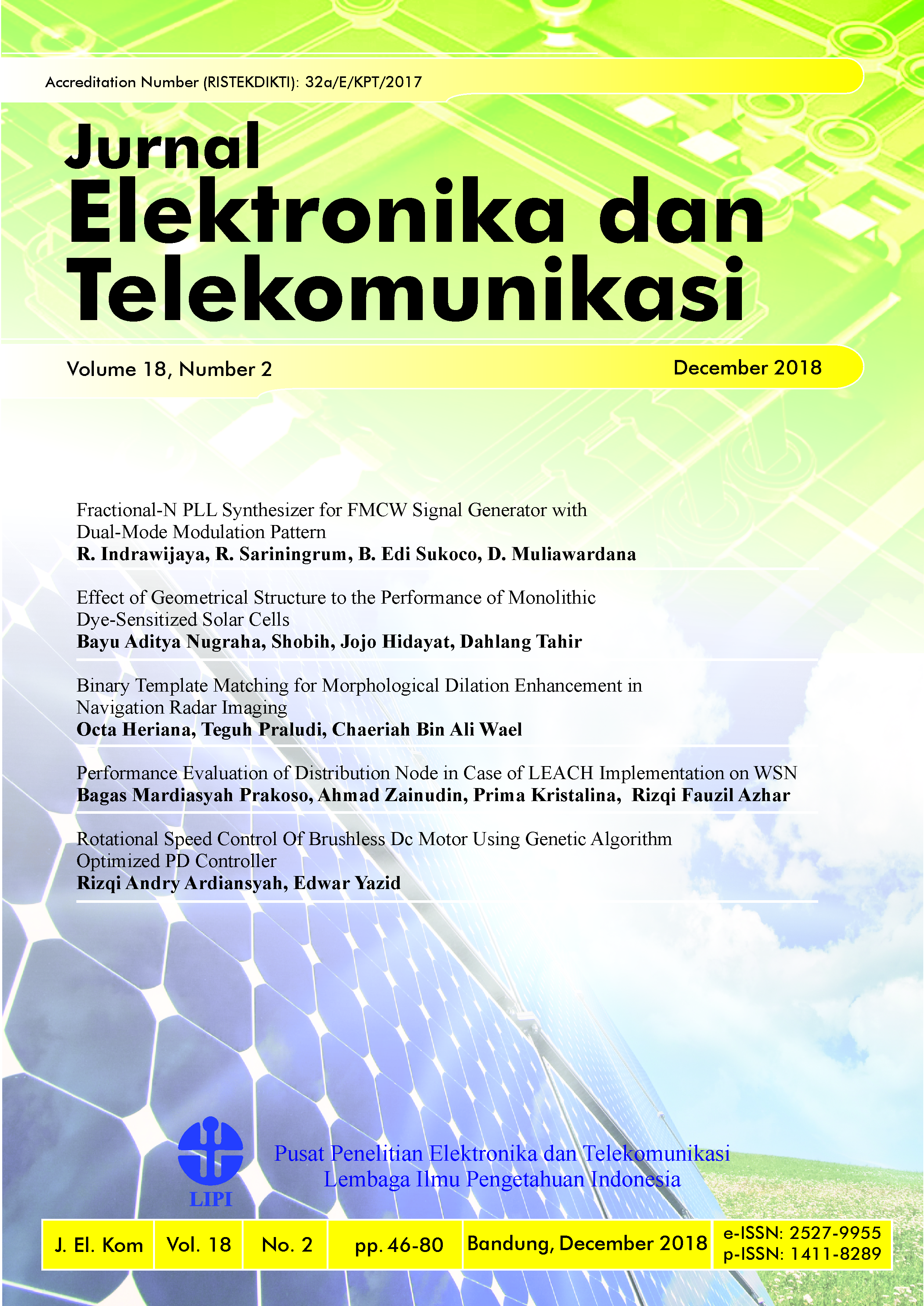
Rotational Speed Control of Brushless Dc Motor Using Genetic Algorithm Optimized PD Controller
DOI:
https://doi.org/10.14203/jet.v18.75-80Keywords:
Rotational speed, BLDC motor, PD controller, genetic algorithmAbstract
Controlling the rotational speed of brushless DC (BLDC) motor is an essential task to improve the transient and the steady state performances under loaded condition. Rotational speed control of BLDC motor using genetic algorithm optimized proportional-derivative (PD) controller to form what the so-called the genetic algorithm-PD (GA-PD) controller is proposed in this paper. Control system is realized in a microcontroller namely a 16MHz Atmega2560 with an absolute encoder as a position sensor. The effectiveness of the GA-PD controller is tested under constant and varying step functions with the Ziegler-Nichols-PD (ZN-PD) controller as a benchmark. Experimental results show that the GA-PD controller has slower speed than the ZN-PD controller, but the latter has overshoot and small oscillations during its steady state condition as a consequent of having a fast rise time.
Downloads
References
K. Premkumar and B.V.Manikandan, “Adaptive neuro-fuzzy inference system based speed controller for brushless DC motor”, Neurocomputing, vol. 138, pp. 260-270, 2014. Crossref
K. Premkumar and B.V.Manikandan,”Speed control of BLDC motor using bat algorithm optimized adaptive neuro-fuzzy inference system”, Applied Soft Computing, vol. 138, pp. 260-270, 2015. Crossref
K. Premkumar and B.V.Manikandan, “Fuzzy PID supervised online ANFIS based speed controller for brushless DC motor”, Neurocomputing, vol. 157, pp. 76-90, 2015. Crossref
A.A. El-Samahy and M.A. Shamseldin, “Brushless DC motor tracking control using self-tuning fuzzy PID control and model reference adaptive control”, Ain Shams Engineering Journal, In Press, pp. 76-90, 2016. Crossref
M. Tariq, et al., “Fast response antiwindup PI speed controller of brushless DC motor drive: modelling, simulation and implementation on DSP”, Journal of Electrical Systems and Information Technology, vol. 3, pp. 1-13, 2016. Crossref
E. Gowthaman, et al., “Speed control of permanent magnet brushless DC motor using hybrid fuzzy proportional plus integral plus derivative controller”, Energy Procedia, vol. 117, pp. 1101-1108, 2017. Crossref
H.E.A. Ibrahim, F.N. Hassan, and A.O. Shomer, “Optimal PID control of a brushless DC motor using PSO and BF techniques”, Ain Shams Engineering Journal, vol. 5, pp. 391-398, 2014. Crossref
S. Zhang and Y. Wang, “The simulation of BLDC motor speed control based-optimized fuzzy PID algorithm”, in Proc. IEEE International Conference on Mechatronics and Automation, 2016, pp. 287 –292. Crossref
A. Varshney, D. Gupta, and B. Dwivedi,”Speed response of brushless DC motor using fuzzy PID controller under varying load condition”, Journal of Electrical Systems and Information Technology, vol. 4, pp. 310-321,2017. Crossref
J. Joy, and S. Ushakumari, “Performance comparison of a sensorless PMBLDC motor drive system with conventional and fuzzy logic controllers”, Procedia Technology, vol. 25, pp. 643-651, 2016. Crossref
KC AXHM5100 BLDCM user manual, Oriental Motor, 2014.
E. Yazid, M.S. Liew, S. Parman, and V.J. Kurian, “Improving the modelling capacity of Volterra model using evolutionary computing methods based on Kalman smoother adaptive filter”, Journal of Applied Soft Computing, vol. 35, pp. 695-707, 2015. Crossref
Downloads
Published
Issue
Section
License
Authors who publish with this journal agree to the following terms:
The copyright to this article is transferred to BRIN if and when the article is accepted for publication. The undersigned hereby transfers any and all rights in and to the paper including without limitation all copyrights to BRIN. The undersigned hereby represents and warrants that the paper is original and that he/she is the author of the paper, except for material that is clearly identified as to its original source, with permission notices from the copyright owners where required. The undersigned represents that he/she has the power and authority to make and execute this assignment. The copyright transfer form can be downloaded here.
The corresponding author signs for and accepts responsibility for releasing this material on behalf of any and all co-authors. This agreement is to be signed by at least one of the authors who have obtained the assent of the co-author(s) where applicable. After submission of this agreement signed by the corresponding author, changes of authorship or in the order of the authors listed will not be accepted.

This work is licensed under a Creative Commons Attribution-NonCommercial-ShareAlike 4.0 International License.