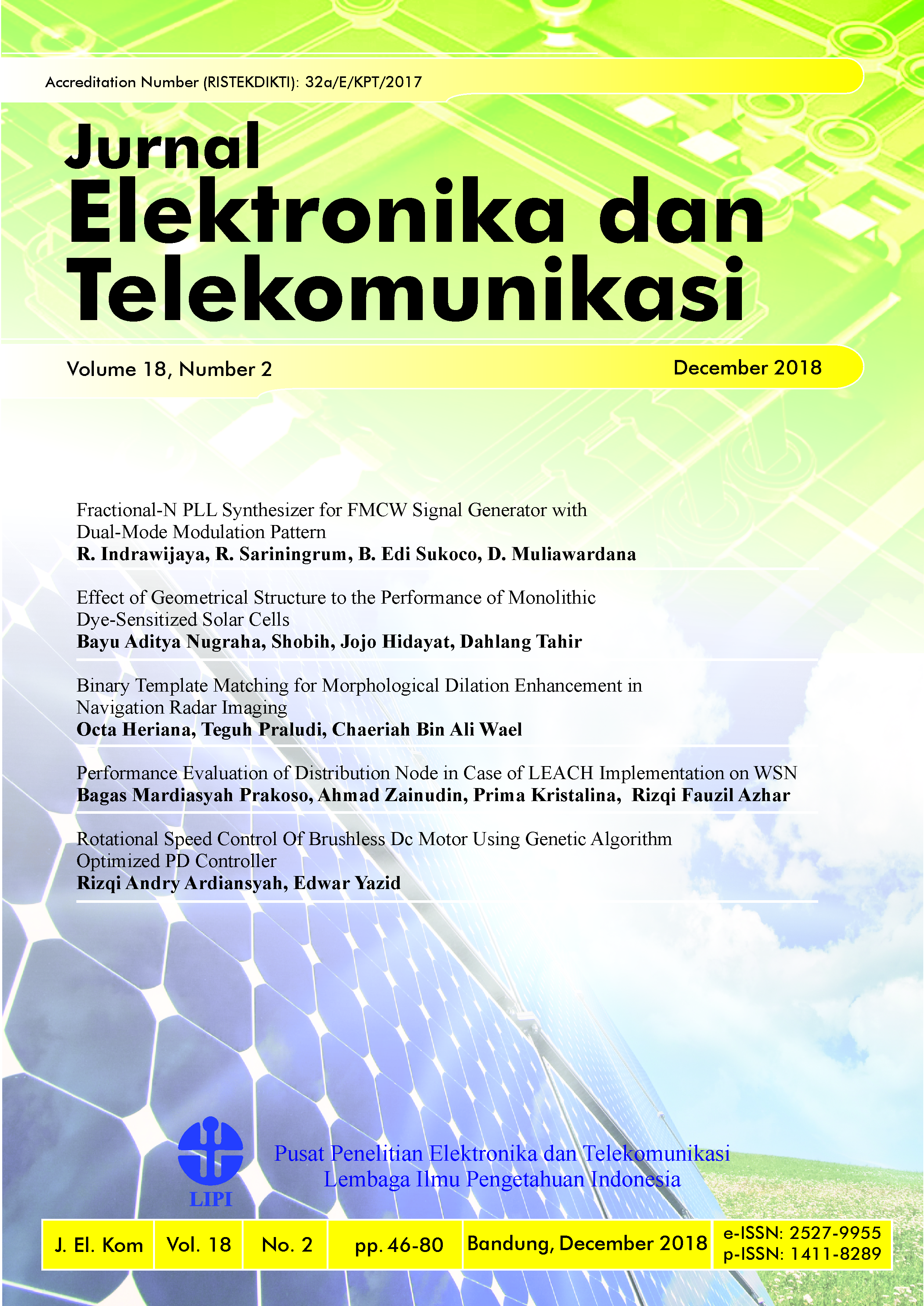
Performance Evaluation of Distribution Node in Case of LEACH Implementation on Wireless Sensor Network
DOI:
https://doi.org/10.14203/jet.v18.67-74Keywords:
WSN, LEACH, energy savingAbstract
Wireless sensor networks consisting of sensor nodes can be used as an effective tool for collecting data in various situations. Nodes are usually placed randomly in an area to perform sensing and monitor various parameters related to environmental conditions in various locations. One of the major problems in wireless sensor networks is developing energy-efficient routing protocols that have a significant impact on the overall life of sensor networks so it is important to make energy savings in these limited energy sources to extend network life. This paper proposes a hardware design and Low-Energy Adaptive Clustering Hierarchy (LEACH) routing protocol configuration for power saving by utilizing cluster head selection mechanism. The cluster head selection process is performed periodically based on LEACH algorithm enables the node to have the best lifetime responsible for communication between the nodes and the server as well as the effort to save energy consumption of limited energy sources to extend network life. So that makes the process of sending information more effective and optimal. The system has been able to display data information along with the position of nodes in the web server with an average of 42 seconds of computing time in a rotation of the system so that it can be done 85 times in 1 hour. The system is able to provide real-time information with a throughput of more than 1.052 Kbps and packet loss of no more than 6.7%. In addition, energy savings can up to 6.5% of the existing energy in a lithium battery.Downloads
References
K. Langendoen, Medium Access Control in Wireless Networks, Volume II: Practice and Standards, New York, United States: Nova Science Publishers, 2008.
P. Antoniou and A. Pitsillides, “Wireless sensor networks control: drawing inspiration from complex systems,” Med Hoc-Net. Ionian Academy, 2007.
D. Tian and N.D. Georganas, “A coverage-preserving node scheduling scheme for large wireless sensor networks,” In Proc. The 1st ACM International Workshop on Wireless Sensor Networks and Applications (WSNA ‘02), 2002, pp. 32-41. Crossref
A. Salazar, Wireless Sensor Network Simulator. Texas (US): Texas A&M University Thesis, 2010.
M. F. Mosleh, D. S. Talib, “Implementation of active wireless sensor network monitoring using ZigBee protocol,” Journal of Engineering Science and Technology, vol. 12, no. 11, pp. 3082-3091, 2017.
Y. Wang, “Design and implementation of a wireless sensor network node based on Arduino,” International Journal of Online Engineering, vol. 13, no.11, pp. 128-135, 2017. Crossref
A. Ismail, K. Seddik, “The design and implementation of a constrained WSN for permaculture farming in Egypt,” In Proc. The 2014 IEEE Emerging Technology and Factory Automation (ETFA), 2014. Crossref
R.K. Kodali and N.K. Aravapalli, “Multi-level LEACH protocol model using NS-3,” In Proc. Advance Computing Conference (IACC), 2014, pp. 375-380. Crossref
L.M.A. Cobo, Cluster-based Routing Protocol for Mobile Sensor Networks. Guelph (CA): University of Guelph Thesis, 2007.
I. Howitt and G. Jose, “IEEE.802.15.4 low rate – wireless personal area network coexistence issues,” in Proc. IEEE Wireless Communications and Networking (WCNC), 2003, pp. 1481-1486. Crossref
Downloads
Published
Issue
Section
License
Authors who publish with this journal agree to the following terms:
The copyright to this article is transferred to BRIN if and when the article is accepted for publication. The undersigned hereby transfers any and all rights in and to the paper including without limitation all copyrights to BRIN. The undersigned hereby represents and warrants that the paper is original and that he/she is the author of the paper, except for material that is clearly identified as to its original source, with permission notices from the copyright owners where required. The undersigned represents that he/she has the power and authority to make and execute this assignment. The copyright transfer form can be downloaded here.
The corresponding author signs for and accepts responsibility for releasing this material on behalf of any and all co-authors. This agreement is to be signed by at least one of the authors who have obtained the assent of the co-author(s) where applicable. After submission of this agreement signed by the corresponding author, changes of authorship or in the order of the authors listed will not be accepted.

This work is licensed under a Creative Commons Attribution-NonCommercial-ShareAlike 4.0 International License.