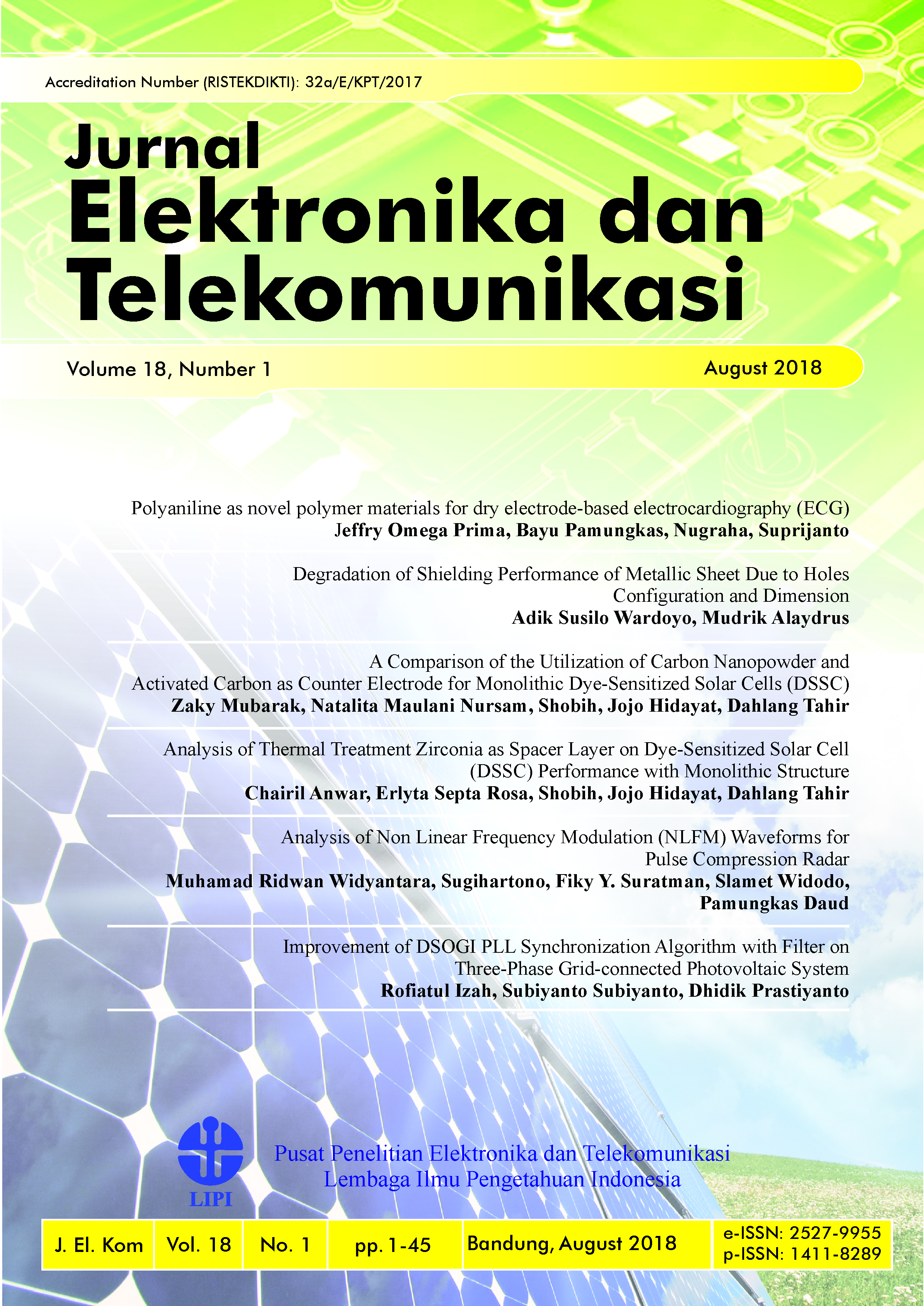
Analysis of Thermal Treatment Zirconia as Spacer Layer on Dye-Sensitized Solar Cell (DSSC) Performance with Monolithic Structure
DOI:
https://doi.org/10.14203/jet.v18.21-26Keywords:
monolithic, DSSC, spacer layer, zirconia, thermal treatment, performance, sinteringAbstract
Monolithic dye-sensitized solar cells (DSSC) offer the prospect of lower material cost and require a simpler manufacturing process compared with conventional DSSC. Fabricated on a single fluorine tin oxide (FTO) glass substrate consists of a nanoporous TiO2 photoanode layer, a ZrO2 spacer layer, a carbon counter electrode layer, a dye, and an electrolyte. The spacer layer on the monolithic DSSC serves as electrolyte storage and insulating layer to separate between photoanode and counter electrode. Zirconia is often used as a spacer because it has high temperature resistant properties, high dielectric constant and adhesive as an insulator that has band gap between 5-6 eV. The effects of the thermal treatment of zirconia layer as a spacer electrolyte on the performance of monolithic DSSC have been investigated. The cell’s performance increases with the sintering temperature as well as indicated by the decreased in particle size and increased in quantum efficiency in the absorption region of the titania layer. Co-sintering treatment tends to drastically reduce cell’s performance. The highest performance was obtained at a temperature sintering of 500o C with an PCE of 0.22%, Isc = 0.16 mA and Voc = 0.71 V.
Downloads
References
Y. Wang and C. Choi, “Application of TiO2-graphene nanocomposites to photoanode of dye-sensitized solar cell,” J.Photochemistry and Photobiology A: Chemistry, vol. 332, pp. 1-9, Jan, 2017. Crossref
J.B. Baxter, “Commercialization of dye sensitized solar cells: Present status and future research needs to improve efficiency,stability, and manufacturing,” J. Vacuum Sci. Tech. A, vol. 30, p.020801, Mar. 2012. Crossref
A. Hagfeldt, G. Boschloo, L. Sun, L. Kloo, and H. Pettersson, “Dye-sensitized solar cells,” Chemical Review, vol. 110, pp. 6595-6663, Sep. 2010. Crossref
S.J. Thompson, N.W. Duffy, U. Bach, Y.B. Cheng, “On the role of the spacer layer in monolithic dye-sensitized solar cells,” J.Physical Chemistry C, vol. 114, pp. 2365–2369, Jan. 2010. Crossref
H. Pettersson, T. Gruszecki, R. Bernhard, L. Haggman, M.Gorlov, G. Boschloo, T. Edvinsson, L. Kloo and A. Hagfeldt, “The monolithic multicell: a tool for testing material components in dye sensitized solar cells,” Progress in Photovoltaics, vol. 15, no. 2, pp. 113–121, 2007. Crossref
L. Vesce, R. Riccitelli, T. Brown, and A.D. Carlo., "Fabrication of spacer and catalytic layers in monolithic dye-sensitized solar cells," IEEE J. Photovoltaics, vol. 3, no. 3, pp. 1004-1011, Jul. 2013. Crossref
S. Ito and K. Takahashi, “Fabrication of monolithic dyesensitized solar cell using ionic liquid electrolyte,” Int. J.Photoenergy, pp. 1-6, 2012. Crossref
Y. Rong, Z. Ku, M. Xu, L. Liu, M. Hu, Y. Yang, J. Chen, A. Mei, T. Liu, and H. Han, “Monolithic quasi-solid-state dyesensitized solar cells based on iodine-free polymer gel electrolyte,” J. Power Sources, vol. 235, pp. 243-250, Aug.2013. Crossref
H. Pettersson, T Gruszecki, L.H. Johansson, and P. Johander, “Manufacturing method for monolithic dye-sensitized solar cells permitting long-term stable low-power modules,” Solar Energy Materials and Solar Cells, vol. 77, no. 4, pp. 405–413, Nov.2003. Crossref
G. Liu, H. Wang, X. Li, Y. Rong, Z. Ku, M. Xu, L. Liu, M. Hu, Y. Yang, P. Xiang, T. Shu, and H. Han, “A mesoscopic platinized graphite/carbon black counter electrode for a highly efficient monolithic dye-sensitized solar cell,” Electrochimica Acta, vol. 69, pp. 334-339, May. 2012. Crossref
N. M. Nursam, A. Istiqomah, J. Hidayat, P. N. Anggraini , and Shobih, “Analysis of catalytic material effect on the photovoltaic properties of monolithic dye-sensitized solar cells”, Jurnal Elektronika dan Telekomunikasi (JET), vol. 17, no. 2, pp. 30-35, Dec. 2017. Crossref
H. Jiang, R. I. Gomez-Aba, P. Rinke, and M. Scheffler, “Electronic band structure of zirconia and hafnia polymorphs from the gw perspective,” Physical Review B, vol. 81, pp. 085119, Feb. 2010. Crossref
W. Y. Rho, M. H. Chun, H. S. Kim, Y. B. Hahn, J. S. Suh, and B.-H. Jun, “Improved energy conversion efficiency of dyesensitized solar cells fabricated using open-ended TiO2 nanotube arrays with scattering layer,” Bulletin-Korean Chemical Soc.,vol. 35, no. 4, pp. 1165-1168, Apr. 2014. Crossref
A. S. Keiteb, E. Saion, A. Zakaria, and N. Soltani, “Structural and optical properties of zirconia nanoparticles by thermal treatment synthesis,” J. Nanomaterials, vol. 2016, no. 1, pp. 1-6,2016. Crossref
R. Srinivasan, C. R. Hubbard, O. B. Cavin, and B. H. Davis., “Factors determining the crystal phases of zirconia powders: a new outlook,” Chem. Mater., vol. 5, no. 1, pp. 27-31, Jan. 1993. Crossref
S. N. Basahel, T. T. Ali, M. Mokhtar, and K. Narasimharao, “Influence of crystal structure of nanosized ZrO2 on photocatalytic degradation of methyl orange,” Nanoscale Research Lett., vol. 10, no. 73, pp. 1-13, Jan. 2016. Crossref
F. Heshmatpour and R. B. Aghakhanpour, “Synthesis and characterization of nanocrystalline zirconia powder by simple sol–gel method with glucose and fructose as organic additives,” Powder Technology, vol. 205, pp. 193-200, Jan. 2011. Crossref
S. H. Kang, M.-S. Kang, H.-S. Kim, J.-Y. Kim, Y.-H. Chung, W. H. Smyrl, and Y.-E. Sung, “Columnar rutile TiO2 based dyesensitized solar cells by radio-frequency magnetron sputtering,” J. Power Sources, vol. 184, pp. 331–335, Sep. 2008. Crossref
E. S. Rosa, L. Muliani, J. Hidayat, Shobih, and M. Qibtiyah, “Fabrication of plastic dye-sensitized solar cells prepared by blade coating”, in Proc. Int. Conf. Sustainable Energy Eng. Applicat., 2012, pp. 69-72.
Downloads
Published
Issue
Section
License
Authors who publish with this journal agree to the following terms:
The copyright to this article is transferred to BRIN if and when the article is accepted for publication. The undersigned hereby transfers any and all rights in and to the paper including without limitation all copyrights to BRIN. The undersigned hereby represents and warrants that the paper is original and that he/she is the author of the paper, except for material that is clearly identified as to its original source, with permission notices from the copyright owners where required. The undersigned represents that he/she has the power and authority to make and execute this assignment. The copyright transfer form can be downloaded here.
The corresponding author signs for and accepts responsibility for releasing this material on behalf of any and all co-authors. This agreement is to be signed by at least one of the authors who have obtained the assent of the co-author(s) where applicable. After submission of this agreement signed by the corresponding author, changes of authorship or in the order of the authors listed will not be accepted.

This work is licensed under a Creative Commons Attribution-NonCommercial-ShareAlike 4.0 International License.