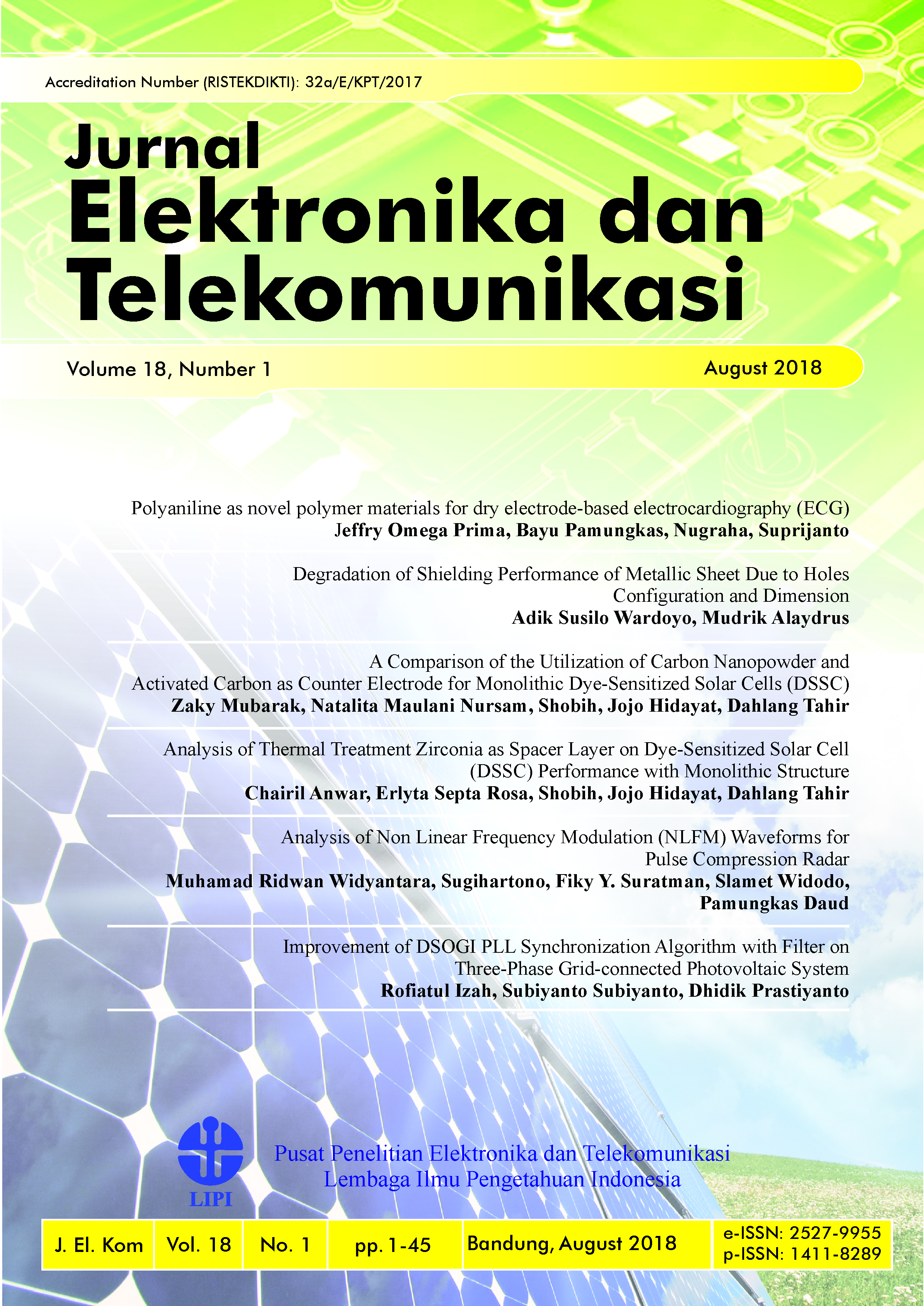
A Comparison of the Utilization of Carbon Nanopowder and Activated Carbon as Counter Electrode for Monolithic Dye-Sensitized Solar Cells (DSSC)
DOI:
https://doi.org/10.14203/jet.v18.15-20Keywords:
Carbon paste, counter electrode, dye-sensitized solar cells (DSSC)Abstract
Monolithic design is one of the most promising dye-sensitized solar cell (DSSC) architectures to develop, because it allows the elimination of one conductive substrate and offers the possibility for printing layer-by-layer of the materials that made up its structure. In this study, titanium dioxide-based monolithic type DSSCs were fabricated on a single fluorine-doped transparent oxide coated glass with TiO2 as photoanode and porous ZrO2 as spacer. The type of the carbon material used as the composite paste for the counter electrode was varied to see the effect on the solar cell efficiency. Four-point probes measurement revealed that the resistivity of the carbon layer synthesized using activated carbon exhibited slightly higher conductivity with a sheet resistance of 10.70 Ω/sq and 11.09 Ω/sq for activated carbon and carbon nanopowder, respectively. The efficiency of DSSC that uses activated carbon as counter electrode was higher (i.e. 0.221%) than the DSSC with carbon nanopowder (i.e. 0.005%). The better performance of DSSC with activated carbon as a counter electrode was due to its better conductivity and higher surface area compared to those of carbon nanopowder.
Downloads
References
S. Yuliananda, G. Sarya., and RA. R Hastijanti, “Pengaruh perubahan intensitas matahari terhadap daya keluaran panel surya," Jurnal Pengabdian LPPM Untag Surabaya, vol. 01, pp. 193-202, Nov. 2015.
S. Sidopekso, " Uji karakteristik sel surya pada sistem 24 volt DC sebagai catudaya pada sistem pembangkit tenaga hybrid," in Proc. Pertemuan Ilmiah XXVI HFI Jateng & DIY, Purworejo, 2012, pp. 208-212.
R. Prasetyowati, “Sel surya berbasis titania sebagai sumber energi listrik alternatif,” in Proc. Seminar Nasional Penelitian, Pendidikan dan Penerapan MIPA, 2012, pp. 1-6.
L. Muliani, E. S. Rosa, J. Hidayat, Shobih, and B. Yuliarto, "Pembuatan sel surya berbasis dye-sensitized menggunakan substrat fleksibel," in Proc. InSINas, 2012, p. 22-26.
M. S. W. Kumara, G. Prajitno, 2012, “Studi awal fabrikasi dye sensitized solar cell (DSSC) dengan menggunakan ekstraksi daun bayam (Amaranthus Hybridus L.) sebagai dye sensitizer dengan variasi jarak sumber cahaya pada DSSC,” Jurnal Ilmiah ITS, 2012.
N. Puspitasari, et. al., "Pengaruh jenis katalis pada elektroda pembanding terhadap efisiensi dye sensitized solar cells dengan klorofil sebagai dye sensitizer," in Jurnal Fisika dan Aplikasinya, vol. 13, no.1, pp. 30-33, Jan. 2017.
N. M. Nursam, A. Istiqomah, J. Hidayat, P. N. Anggraini, Shobih "Analysis of Catalytic Material Effect on the Photovoltaic Properties of Monolithic Dye-sensitized Solar
Cells," Jurnal Elektronika dan Telekomunikasi, vol. 17, no. 2, pp. 30-35, Dec. 2017. Crossref
A. Y. Dewi, "Pemanfaatan energi surya sebagai suplai cadangan pada laboratorium elektro dasar di Institut Teknologi Padang," Jurnal Teknik Elektro ITP, vol. 2, no. 3, pp. 20-28, Nov. 2013.
L. Vesce, et al., ”Fabrication of Spacer and Catalytic Layers in Monolithic Dye-Sensitized Solar Cells,” IEEE J. Photovoltaics, vol. 3, no. 3, pp. 1004-1011, Jul. 2013. Crossref
Y. Rong, H. Han, ”Monolithic quasi-solid-state dye-sensitized solar cells based on graphene-modified mesoscopic carbon-counter electrodes,” J. Nanophotonics, vol.7, no. 1, pp. 1-10, Jun. 2013. Crossref
S. Ito, K. Takahashi, “Fabrication of monolithic dye- sensitized solar cell using ionic liquid electrolyte,” Int. J. Photoenergy, vol. 2012, Feb. 2012. Crossref
A. Kay, M. Gratzel, “Low cost photovoltaic modules based on dye sensitized nanocrystalline titanium dioxide and carbon powder,” Solar Energy Materials and Solar Cells, vol. 44, no.1, pp. 99-117, Oct. 1996. Crossref
C. Y. Chen, et.al, “Highly efficient light-harvesting ruthenium sensitizer for thin-film dye-sensitized solar cells,” ACS Nano, vol.3 , no. 10, pp. 3103–3109, Sep. 2009. Crossref
R. S. Bawono, “Analisis perbandingan performa sel surya tersensitasi zat pewarna terbuat dari lapisan TiO 2 hasil sintesis pasca-hidrotermal dengan TiO 2 P-25 degussa,” B. Eng. Thesis, Materials and Energy Engineering Study Program, University of Indonesia, Depok, Indonesia, Dec. 2014.
Downloads
Published
Issue
Section
License
Authors who publish with this journal agree to the following terms:
The copyright to this article is transferred to BRIN if and when the article is accepted for publication. The undersigned hereby transfers any and all rights in and to the paper including without limitation all copyrights to BRIN. The undersigned hereby represents and warrants that the paper is original and that he/she is the author of the paper, except for material that is clearly identified as to its original source, with permission notices from the copyright owners where required. The undersigned represents that he/she has the power and authority to make and execute this assignment. The copyright transfer form can be downloaded here.
The corresponding author signs for and accepts responsibility for releasing this material on behalf of any and all co-authors. This agreement is to be signed by at least one of the authors who have obtained the assent of the co-author(s) where applicable. After submission of this agreement signed by the corresponding author, changes of authorship or in the order of the authors listed will not be accepted.

This work is licensed under a Creative Commons Attribution-NonCommercial-ShareAlike 4.0 International License.