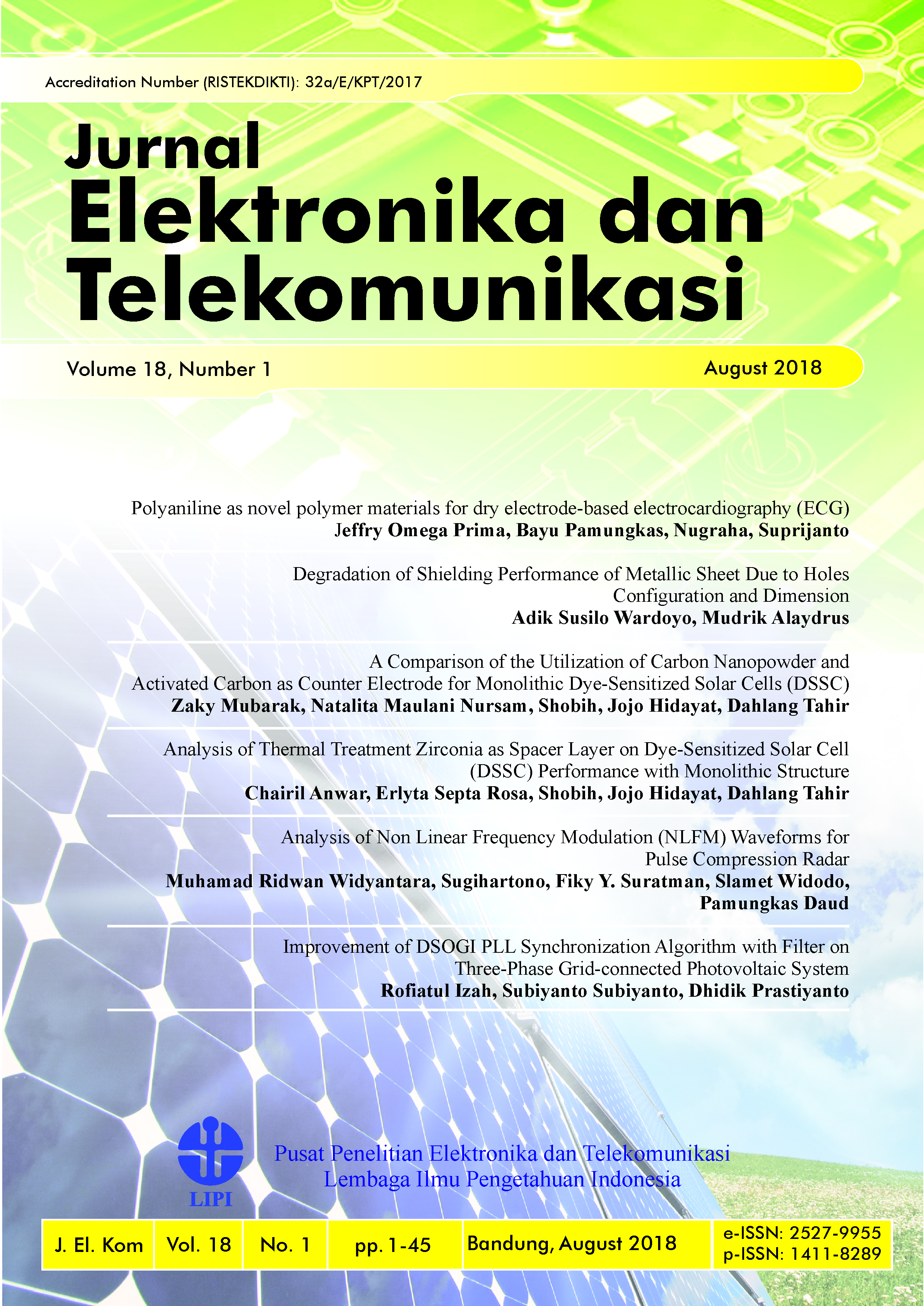
Analysis of Non Linear Frequency Modulation (NLFM) Waveforms for Pulse Compression Radar
DOI:
https://doi.org/10.14203/jet.v18.27-34Keywords:
NLFM, LFM, PSL, Pulse Compression Radar, Doppler EffectAbstract
Non Linear Frequency Modulation (NLFM) method can suppress the peak sidelobe level without additional windowing function. NLFM doesn’t require any weighting function because it has inbuilt one. NLFM has a variable frequency deviation function due to the relation between frequency and time of the signal which is not linear so that it is possible to suppress of peak sidelobe level. This paper studies the characteristic of various NLFM waveform, such as NLFM Tri Stage Piece Wise (TSPW), NLFM S, and NLFM Taylor. The study of Pulse Compression of NLFM waveform consists of three aspects. First, analysis of pulse compression performance. Second, analysis of background noise. Last, analysis of Doppler effects. The simulation is done using Matlab software. The lowest value Peak Sidelobe Level (PSL)of NLFM TSPW is about -20 dB while NLFM S and NLFM Taylor are about -32 dB and -39 dB. Additive White Gaussian Noise (AWGN) and Doppler Effect influenced the value of PSL for each NLFM waveform. NLFM Taylor has the best NLFM waveform when the Doppler Effect and AWGN cause the value of PSL become high. Comparison between NLFM Taylor and Linear Frequency Modulation(LFM) is done in radar surveillance applications to analyze the detectability performance where the condition of Radar Cross Section (RCS) for each target has different significant value. The three targets are commercial airplanes, helicopter and fighter. For detectability performance, NLFM Taylor can detect more clearly than LFM conventional.
Downloads
References
M. I. Skolnik, Radar Handbook, 3rd ed. New York: McGraw-Hill, 2008.
A. K. Sahoo, “Development of radar pulse compression techniques using computational intelligence tools,” Ph.D. dissertation, Institute of Technology Rourkela, 2012.
C. Kumar, “Development of efficient radar pulse compression technique for frequency modulated pulses,” M.S. thesis, Institute of Technology, Rourkela, 2014.
M. I. Skolnik, Introduction to Radar System, 2nd ed. McGraw-Hill, 1981.
I. Intyas, R. Hasanah, M. R. Hidayat, B. Hasanah, A. B. Suskmono, A. Munir, “Improvement of radar performance using LFM pulse compression technique,” in 2015 Int. Conf. Elect. Eng. Informatics (ICEEI), Bali, Indonesia, 2015. Crossref
B. P. A. Rohman, R. Indrawijaya, D. Kurniawan, O. Heriana, C. B. A. Wael, “Sidelobe suppression on pulse compression using curve-shaped nonlinear frequency modulation,” in 2016 1st Int. Conf. Inform. Technology, Inform. Syst. Elect. Eng. (ICITISEE), Yogyakarta, Indonesia, 2016. Crossref
S. Boukeffa, Y. Jiang, T. Jiang. “Sidelobe reduction with nonlinear frequency modulated waveforms,” in 2011 IEEE 7th Int. Colloq. Signal Process. and its Applicat. (CSPA), Penang, Malaysia, 2011. Crossref
A. W. Doerry, “Generating nonlinear FM chirp waveforms for radar,” Sandia National Laboratories, California, 2006.
S. Parwana, S. Kumar, “Analysis of LFM and NLFM radar waveforms and their performance analysis,” Int. Res. J. Eng. Tech., 2015.
B. R. Mahafza, Radar Systems Analysis and Design Using MATLAB, 3rd ed. Florida: CRC Press, 2013.
A. Orduyılmaz, G. Kara, M. Serin, A. Yıldırım, A. C. Gürbüz, M. Efe, “Real-time pulse compression radar waveform generation and digital matched filtering,” in 2015 IEEE Radar Conf. (RadarCon), USA, 2015. Crossref
H. D. Griffiths and L. Vinagre, “Design of low-sidelobe pulse compression waveforms,” Electron. Lett., vol. 30, no. 12, Jun. 1994. Crossref
E. D. Witte and H. D. Griffiths, ”Improved ultra-low range sidelobe pulse compression waveform design,” Electron. Lett., vol. 40, no. 22, Oct. 2004. Crossref
R. Jeevanmai and N. D. Rani, “Sidelobe reduction using frequency modulated pulse compression techniques in radar,” Int. J. Latest Trends Eng. Tech., vol. 7, no. 3, pp.171-179, 2013. Crossref
J. Song, Y. Gao, and D. Gao, “Analysis and detection of S-shaped NLFM signal based on instantaneous frequency,” J. Commun., vol. 10, no. 12, Dec. 2015. Crossref
L. R. Varshney and D. Thomas, “Sidelobe reduction for matched filter range processing,” in the 2003 IEEE Radar Conf., USA, 2003. Crossref
I. C. Vizitiu, F. Enache and F. Popescu, “Sidelobe reduction in pulse-compression radar using the stationary phase technique: an extended comparative study,” in 2014 Int. Conf. Optimization Electr. Electron. Equipment (OPTIM), Romania, 2014. Crossref
B. P. A. Rohman, et al., “Performance analysis of curve-shaped NLFM against doppler effect and background noise,” in 2016 Int. Conf. Radar Antenna Microw. Electron. Telecommunications (ICRAMET), Indonesia, 2016. Crossref
T. Collins and P. Atkins, “Nonlinear frequency modulation chirps for active sonar,” in IEE Proc. Radar Sonar Navigation, vol. 146, no. 6, Dec. 1999. Crossref
Downloads
Published
Issue
Section
License
Authors who publish with this journal agree to the following terms:
The copyright to this article is transferred to BRIN if and when the article is accepted for publication. The undersigned hereby transfers any and all rights in and to the paper including without limitation all copyrights to BRIN. The undersigned hereby represents and warrants that the paper is original and that he/she is the author of the paper, except for material that is clearly identified as to its original source, with permission notices from the copyright owners where required. The undersigned represents that he/she has the power and authority to make and execute this assignment. The copyright transfer form can be downloaded here.
The corresponding author signs for and accepts responsibility for releasing this material on behalf of any and all co-authors. This agreement is to be signed by at least one of the authors who have obtained the assent of the co-author(s) where applicable. After submission of this agreement signed by the corresponding author, changes of authorship or in the order of the authors listed will not be accepted.

This work is licensed under a Creative Commons Attribution-NonCommercial-ShareAlike 4.0 International License.