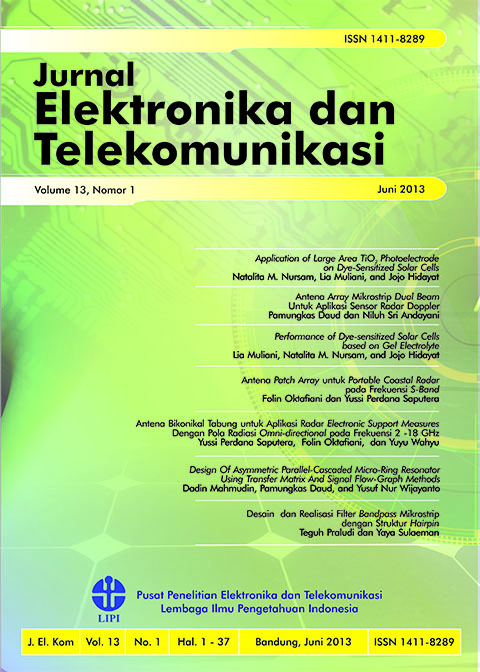
Performance of Dye-sensitized Solar Cells Based on Gel Electrolyte
DOI:
https://doi.org/10.14203/jet.v13.14-17Keywords:
dye sensitized solar cell (DSC), gel electrolyte, liquid electrolyte, I-V curve, life timeAbstract
Electrolyte is one of the crucial elements in dye sensitized solar cells (DSC) due to the reduction-oxidation reactions take place in this area and it has the function as the charge transfer medium. An electrolyte solution contains redox couple such as I-/I3 is filled up into a space between the photo-anodes and the counter electrode. Usually, the DSC employs a liquid electrolyte which using organic solution because easy preparation. But it has disadvantage, solvent evaporation occurs and this can decrease the cell performance. One of way to solve this problem is change liquid electrolyte to gel electrolyte. This paper describes fabrication of DSC based on gel electrolyte. Performance of the DSC is compared to the cell which using a liquid electrolyte. The result shows that the energy conversion efficiency of the solar cells based on gel electrolyte was lower than liquid electrolyte solar cell that is 1.51% and 2.23% respectively. Based on life time investigation obtained the performance of gel electrolyte solar cell is much stable than liquid electrolyte solar cell.Downloads
References
M. Gratzel, “Dye-sensitized solar cells”, Journal of Photochemistry and Photobiology C: Photochemistry Review, vol. 4, pp. 145-153, 2003.
M. Hiroshi, K. Okada, T. Kawashima, T. Ezure, and N. Tanabe, “Dye-sensitized solar cells using ionic liquid-based electrolytes”, Fujikura Technical Revie, 2004.
C. Longo and M. A. De Paoli, “Dye-sensitized solar cells: a successsful combination of materials”, J. Braz, Chem, Soc., vol.14, no.6, pp. 889-901, 2003.
H. Arakawa and K. Hara, “Current status of dye-sensitized solar cells”, Semiconductor Photochemistry and Photophysics, vol. 10, pp.123-171, 2003.
J. Halme, “Dye sensitized nanostructured and organic photovoltaic cells: technical review and preeliminary test”, Master thesis, Helsinki University of Technology, 2002.
R. Sastrawan, “Photovoltaic modules of dye solar cells”, Dissertation, University of Freiburg, 2006.
P. Joshi, Y. Xie, M. Ropp, D. Galipeau, S. Bailey, and Q. Qiao, “Dye-sensitized solar cell based on low cost nanoscale Carbon/TiO2 composite counter electrode”, Energy & Environmental Science, vol. 2, pp. 426-429, 2009.
A. F. Nogueira, C. Longo, and M. A. De Paoli, “Polymers in dye sensitized solar cells, overview and perspectives”, Coordination Chemistry Reviews, vol. 248, pp.1455–1468, 2004.
J. Wu, Z. Lan, S. Hao, P. Li, J. Lin, M. Huang, L. Fang, and Y. Huang, “Progress on the electrolytes for dye sensitized solar cells”, Pure Appl. Chem, vol. 80, no. 11, pp. 2241–2258, 2008.
L. Muliani, Y. Taryana, dan J. Hidayat, “Pembuatan sel surya TiO2 dye-sensitized menggunakan metoda screen printing”, Jurnal Elektronika dan Telekomunikasi, vol. 10, no. 1, hal. 126-131, 2010.
Z. Huo, S. Dai, K. Wang, F. Kong, C. Zhang, X. Pan, and X. Fang, “Nanocomposite gel electrolyte with large enhanced charge transport properties of an I3-/I- redox couple for quasi-solid-state dye-sensitized solar cells”, Solar Energy Materials & Solar Cells, vol. 91, pp. 1959–1965, 2007.
(2010) Dyesol Product
Downloads
Published
Issue
Section
License
Authors who publish with this journal agree to the following terms:
The copyright to this article is transferred to BRIN if and when the article is accepted for publication. The undersigned hereby transfers any and all rights in and to the paper including without limitation all copyrights to BRIN. The undersigned hereby represents and warrants that the paper is original and that he/she is the author of the paper, except for material that is clearly identified as to its original source, with permission notices from the copyright owners where required. The undersigned represents that he/she has the power and authority to make and execute this assignment. The copyright transfer form can be downloaded here.
The corresponding author signs for and accepts responsibility for releasing this material on behalf of any and all co-authors. This agreement is to be signed by at least one of the authors who have obtained the assent of the co-author(s) where applicable. After submission of this agreement signed by the corresponding author, changes of authorship or in the order of the authors listed will not be accepted.

This work is licensed under a Creative Commons Attribution-NonCommercial-ShareAlike 4.0 International License.