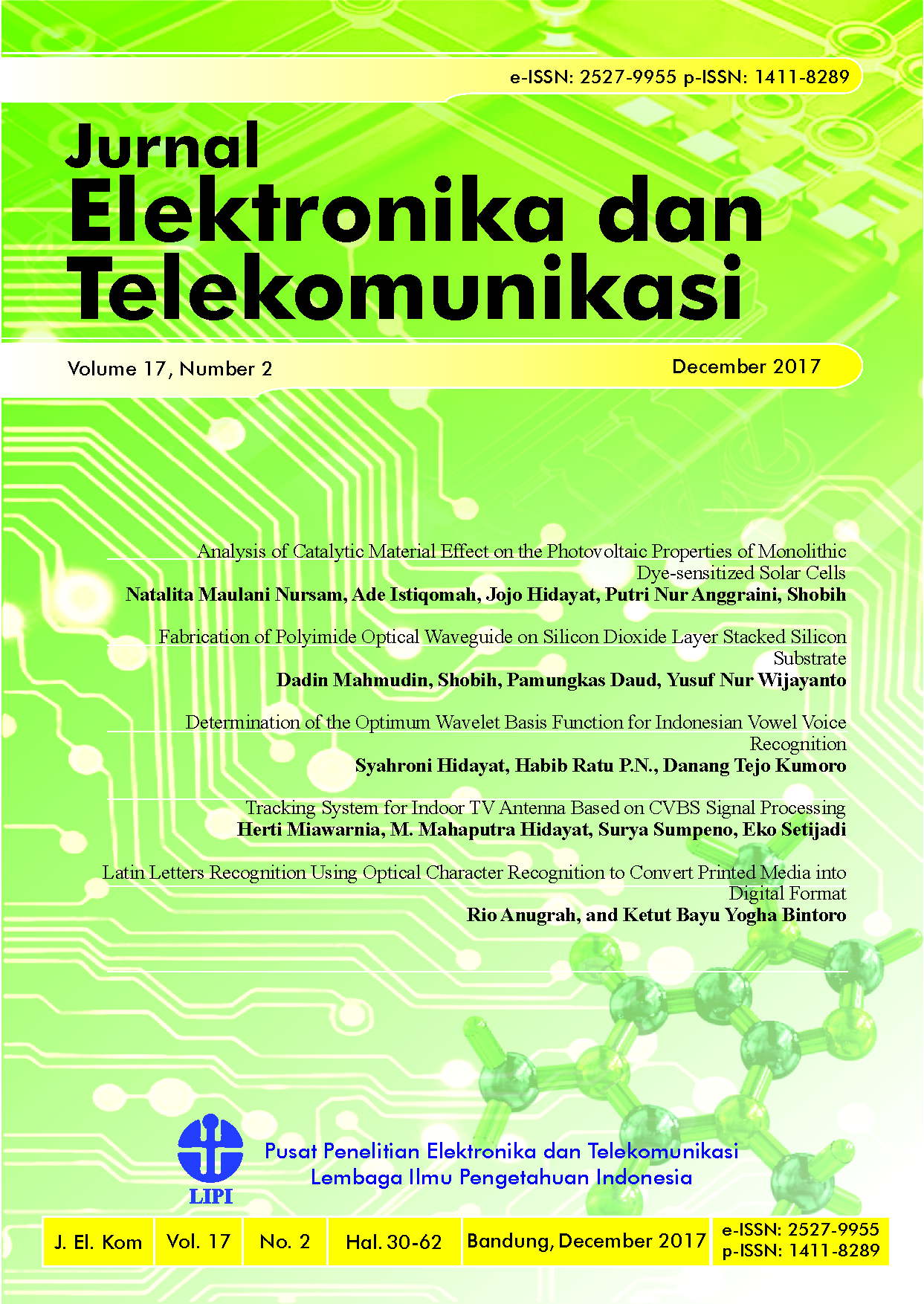
Analysis of Catalytic Material Effect on the Photovoltaic Properties of Monolithic Dye-sensitized Solar Cells
DOI:
https://doi.org/10.14203/jet.v17.30-35Keywords:
carbon, counter-electrode, dye-sensitized, photovoltaic, platinum, solar cellAbstract
Dye-sensitized solar cells (DSSC) are widely developed due to their attractive appearance and simple fabrication processes. One of the challenges that arise in the DSSC fabrication involves high material cost associated with the cost of conductive substrate. DSSC with monolithic configuration was then developed on the basis of this motivation. In this contribution, titanium dioxide-based monolithic type DSSCs were fabricated on a single fluorine-doped transparent oxide coated glass using porous ZrO2 as spacer. Herein, the catalytic material for the counter-electrode was varied using carbon composite and platinum in order to analyze their effect on the solar cell efficiency. Four-point probe measurement revealed that the carbon composite exhibited slightly higher conductivity with a sheet resistance of 9.8 Ω/sq and 10.9 Ω/sq for carbon and platinum, respectively. Likewise, the photoconversion efficiency of the monolithic cells with carbon counter-electrode almost doubled the efficiency of the cells with platinum counter-electrode. Our results demonstrate that carbon could outperform the performance of platinum as catalytic material in monolithic DSSC.
Downloads
References
A. Hagfeldt, G. Boschloo, L. Sun, L. Kloo, and H. Pettersson, "Dye-sensitized solar cell," Chem. Rev., vol. 110, pp. 6595-6663, 2010. Crossref
B. O'Regan and M. Gratzel, "A low-cost, high-efficiency solar cell based on dye-sensitized colloidal TiO2 films," Nature, vol. 353, pp. 737-740, 1991. Crossref
S. Mathew, A. Yella, P. Gao, R. Humphrey-Baker, B. F. E. Curchod, and N. Ashari-Astani, "Dye-sensitized solar cells with 13% efficiency achieved through the molecular engineering of porphyrin sensitizers," Nat. Chem., vol. 6, pp. 242-247, 2014. Crossref
J. M. Kroon et al., "Nanocrystalline dye-sensitized solar cells having maximum performance," Prog. Photovoltaics Res. Appl., vol. 15, no. 1, pp. 1-18, 2007. Crossref
N. M. Nursam, L. M. Pranoto, and J. Hidayat, "Application of Pt counter-electrode on TCO-free substrates for dye-sensitized solar cells," Jurnal Elektronika dan Telekomunikasi, vol. 12, pp. 70-76, 2012.
T.-L. Zhang, H.-Y. Chen, C.-Y. Su, and D.-B. Kuang, "A novel TCO- and Pt-free counter electrode for high efficiency dye-sensitized solar cells," J. Mater. Chem. A, vol. 1, no. 5, pp. 1724-1730, 2013. Crossref
D. Li, J. Huang, and R. B. Kaner, "Polyaniline nanofibers: A unique polymer nanostructure for versatile applications," Acc. Chem. Res., vol. 42, no. 1, pp. 135-145, 2009. Crossref
J. Xia, L. Chen, and S. Yanagida, "Application of polypyrrole as a counter electrode for a dye-sensitized solar cell," J. Mater. Chem., vol. 21, no. 12, pp. 4644-4649, 2011. Crossref
S. Kirchmeyer and K. Reuter, "Scientific importance, properties and growing applications of poly(3,4-ethylenedioxythiophene)," J. Mater. Chem., vol. 15, no. 21, pp. 2077-2088, 2005. Crossref
L. Vesce et al., "Fabrication of spacer and catalytic layers in monolithic dye-sensitized solar cells," IEEE J. Photovoltaics, vol. 3, no. 3, pp. 1004-1011, 2013. Crossref
L. Muliani and N. M. Nursam, "Dye-sensitized solar cells based on carbon nanoparticle counter-electrode," Jurnal Teknologi Indonesia, vol. 35, pp. 1-6, 2012.
H. Pettersson and T. Gruszecki, "Long-term stability of lowpower dye-sensitised solar cells prepared by industrial methods," Sol. Energy Mater. Sol. Cells, vol. 70, no. 2, pp. 203-212, 2001. Crossref
N. M. Nursam, J. Hidayat, L. Muliani, P. N. Anggraeni, L. Retnaningsih, and N. Idayanti, "From cell to module: Fabrication and long-term stability of dye-sensitized solar cells," IOP Conference Series: Materials Science and Engineering, vol. 214, no. 1, p. 012007, 2017. Crossref
N. G. Park, J. van de Lagemaat, and A. J. Frank, "Comparison of dye-sensitized rutile- and anatase-based TiO2 solar cells," J. Phys. Chem. B, vol. 104, no. 38, pp. 8989-8994, 2000. Crossref
J. Yu, J. Fan, and K. Lv, "Anatase TiO2 nanosheets with exposed (001) facets: improved photoelectric conversion efficiency in dye-sensitized solar cells," Nanoscale, vol. 2, no. 10, pp. 2144-2149, 2010. Crossref
B. Ohtani, Y. Ogawa, and S.-i. Nishimoto, "Photocatalytic activity of amorphous−anatase mixture of titanium(IV) oxide particles suspended in aqueous solutions," J. Phys. Chem. B, vol. 101, no. 19, pp. 3746-3752, 1997. Crossref
A. L. Patterson, "The Scherrer formula for X-ray particle size determination," Phys. Rev., vol. 56, no. 10, pp. 978-982, 1939. Crossref
R. Srinivasan, C. R. Hubbard, O. B. Cavin, and B. H. Davis, "Factors determining the crystal phases of zirconia powders: a new outlook," Chem. Mater., vol. 5, no. 1, pp. 27-31, 1993. Crossref
N. M. Nursam, "Porous titania-based composite materials and their high-throughput photocatalytic evaluation for environmental remediation," PhD PhD thesis, School of Chemistry, University of Melbourne, Australia, 2016.
L. Han et al., "Improvement of efficiency of dye-sensitized solar cells by reduction of internal resistance," Appl. Phys. Lett., vol. 86, no. 21, p. 213501, 2005. Crossref
Downloads
Published
Issue
Section
License
Authors who publish with this journal agree to the following terms:
The copyright to this article is transferred to BRIN if and when the article is accepted for publication. The undersigned hereby transfers any and all rights in and to the paper including without limitation all copyrights to BRIN. The undersigned hereby represents and warrants that the paper is original and that he/she is the author of the paper, except for material that is clearly identified as to its original source, with permission notices from the copyright owners where required. The undersigned represents that he/she has the power and authority to make and execute this assignment. The copyright transfer form can be downloaded here.
The corresponding author signs for and accepts responsibility for releasing this material on behalf of any and all co-authors. This agreement is to be signed by at least one of the authors who have obtained the assent of the co-author(s) where applicable. After submission of this agreement signed by the corresponding author, changes of authorship or in the order of the authors listed will not be accepted.

This work is licensed under a Creative Commons Attribution-NonCommercial-ShareAlike 4.0 International License.