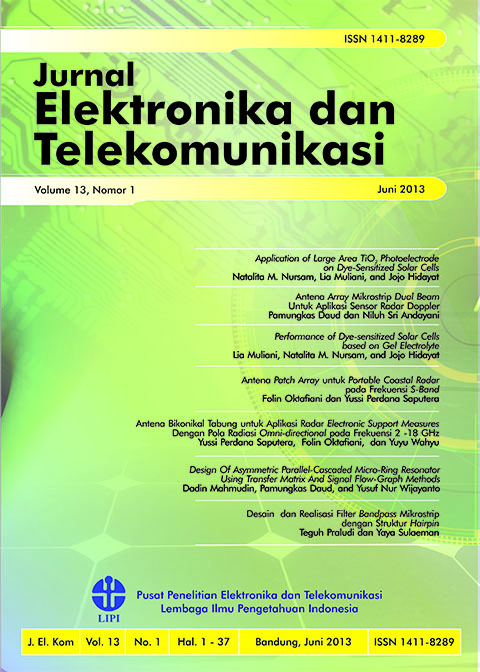
Application of Large Area TiO2 Photoelectrode on Dye-Sensitized Solar Cells
DOI:
https://doi.org/10.14203/jet.v13.1-5Keywords:
DSSC, TiO2, photo-electrode, efficiencyAbstract
The scale-up of dye-sensitized solar cell (DSSC) has been a big issue as the DSSC technology process progresses from laboratory scale to large area applications. Meanwhile, this type of solar cell has been of great interest among PV scientist and academics as it can be produced in lower-cost processes compared to the conventional solar cells which are mostly fabricated from silicon. The fabrication of DSSC prototypes with a relatively large active area of 9x9 cm2 are demonstrated in this paper. Large area of TiO2 surface has been shown to significantly increase the ISC, as well as VOC and Pmax. Nevertheless, deterioration of fill factor (FF) was observed as the result of the increase on series resistance with respect to the increase in the photoelectrode area.Downloads
References
B. O. Regan and M. Graetzel, “A low-cost, high-efficiency solar cell based on dye sensitized colloidal TiO2 films”, Nature, vol. 353, pp. 737-740, 1991.
S. Yoon, S. Tak, J. Kim, Y. Jun, K. Kang, and J. Park, “Application of transparent dye-sensitized solar cells to building integrated photovoltaics system”, Building and Environment, vol. 46, pp. 1899-1904, 2011.
(2013). solar@csiro: solar technologi blog. [Online]. Available: http://csirosolarblog.com/2011/11/24/solar-exposures-4/
M. Graetzel, “Photovoltaic performance and long-term stability of dye-sensitized meosocopic solar cells”, C. R. Chimie, vol. 9, pp. 578-583, 2006.
Y. Chiba, A. Islam, Y. Watanabe, R. Komiya, N. Koide, and L. Han, “Dye-sensitized solar cells with conversion efficiency of 11.1%”, Jap. J. of Appl. Phys., vol. 45, pp. L638-L640, 2006.
A. Kay and M. Graetzel, “Low cost photovoltaic modules based on dye sensitized nanocrystalline titanium dioxide and carbon powder”, Sol. En. Mat. and Sol. Cells, vol. 44, pp. 99-117, 1996.
Sastrawan, J. Beiber, U. Belledin, S. Hemming, A. Hinsch, R. Kern, C. Vetter, F.M. Petrat, A. Prodi-Schwab, P. Lechner, and W. Hoffmannf, “A glass frit-sealed dye solar cell module with integrated series connections”, Sol. En. Mat. and Sol. Cells, vol. 90, pp. 1680-1691, 2006.
L. Wang, X. Fang, and Z. Zhang, “Design methods for large scale dye-sensitized solar modules and the progress of stability research”, Renew. and Sust. En. Reviews, vol. 14, pp. 3178-3184, 2010.
“Product Catalog Februari 2011”, Dyesol, Australia.
L. Muliani, Y. Taryana, dan J. Hidayat, “Pembuatan sel surya TiO2 dye-sensitized menggunakan metoda screen-printing”, Jurnal Elektronika dan Telekomunikasi, vol. 10, hal. 126-131, 2010.
C. Honsberg, and S. Bowden, (2010). Pvcdrom. [Online]. Available: http://pveducation.org/pvcdrom/characterisation/double-diode-model
F. Dinçer and M. E. Meral, “Critical factors that affecting efficiency of solar cells”, Smart Grid and Renewable Energy, vol. 1, pp. 47-50, 2010.
J. Hidayat, L. Muliani, dan N. M. Nursam, “Studi perakitan dan pengujian karakteristik I-V sel surya dye-sensitized (DSSC) dalam rangkaian seri yang terhubung secara eksternal”, Jurnal Elektronika dan Telekomunikasi, vol. 11, hal. 155-160, 2011.
M. G. Kang, N. G. Park, Y. J. Park, K. S. Ryu, and S. H. Chang, “Manufacturing method for transparent electric windows using dye-sensitized TiO2 solar cells”, Sol. En. Mat. and Sol. Cells, vol 75, pp. 475-479, 2003.
L. Han, N. Koide, Y. Chiba, A. Islam, R. Komiya, N. Fuke, A. Fukui, and R. Yamanaka, “Improvement of efficiency of dye-sensitized solar cells by reduction of internal resistance”, Appl. Phys. Lett., vol. 86, pp. 1-3, 2005.
Downloads
Published
Issue
Section
License
Authors who publish with this journal agree to the following terms:
The copyright to this article is transferred to BRIN if and when the article is accepted for publication. The undersigned hereby transfers any and all rights in and to the paper including without limitation all copyrights to BRIN. The undersigned hereby represents and warrants that the paper is original and that he/she is the author of the paper, except for material that is clearly identified as to its original source, with permission notices from the copyright owners where required. The undersigned represents that he/she has the power and authority to make and execute this assignment. The copyright transfer form can be downloaded here.
The corresponding author signs for and accepts responsibility for releasing this material on behalf of any and all co-authors. This agreement is to be signed by at least one of the authors who have obtained the assent of the co-author(s) where applicable. After submission of this agreement signed by the corresponding author, changes of authorship or in the order of the authors listed will not be accepted.

This work is licensed under a Creative Commons Attribution-NonCommercial-ShareAlike 4.0 International License.