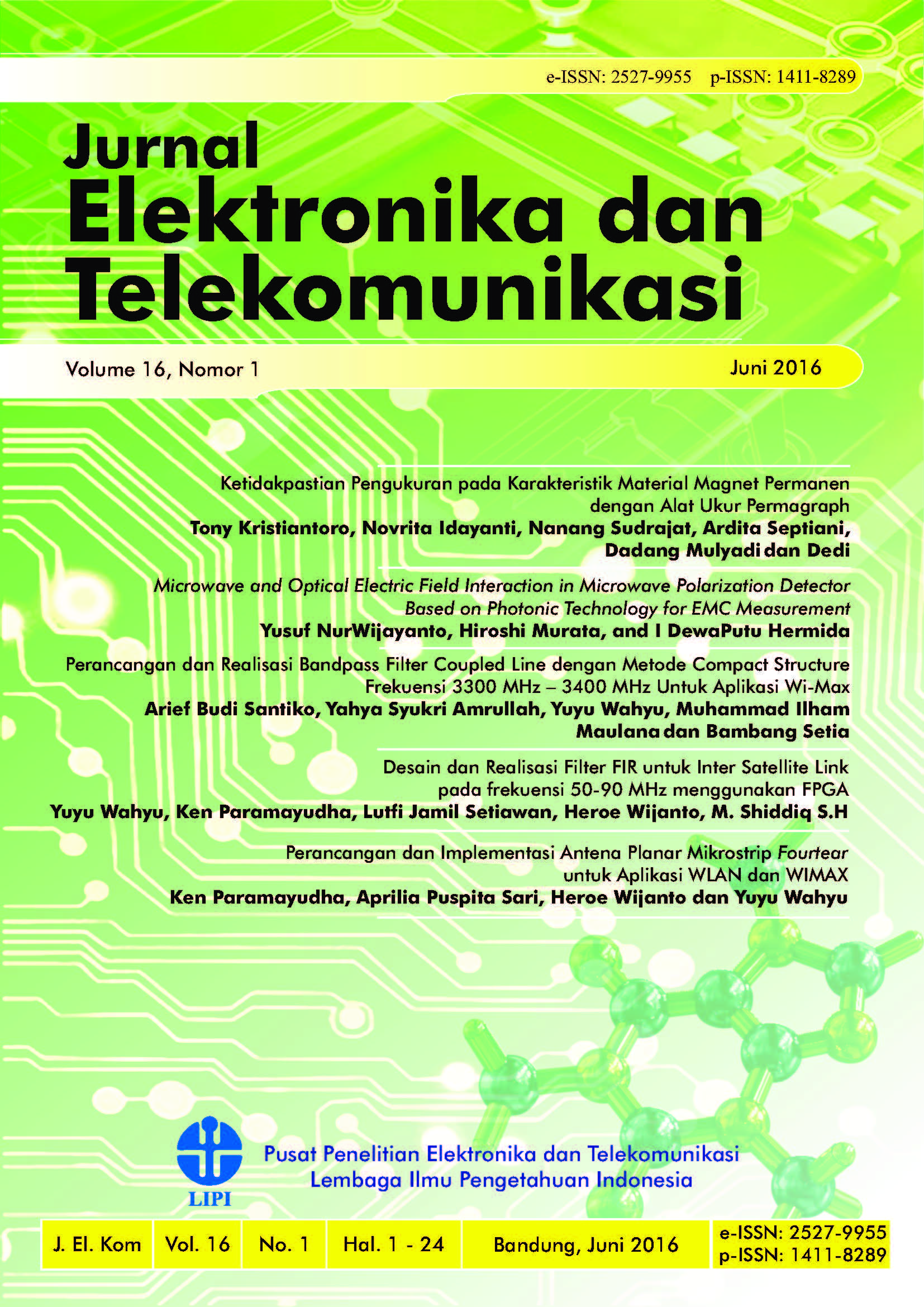
Design and Realization of Coupled Line Bandpass Filter Using Compact Structure at Frequencies of 3300 MHz – 3400 MHz for WiMAX Application
DOI:
https://doi.org/10.14203/jet.v16.11-14Keywords:
WiMAX, Coupled Line, Compact BPF, ADSAbstract
In this paper, the design of microstrip BPF (Bandpass Filter) for WiMAX (Worldwide Interoperability for Microwave Access) application has been presented. The frequency band allocations for BWA (Broadband Wireless Access) in Indonesia are 2.3; 3.3 and 5.8 GHz. This microtrip BPF is designed using parallel coupled line in compact form and it has spesific parameter, i.e. 3.35 GHz center frequency, 400 MHz bandwidth, VSWR ≤ 2, -3 dB insertion loss and matching impedance between two port is 50 Ω. The Advanced Design System (ADS) software has been used during simulation and optimization. The simulation results show that return loss S11 and insertion loss S21 are -15.31 dB and -2.2 dB at 3.35 GHz respectively. For the design verification, the prototype of the proposed design wasfabricated and measured.The results of the fabrication approach of simulation results, which have return loss value S11and insertion loss S21 of the proposed microstrip filter are -18.20 dB and -2.91 dB at 3.35 GHz respectively. The result shows that the proposed design can be implemented forWiMAX communication system applications
Downloads
References
G. Mattaei, L. Young, and E.M.T. Jones, Microwave filters, impedance matching networks, and coupling structures, Norwood, MA: Artech House, 1980, pp 521-582.
Mansour, Rafaat R, “High-Q tunable dielectric resonator,” IEEE Microwave Magazine, vol. 10, 2009.
J. Marimuthu, M. Esa and S-Kamilah Yusof, “Single-stage parallel coupled microstrip line bandpass filter using weak coupling technique,” in Proc. of IEEE International Conference on RF and Microwave, pp. 242-246, 2008.
A. K. Tiwary and N. Gupta, “Design of compact coupled microstrip line band pass filter with improved stopband characteristics,” Progress In Electromagnetic Research C, Vol. 24, pp 97–109, 2011.
Gautam J.,Taneja S., Sharma J., “Design and performance analysis of 2.5 GHz microstrip bandpass filter for LTE,” in Proc. of International Conference on Computational Intelligence & Communication Technology, pp. 549–553, 2016.
R. A. Rahim, S. I. S. Hassan, M. N. Junita, and N. A. M. Damrah, “Microstrip dual-band bandpass filter for ISM band applications,” in Proc. of IEEE International Conference on Control System, Computing and Engineering (ICCSCE), pp 281-286, 2015.
Ayush Garg, Bhanu Pratap and Deepti Gupta, “Design of parallel coupled line bandpass filter,” in Proc. of International Conference on Computational Intelligence & Communication Technology, pp. 452-454, 2016.
Ipsa Pradhan and Budhadeb Maity, “Design of a parallel coupled microstrip band pass filter in C-band for test loop translator,” in Proc. of International Conference on Electrical, Electronics, Signals, Communication and Optimization (EESCO), pp. 1-4, 2015.
J.S. Hong, Microstrip filters for RF/microwave applications, Hokoben New Jersey : John Wiley & Sons, 2011, pp 75-109.
K. Vidhya and T. Jayanthy, “Design of microstrip hairpin bandpass filter using defected ground structure and open stubs,” in Proc. International Conference on Information and Electronics Engineering (IPCSIT), vol. 6, pp. 268 – 272, 2011.
Downloads
Published
Issue
Section
License
Authors who publish with this journal agree to the following terms:
The copyright to this article is transferred to BRIN if and when the article is accepted for publication. The undersigned hereby transfers any and all rights in and to the paper including without limitation all copyrights to BRIN. The undersigned hereby represents and warrants that the paper is original and that he/she is the author of the paper, except for material that is clearly identified as to its original source, with permission notices from the copyright owners where required. The undersigned represents that he/she has the power and authority to make and execute this assignment. The copyright transfer form can be downloaded here.
The corresponding author signs for and accepts responsibility for releasing this material on behalf of any and all co-authors. This agreement is to be signed by at least one of the authors who have obtained the assent of the co-author(s) where applicable. After submission of this agreement signed by the corresponding author, changes of authorship or in the order of the authors listed will not be accepted.

This work is licensed under a Creative Commons Attribution-NonCommercial-ShareAlike 4.0 International License.